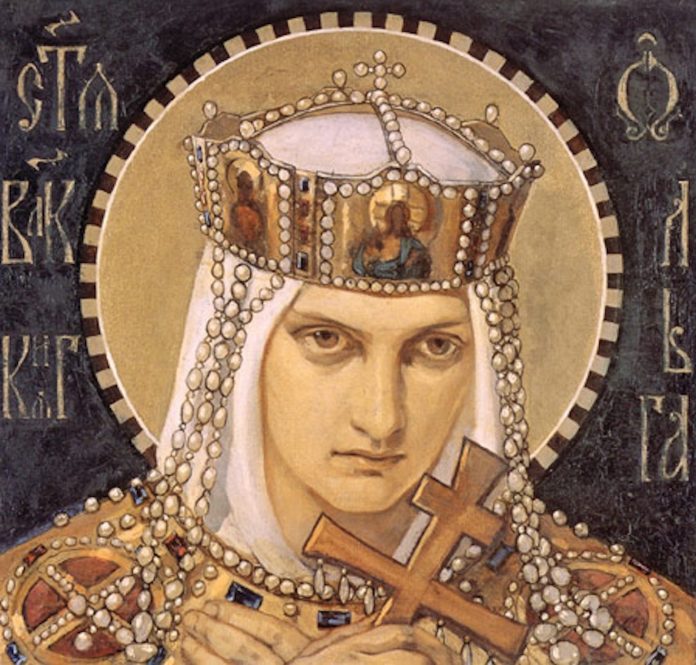
This month, in an occasional series on historically neglected women of note, Philosophilia commemorates Olga of Kyiv, whose feast day was July 11.
Olga was a 10th-century queen consort, mother and grandmother of kings, and for 12 years herself regent of Kievan Rus, the first Eastern European state and a cultural ancestor of Ukraine, Belarus and Russia. Olga was instrumental in bringing Orthodox Christianity to Slavic (animist) Eastern Europe; she forged diplomatic connections with Constantinople, converting to and advocating for the faith – an introduction which would result, in her grandson’s time, in the Christianisation of Kievan Rus, beginning the joining of Eastern and Western Europe under the umbrella of Christendom.
For this Olga is celebrated as a saint “equal to the Apostles” in the Orthodox tradition – but today her contribution is too often reduced to an approved submission: she was the first leader of the Slavic tribes to “see the Light”. This ignores her significance as a powerful ruler and a legendary strategist: there are multiple accounts of her use of reason, diplomacy, deception, unflinching iron will and demure seduction to outwit both allies and enemies. As the widow of Igor, himself only the second-generation ruler of the federation of Slavic tribes, Olga avenged her husband’s murder with chilling ferocity, then toured the newly formed empire with her young son Sviatoslav and their entourage, establishing laws, hunting grounds, trading posts, administrative centres, towns and boundary posts; consolidating the kingdom culturally, economically, ethnically and geographically. When Sviatoslav was 19, he ascended the throne and headed straight out on a series of military campaigns while Olga continued to rule in Kyiv.
Sviatoslav was a warrior; he lived and died by the sword and didn’t see his 30th birthday. He did significantly enlarge the kingdom, though not for long. He remained staunchly pagan, and sidelined Olga after she tried to have Christian bishops installed. After Sviatoslav’s death, his two legitimate sons raised armies and fought a war of succession; his other son Vladimir, by a concubine who had been a servant of Olga’s, left the country, raised an army of Vikings, and returned to fight the winner, emerging victorious. Since he was the one that duly made Christianity the state religion of Kievan Rus, I can’t help suspecting he was Olga’s favourite.
It goes without saying that Vladimir Putin’s unchristian belligerence against a sister state insults Olga’s memory and defiles her legacy. Though Olga didn’t flinch from extreme violence when it was necessary to repel a threat to both her person and the stability of the federation, and although she allowed her son to do the dirty work of colonial expansion, she demonstrated a clear preference for diplomacy, negotiation and alliance – as it turned out even in her time, a far more successful strategy than aggression.