From hate speech laws to anti-protest measures later ruled unconstitutional, the NSW government’s rushed legislative response following the Bondi tragedy has prompted severe concerns over its impact on protest rights and free speech.
In April, the New South Wales Court of Appeal (NSWCA) ruled that the anti-protest laws introduced by NSW Premier Chris Minns after the brutal attack on the Jewish community in Bondi were unconstitutional.
The legislation, referred to as the PARD laws, was inserted into the Summary Offences Act 1988 and the Terrorism (Police Powers) Act 2002. The laws enabled the commissioner of police and deputy commissioner to issue a public assembly restriction declaration (PARD) over a public area if they believed an upcoming protest would cause a reasonable person to fear harassment, intimidation or violence.
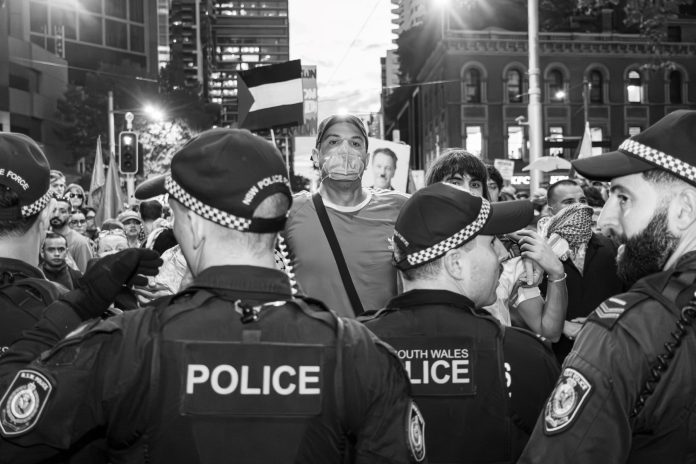
A PARD was subsequently imposed ahead of a protest against the Australian visit of Israel’s President, Isaac Herzog. Despite the declaration, an estimated 30,000 civilians attended the protest at Sydney’s Town Hall in February, where they clashed with police enforcing the PARD laws.
In a joint judgment, the NSWCA ruled that the PARD laws “impermissibly burdened” the implied right to freedom of political communication protected by the Australian Constitution.
Kobi Shetty, the Greens MP for Balmain and holder of the Greens portfolio of Democracy, believes the PARD laws prove that the Minns Government does not respect the pro-Palestine movement.
“Minns was really keen to link the attack [in Bondi] to the peaceful protest movement,” Shetty said.
“Since the earliest days of the conflict [in Gaza], Minns has hitched his wagon to the Israel lobby.”
A fundamental issue with the PARD laws is the broad individual discretion required to declare that a protest – which has not yet occurred – might incite fear. The laws were introduced after Bondi and was accompanied by right-wing rhetoric linking the attack to protests against what a United Nations Commission and other organisations have declared as genocide in Gaza. The timing supports the notion that pro-Palestinian protests would bear the brunt of police discretion.
The PARD laws, alongside Prime Minister Anthony Albanese’s broader federal hate speech laws, have been critiqued as a quick fix mechanism to combat antisemitism. Rushed legislation can lead to the bypassing of vital law-making processes, such as evidence-based research and democratic participation.
“There has been no evidence that what happened in Bondi has anything to do with peaceful protesters,” Shetty said.
Shetty suggested that Minns’ rushed creation of these laws was a concession to Israel lobbyists and an attempt to preserve the government’s reputation amid public dissent, effectively disregarding fundamental human rights such as protest and free speech.
“I think he just doesn’t like dissent. His approach to having dissenting voices when people are unhappy with the decisions of the government is to crack down and try to stop protesting. There is this signal to push towards this law-and-order agenda, to tell people, ‘Oh, we are making you safer by locking more people up.’ ”
Concerns about the future of protest
Charges involving offences against police officers
While the laws have been overturned and PARD charges against protesters have been dropped, Shetty fears that a pattern of censorship will continue.
Following police actions arising from the now-unlawful PARD laws, 29 protesters were charged with assaulting a police officer and using offensive language – charges that fell outside the scope of the PARD framework itself.
Shetty urged that “common sense be applied” as these remaining charges are subjected to prosecutorial discretion.
“We’ve seen many times that offensive language charges are used against people who are subject to police violence themselves.”
In Australia, a “reasonable excuse” defence is available when offensive language is used in direct response to police brutality. However, these specific charges have yet to be examined by a court.
Shetty also fears that the violence witnessed at the Herzog rally has caused lasting damage and instilled a reluctance among the public to protest in the future.
Shetty’s speculation comes after protesters were injured and pepper-sprayed by police, and met with alleged unreasonable and unnecessary force, which may constitute an offence under the Law Enforcement (Powers and Responsibilities) Act (LEPRA). One example is a 69-year-old woman who had four vertebrae broken after a police officer allegedly pushed her onto the pavement violently.
56-year-old Derek Jones also alleged police brutality; video footage appears to show Jones not engaging physically with police before being repeatedly punched by multiple police officers. He now plans to launch legal action against the police in the Supreme Court of NSW.
“[As] elderly relatives or vulnerable people were exposed to violence or injured, it has really scared people. I think that was the point of the violence,” said Shetty.
Police brutality serves as a reminder of the power police can exert with minimal consequence and the impact policing tactics can have on rights such as free speech and protest. Shetty says the Minns Government has “doubled down”, taken no accountability and excused the media clips as lacking context.
While individuals can lodge complaints regarding police violence with the Law Enforcement Conduct Commission, systemic underfunding means only 2% of cases are fully investigated, according to 2019 data.
Hate speech law
Censorship of protesting in Australia is a continued pattern, as Albanese’s new hate speech law, the Combating Antisemitism, Hate and Extremism Act 2026, raises questions regarding what constitutes hate speech.
Inconsistent definitions of hate speech are evident in Queensland, where the phrase ‘Palestine will be free from the river to the sea’ has been deemed as hate speech, with users facing up to two years’ imprisonment.
The Queensland board said the phrase calls for the annihilation of the state of Israel and its Jewish population and has been used by terrorists.
Conversely, as the phrase references the geographic land between the Jordan River and the Mediterranean Sea, advocates argue that the phrase calls for Palestinian freedom from occupation, unity and their right to access their homeland.
Some political analysts and experts argue that banning this phrase falsely equates antisemitism to criticism of Israel’s military actions against Palestinians and that this law operates as a justification for the government’s unwillingness to undertake adequate research, actively condemn genocide, divest from and sanction Israel.
Some commentators have used Ireland as an example, as it has drafted a bill to ban the imports of goods produced in occupied Palestinian territories by Israeli settlements.
Ultimately, Shetty believes that restrictions on protesting are deeply concerning and could prevent necessary change.
“Protests have been critical for us to win so many things we value, such as the shorter working week and women being able to vote. None of those would have been won without protest. We can’t afford heavy-handed government intervention on protests.”