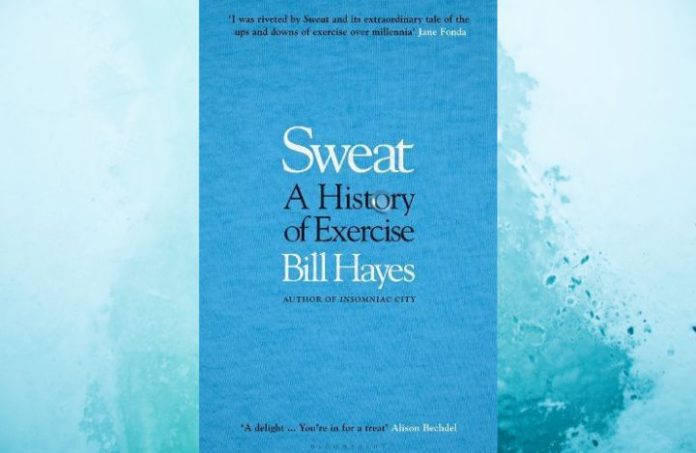
Sweat: A History of Exercise
Bill Hayes
Bloomsbury, $29.99
“One of my big fears about getting old”, Bill Hayes writes in the opening chapter of Sweat: A History of Exercise, “is that I won’t be able to get any exercise at all … Please, shoot me first. No, wait. Throw me into a lake. I want to go out swimming …”
Sixty-two-year-old Hayes is clearly fascinated not only by exercise, but by the human body; his previous books include works on blood, insomnia and anatomy. As a child – the only boy in a house full of sisters – he accompanied his father on Sunday visits to his health club in Spokane, Washington.
One of this book’s charms is its structure, with some sections describing Hayes’s own forays into various forms of exercise. He boxes, hits the gym, does yoga, swims in various bodies of water, runs (including an experiment to see what it’s like to run nude, as the early Olympians did – this, to me verged on Too Much Information). The personal stories alternate with his research – not only what it reveals, but the lengths to which he sometimes goes to track down and access sources. The machinations involved in achieving an audience with a rare volume in the Bibliotheque Nationale in Paris make a dive into 10-degree water seem appealing.
What interests Hayes is when, and why, some peoples and cultures indulged in exercise for its own sake – physical activity done voluntarily as opposed to physical toil for survival. He is also fascinated by how the ancients viewed exercise, what they got right about it, and where they were totally wrong.
Interspersed with these themes are lots of random but interesting facts. Who knew that Leo Tolstoy, in his sixties, disappeared for 35-kilometre bike rides? That Marie Curie took time out of the lab each summer for weeks-long hiking holidays? That Einstein cycled and sailed? That a 17th-century illustrated book provides detailed instructions on swim technique (admittedly, not the strokes most of us do today).
While commentators since Plato’s time have extolled the virtues of exercise, it is only in the last 70 years that its value to health has been demonstrated scientifically. A pioneer in this field was British epidemiologist Jeremy Morris. In the 1950s, Morris studied over 30,000 British bus conductors and drivers, discovering that the drivers, whose jobs were sedentary, suffered twice the rate of fatal heart attacks of the conductors, who walked constantly. A comparison of mail carriers and civil servants in office jobs yielded similar results.
While the Greeks’ lionisation of athletes and athletic prowess is world famous, Hayes is curious as to why, for hundreds of years, there was nothing like the Olympic Games, and Western art of the Middle Ages and Renaissance rarely depicted athletic pursuits. The experts he consults explain that the rise of Christianity, with its focus on the soul rather than the body, drove this change.
Sweat is quirky, entertaining and informative. Whether or not you love exercise, Hayes’s lively prose is likely to give you new insights into its role in our history and culture.