The Rise and Fall of Little Voice
Eternity Playhouse, Darlinghurst
Writer: Jim Cartwright
Director: Shaun Rennie
February 5-24, 2019
Does Jim Cartwright’s repertory staple The Rise and Fall of Little Voice suggest to our celebrity obsessed age that it is the meek who will inherit the world? Perhaps not, if meek means both quiet and submissive, for Little Voice (Geraldine Hakewill) of the title, while a reclusive, damaged young woman, uses song as a daily act of passive aggression against her large-lunged mother Mari (Caroline O’Connor).
The opening sequence quickly establishes the period as loquacious Mari is having the phone connected, and her lubricious manner with the electrician (Kip Chapman) quickly establishes her blowsy nature. We are not intended to like her, and we don’t, except that she provides a kind of rattling vivacity that gives the performance its energy, and ultimately, its tragedy.
As in A Taste of Honey, the husbandless mothers are monsters, shaped by their pursuit of “a berth”, security, in the form of the next male, and whose brashness is their protection, and alcohol their solace. The alternate glare and explosive fusing of old-style stage lights (Trent Suidgeest, Kingsley Reeve) convey a sense of what it would be like living with the high-powered but erratic Mari – either shrinking from a blaze of uncomfortable attention or completely forgotten.
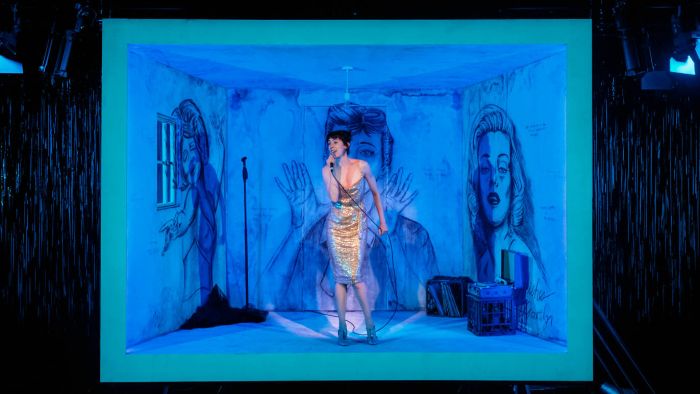
Her separation from her daughter, called LV, is economically conveyed by the stage setting, as LV’s room sits, rather like an open-sided music or juke box, above the domestic interior. It is accessed by awkward stairs visually reinforcing both LV’s withdrawal and her need to defend herself. When Mari does enter LV’s refuge-cum-citadel she bursts through the door (only when she is convinced that LV has talent does she knock) her large presence violating her daughter’s sanctum. We feel the emotional abuse inherent in her voice and stance and have no difficulty understanding why LV speaks so softly, why she stutters and why she refuses any overtures, except those of an equally emotionally battered neighbour Sadie (Bishanyia Vincent).
Nevertheless, LV has her own passive-aggressive agenda, designed to penetrate Mari’s carapace. Her room, decorated with the huge portraits of charismatic but troubled singers, Dusty Springfield, Judy Garland and Marilyn Monroe, and possessing a crate of records, expresses not her own preferences, but that of her loved but deceased father. As she sits in the dark repeating “Dad, dad, dad” we feel the depth of her love, and the extent of her desperation at her present circumstances.
Her father, we learn, had sought refuge from the promiscuous and drunken Mari in popular music, and had bonded with his daughter as together they sang the lyrics over and over again. Now LV plays the same records, sings or mouths the words, not only as a means of comforting herself but also as a means of resisting Mari’s control.
We expect from the opening that the tremulous LV will eventually find her own voice but it is the questions posed by the process that intrigues. She is gifted, and we watch in fascination as pressured into performing by Mari’s opportunistic boyfriend, Ray Say (Joseph Del Re), she gives spectacular and accurate renditions, complete with gestures, of Billy Holiday, Marilyn Monroe, Judy Garland and Edith Piaf. Her appropriately ill-fitting shimmering gold dress suggests that impersonation is not the stage world she will inherit.
Her own voice, when we finally hear it, is the product, perhaps, of her father’s affection and of his obsession, of the suffering inflicted on her by Mari, of her exploitation by the money-hungry Ray and sleazy promoter Mr Boo (Chapman), and of the loving kindness of the young electrician Billy (Charles Wu). Her ability to sing is important, but it is what makes her unique that will give her “voice” star power.
Congratulations to the whole cast for uniformly excellent performances and special mention must go to O’Connor for her powerhouse portrayal of Mari Hoff, and to Geraldine Hakewill, firstly for the razzle dazzle of her song sequence, and secondly for the quiet simplicity of her final offering. The direction is equally commendable for retaining what are recognisable elements of a transformational fairy story but grounding them thoroughly in time and place.
_______________
theatre@ssh.com.au