
This article is sponsored by the University of Sydney. Authorised by Vice-Chancellor and President Prof. Mark Scott. Enquiries: 9351 2000; info.centre@sydney.edu.au
_________________________________________________________________
A University of Sydney student has created a way to aid minke whale conservation through a machine-learning model trained to recognise the species’ distinctive song.
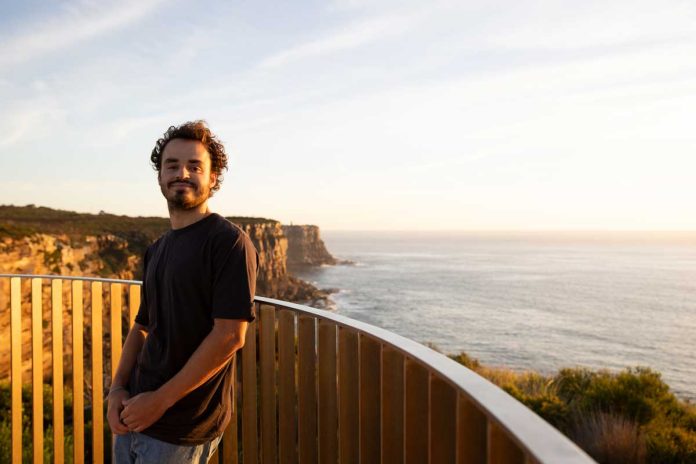
Minke whales produce a range of vocalisations, from the low, mechanical-sounding “downsweep” to the discreet, guttural calls known as “boings”. Commerce and engineering student Oscar Mower, 22, created an AI tool that can detect the call of the North Pacific minke whale, a subspecies of the common minke. The model can detect the presence of minke whales by analysing audio from existing underwater microphones known as hydrophones. “Minke whales are notoriously elusive,” said Mower. “They’re fast, deep divers, so we don’t know much about their migration patterns. To protect them, it’s essential that we understand where they are.”
Mower developed the technology while participating in the University of Sydney’s Engineering Sydney Industry Placement Scholarship, which offers students the opportunity to work on a real-world project with a leading company during a six-month placement, while also conducting research and completing a thesis. Mower spent his placement with Accenture, which provided him with knowledge and training to develop the model.
To train the model, he drew on thousands of hours of whale song recorded by hydrophones that span Arctic, Asian and US waters. These underwater microphones – either fixed or towed behind boats – are part of existing marine infrastructure. They record the soundscape of the sea for conservation, research and defence purposes.
The acoustic data that informed Mower’s work was gathered by the US National Marine Fisheries Service (NOAA Fisheries). Manually labelling acoustic data is labour intensive and time-consuming, but Mower’s machine-learning model can detect instances of whale song in real time. “Using the model, the hydrophone would detect and then alert a ship that a minke is close by,” he said. “The ship could then reduce its noise output or avoid the whale’s territory.”
Common minke whales have been heavily hunted and remain a target of commercial whalers. In recent times, there have been growing numbers of unexplained minke whale mortalities, including mass strandings. As a relatively small whale, they are also vulnerable to becoming bycatch from industrial fishing trawlers. “Minke whales are under real and increasing threat,” said Sea Shepherd Australia managing director Jeff Hansen. “It’s fantastic to see machine learning being used to enhance conservation efforts.”
Mower hopes the tool will help create marine protection zones that are off-limits to whaling and fishing trawlers. “It could be used to create shipping lanes that avoid their territory,” he said. “It could also contribute to better planning for drilling projects to ensure they don’t hurt or disorientate minkes. Noisy deep-sea activities can distress them and set them off course.”
Professor Stefan Williams from the Faculty of Engineering was Mower’s academic supervisor during the project. “Oscar’s work demonstrates AI’s potential to drive positive change and shows how digital technologies can be harnessed for conservation,” he said.
Mower is in his fifth year of a Bachelor of Engineering and Bachelor of Commerce and has a keen interest in marine conservation. After graduation, he hopes to use his technical skills to further environmental causes. His passion for whales began when he was a child in Queensland, taking regular whale watching trips to North Stradbroke Island with his family.