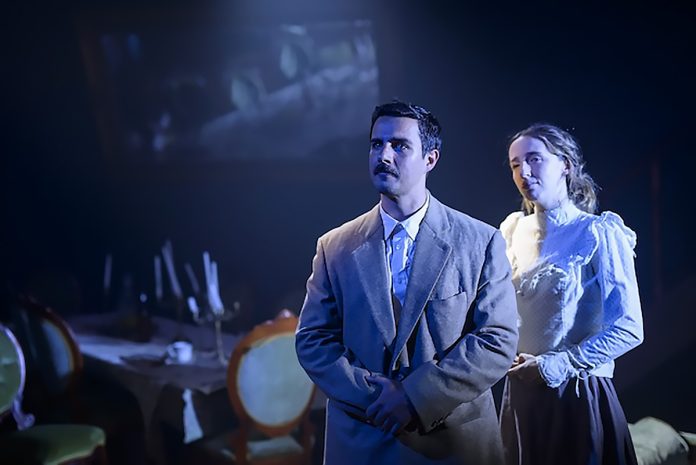
Three Sisters
Playwright: Anton Chekhov
Director: Clara Voda
Old Fitz, Woolloomooloo
17 April 17 – 9 May, 2026
Director Clara Voda’s insistence on an undiluted Chekhovian experience has resulted in a remarkable theatrical experience. The complex, unstable world of the play created by Chekhov, both a relentless and compassionate observer of the human community, is beautifully realised by an empathetic cast and a skilful creative crew.
In a small provincial town in pre-revolutionary Russia, the Prozorov family – three sisters, Olga, Masha and Irina, and their brother Andrey – live in anticipation of a better life based on possibly illusory memories of happier times when their father was alive, and the family resided in Moscow. For the sisters, and to a lesser extent, Andrey, the dream of an imminent return to Moscow represents an escape from the tedium of their present existence and the promise of passionate commitment and intellectual fulfilment. As the play develops, the prospect of return increasingly fades as circumstances erode their hopes.
Olga, movingly performed with a dignified, wounded weariness by Teodora Matovic, has borne the responsibility of the household since her father’s death and works as a schoolteacher. Her married sister Masha, a tempestuous and entrancing Madeline Li, who feels she was “married off” at an early age to a man while under the illusion he was “clever”, conveys through gesture and subtle expression changes how discontented and sceptical she has become. It becomes apparent that Olga once had hopes of attracting the man whom Masha now can scarcely tolerate.
Irina, the youngest, by contrast, is fresh to life, and on her Saint’s Day, discovers with joy that she knows “the way she ought to live” and that she “longs for work”. While it can be observed that the Prozorovs’ nanny works hard without any vestige of dignity, Tessa Olsson brings an innocent radiance to her portrayal of the white-clad Irina, inspiring the hope that she will find the illusory fulfilment she desires.
The destiny of the three women is very much dependent on the men available to them – first on their father whom they miss so much and now on their brother Andrey. This difficult role is played with immense conviction by Matthew Alexander, whose behaviour is spineless, but for which he can be pitied. Pitiable, too, is Kulygin, Masha’s schoolteacher husband, a pedantic, loud bore, brought to startling life by Faisal Hamza who knows he is barely tolerated.
Apart from relatives, the women’s limited world includes several army officers stationed in the town who gravitate to, and disrupt, the Prozorov household. Alfred Kouris’s portrayal of Vershinin is a perfect portrayal of a frequent Chekhovian “type”, as he ignites the unfulfilled passion of Masha with his passionate ‘philosophising’, and Ren Watson is suitably indifferent as the dissolute Chebutykin who remains uninvolved although those he loves will suffer.
Completing the picture is the likeable Baron Tuzenbach, engagingly and movingly performed by Tobey Carey, whose gentleness and warmth towards Irina contrasts with the other, less emotionally intelligent males. Unfortunately, the ingenuous Baron should have been less accommodating of his hanger-on, Solyony, performed with a demonic intensity by Lập Nguyên.
Add to this mix Natasha, the empire-building wife of Andrey. In a well-tuned performance, Emma Wright changes from a shy girl into a domestic termagant who lords it over the servants. Her cruel treatment of the elderly nanny, Anfisa – with the actor Cym scuttling like a mouse between household tasks – is almost totally alienating, although Natasha herself was treated derisively by the sisters.
Enclosed in a wonderfully claustrophobic and cluttered stage evocation of a provincial household (Ella Wilkinson), repressed passions seethe, lifelong frustrations mount and the grief for loss is sublimated as the table is set for meals beneath an enormous mirror. A play should reflect reality according to Chekhov, and the reality is that most of us would like to feel that our lives have meaning.