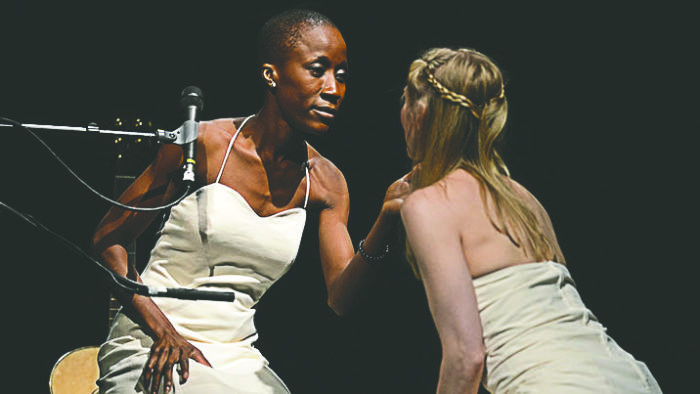
Traditionally, Desdemona is characterised as both innocent and passive but the facts of Shakespeare’s play show her to be headstrong and passionate. She refuses suitors approved by her father, encourages the black general Othello to pursue her, and after a hasty marriage, chooses to accompany Othello to war. What needs explanation is why she does not resist her husband’s attempt to strangle her. Rather than offer a resolution, the now otherworldly Desdemona (Tina Benko) offers instead a disturbingly ugly insight into male behaviour, impervious to either pity or love.
Surprisingly, Othello is rather plaintive in his afterlife encounter with Desdemona in striking contrast to the resonant voiced commander who won the heart of the young noblewoman, through his descriptions of an exotic world outside the restrictive Venetian court. In both encounters, as in the imagined dialogues between the mothers of Othello and Desdemona, and between a recriminatory Desdemona and a defensive Emilia, all parts are voiced by the remarkable Benko. Her pale beauty but sinewy strength is admirably suited to her role, and although the text is often disappointingly mundane, her performance of a woman who refuses to be seen as merely a victim is powerful and tender by turns.
The re-created voice of Desdemona’s one-time African nursemaid, ingeniously conjured up by Morrison from a brief reference by Desdemona to her mother’s maid, Barbara, is central to the play’s success. Barbary (Rokia Traoré), as she is re-named in this version, dies of a broken heart after she is abandoned by her lover, and is remembered by Desdemona as singing the melancholy “Willow Song”, which foretells Desdemona’s own fate. It seems that Desdemona, according to Morrison’s version, has learned to love from Barbary, who cared for her with tenderness not shown by her own mother, and imprinted upon her a love of Africa. While Desdemona greets Barbary in the afterlife with a fond embrace, Barbary is more cautious. “You did not even know my real name,” she says.
Traoré has an enchanting stage presence. Seated with guitar on a high stool for much of the action, accompanied by two backup singers (Fatim Kouyaté, Virginie Dembeté) and two musicians (Mamah Diabaté, Toumai Kouyaté) on ancient West African stringed instruments, her lyrical songs performed in her native Bambara are the soul of the play. Interwoven with the spoken narratives, Traoré’s songs echo, answer and extend the themes in an African context while intensifying the melancholy beauty that underlies both Desdemona’s tragic destiny and her present brave attempts to claim her fate as the consequence of her own choices.
Sellars’ staging, and the production crew’s finesse, evoke a haunting and magical space “between life on earth and life beyond it”. Assemblies of differently shaped glass jars lit from within or suddenly extinguished serve to mark out the shifting movement of the narrative, suspended light bulbs hover mid-air in the dimly lit darkness and the shadows cast by the performers take on a distinct life. As a contrast to the always-encroaching darkness, the simple, white fitted gowns of the four women emphasise their painful vulnerability.
theatre@ssh.com.au