These are just a few of the striking images in Tell: Indigenous Contemporary Photography, a touring exhibition from Ballarat International Foto Biennale in Paddington this month.
Tell showcases recent works by 17 Australian Indigenous artists and collaborators, and explores Aboriginal and Torres Strait Islander life, history and culture.
Curator Jessica Clark (Palawa*) says artists harness photography as a powerful mode of self-expression, and transform photography’s “colonial legacy of imposition into an empowering mode of resistance”.
This resistance manifests in a variety of forms.
The staged placement of dolls in stills and videos by Destiny Deacon (Ku Ku and Erub/Mer Torres Strait) invites viewers to grapple with the limits of stereotypes and the potential for dialogue between Indigenous and non-Indigenous Australians.
Witty taglines stir the possum further. For example, the line that accompanies Deacon’s photo “Daisy and Heather Discuss Race” reads, “Talking about race can be an endless topic. Our gals are just getting started.”
Ricky Maynard’s portraits of Wik elders highlight the emotional and physical costs to Wik people in North Eastern Australia from their decades-long struggle for control over their native lands.
Maynard (Palawa) says he hopes viewers will look under the surface of the images to see people’s struggles.
He writes: “Australia needs to rid itself of the notion of having an ‘acceptable history’ and one that is pleasing to the senses and ‘allows all of us’ to be united as one. This country continues to bypass the truth of the collective past. How can there be a future built on this? We need to understand and learn from history because if we repeat history we head for tragedy.”
Self-portraits and sculpture by Moorina Bonini (Yorta Yorta) shine a light on everyday slurs that she and other Indigenous Australians must endure – including scornful questioning of the legitimacy of their Indigenous identity and heritage.
One compelling portrait shows Bonino holding a baby photo with the words “Real Aborigine” penned across it. Her accompanying sculptures are composed of rocks stacked in tubes and bear the words “Full Blood”, “Half-caste”, “Quadroon” and “Octaroon”.
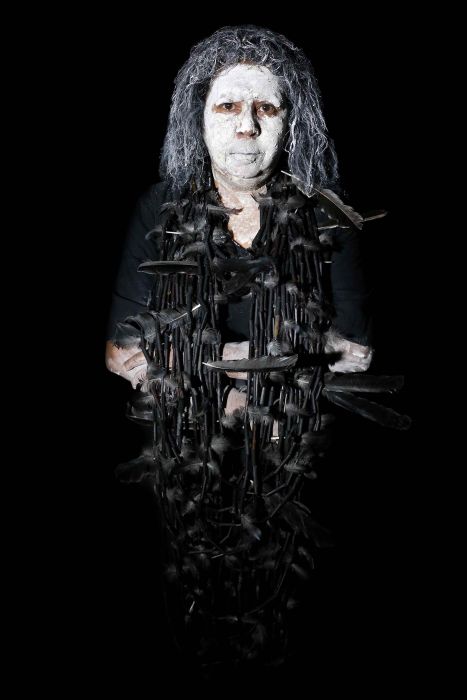
Works by Warwick Thornton (Kaytej), Bindi Cole Chocka (Wathaurong), and Maree Clarke (Mutti Mutti/Yorta Yorta/Boonwurrung) were among my favourites: Thornton’s for cinematic punch, Cole Chocka’s for texturally arresting features, and Clarke’s for the unvarnished sorrow she portrays with stark dignity.
Tell honours the complexity of Indigenous experience and race relations in Australia.
It exposes painful experiences of dislocation and displacement, and deep narratives of mourning and resilience.
Its works are strong, stirring and strangely uplifting.
Don’t miss it.