This article is sponsored by the University of Sydney. Authorised by Vice-Chancellor and President Prof. Mark Scott. Enquiries: 9351 2000; info.centre@sydney.edu.au
_________________________________________________________________
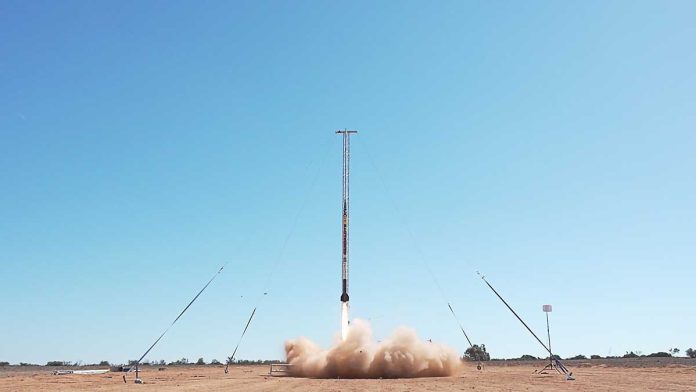
The USYD Rocketry Team has been announced as the winner of the 2025 International Rocket Engineering Competition (IREC), taking out first place with their latest rocket, Pardalote.
In addition to winning the overall New Horizon Award, the team also secured first place in the Student Research and Developed (SRAD) Hybrid/Liquid Category and were runners-up for both the Jim Furfaro Award for Technical Excellence and the Charles Hoult Award for Modelling and Simulation.
A record-setting 156 student rocketry teams, composed of thousands of university students from across 19 countries, travelled to Midland, Texas to compete in a tense six days of competition. The students battled harsh weather conditions including blistering heat and sudden windstorms. One-hundred-and-thirty-six teams had their rockets successfully achieve lift-off.
Soaring to a height of 10,342 feet (3.15 km), with an error margin of just 3.42 per cent, Pardalote achieved the most accurate apogee (point in the orbit of a satellite) ever recorded by a 10k SRAD Hybrid launch vehicle in the history of the competition.
The achievement makes the USYD rocketry team two-time world champions – in 2022, the last time the team attended, they also brought home gold (then called the American Spaceport Cup) with their rocket, Bluewren. This makes USYD Rocketry the only multiple winners of the overall competition.
USYD Rocketry Team is Australia’s first tertiary student rocketry team – a dynamic group of student engineers who design and manufacture high-power rockets and space technologies based in the Faculty of Engineering. In 2019, the team was the first Australian team to attend, compete in and win their category at Spaceport America Cup (now known as the IREC).
“Pardalote shows what’s possible when you give a group of passionate multidisciplinary engineers the freedom to lead, design and build something they genuinely care about,” said Ricky Purani, a third-year School of Electrical and Computer Engineering student and the team’s executive director.
“Launching far from the comfort of our own Australian backyard, Pardalote’s performance on American soil not only broke records of accuracy but established a new standard for what an undergraduate team can accomplish,” said Gigi O’Rourke, currently a third-year student studying a Bachelor of Mechanical Engineering with Space.
The Experimental Sounding Rocket Association (ESRA) has operated the competition since 2006, with the IREC achieving international status in 2011. ESRA is a non-profit organisation founded in 2003 for the purpose of fostering and promoting engineering knowledge and experience in rocketry.
The students learn to work as a team, solving real-world problems under the same pressures of cost, schedule and technical risk they’ll experience in their future careers, such as in aerospace engineering.
Declaration: Project Pardalote was supported by the School of Aerospace, Mechanical and Mechatronic Engineering(AMME) and School of Electrical and Computer Engineering (ECE) in the Faculty of Engineering, The University of Sydney, as well as industry partners and over a dozen sponsors including Pirtek, Coregas, Sydney Composites, The Chancellors Committee, Investment NSW, Office of the Chief Scientist and Engineer, NSW Space Research Network, Sydney Manufacturing Hub, SCF Containers, Royal Aeronautical Society, Calm Aluminium, Tolarno Station, Altium, Leap Australia, Ansys, Air’n’Paint, 80/20 Australia and Terracotta Roasters who provided financial and in-kind support to the team.