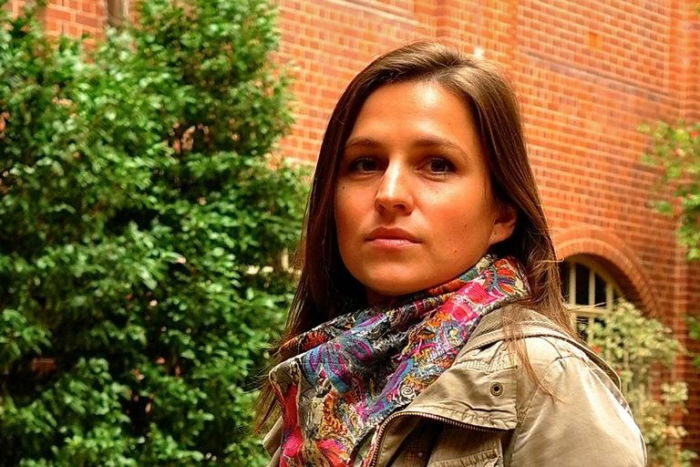
Edyta is not foreign to multicultural environments. She was born in Kraków, an historical city in southern Poland dating back to the 7th century, which escaped destruction during the Second World War. The second largest city in Poland, Kraków has traditionally been one of the leading centres of Polish academic, cultural and artistic life. As a teenager, Edyta travelled across Europe with the choir from the Kraków University of Economics – her first experience with academia. At 17, she went to Canada without prior knowledge of English or French. Learning to communicate was a priority, yet an experience often fraught with fear and frustration. She said: “It is like stepping out of the comfort zone. When you go to a new place, you don’t know anything so everything is strange. From one day to the next you start to discover parts of the streets, then parts of the neighbourhood, then parts of the city, and suddenly things that scared you before become part of your everyday life.”
At 19, Edyta left her family, city and friends. “I wanted to go and study in Germany. So, I started studying economics at the European University, Viadrina, Frankfurt (Oder) in 2001. Learning German was made easy through a language program at the university.” While studying in Frankfurt she also enrolled into Political Science in Slubice at a branch of the Polish Poznan University.
Located only a few kilometres from Frankfurt (on the Oder river), Sublice is very popular with Germans who can buy goods cheaper there than at home; similarly, Polish people can access in Germany what they cannot acquire in Poland. This was Edyta’s first experience with multiculturalism. She said: “People living close to each other can live in very different ways. The differences were so obvious to us we did not discuss them anymore. It was part of everyday life.”
“I spent the following three years studying in two faculties in two different countries crossing the border daily. In 2004 things changed, Poland became a EU member; suddenly I didn’t have to show my passport all the time,” she said.
After completing a Master of Business/Economics in Frankfurt and a Bachelor of Political Science in Slubice, she went back to Kraków, her hometown in Poland, to complete a Master in International Relations at the Jagiellonian University.
This period influenced her greatly and her plan to stay in Kraków for life changed. Instead, she developed an urge for discovering new places, meeting new people, soon realising that building a career in international relations was her way, given the right studies and experience.
A brief encounter with the corporate world working as a buyer for a fashion company saw her travelling to China, facing the realities of what it means to be culturally appropriate, especially when issues relating to Tibet and human rights can easily be brought into the conversation. She had to learn how to handle those delicate situations and her interest in international relations grew even stronger. This experience made her realise she was not cut for the corporate world. She said: “This was not the best time of my life. Travelling was nice but I knew I could do better than that, so I decided to complete my studies in international relations and work in this area. Learning to understand people – what they know but most of all what they don’t know – was important to me.”
She was told the University of Sydney had a very good reputation in this area; she wanted to study in an English-speaking institution, so she applied to enrol into a Master program with the Centre of Peace and Conflict Studies at Sydney while in the US. Months later she received notification that she had been accepted. After another six months organising her trip, she moved to Sydney.
Edyta said: “The University of Sydney changed me a lot. The standard is very high. Teaching there allows for more creative and critical thinking. Much of the knowledge I acquired from the universities in Poland and Germany was book-based knowledge. Here, I learned how to think and how to ask questions. These were the things I was missing from my previous studies.”
According to Edyta, Poland is a homogeneous society in which influencing young people is easy. She said: “Studying international relations while staying with people from one’s own country and culture does not allow for the appreciation of cultural and ethnic perspectives. If you live with people who think the same way as you do, it is so much easier to judge than to understand. Australia is a heterogeneous society. Interacting daily with people from a variety of ethnic backgrounds makes it easier to understand their point of view, sharing knowledge, asking the proper questions; most of all, it helps remove prejudice and not judging others so quickly. Experiencing this difference is important to me; it is not what I get from it but who I become after it.” When discussing cultural perspectives Edyta stresses the conflict evident in Australia with issues of identity. According to her, beneath the apparent affluence and tolerance lies a struggle for a multicultural society to come to terms with the need to address the intricate relationship between migrants arriving on a new land and the original inhabitants of this land.