


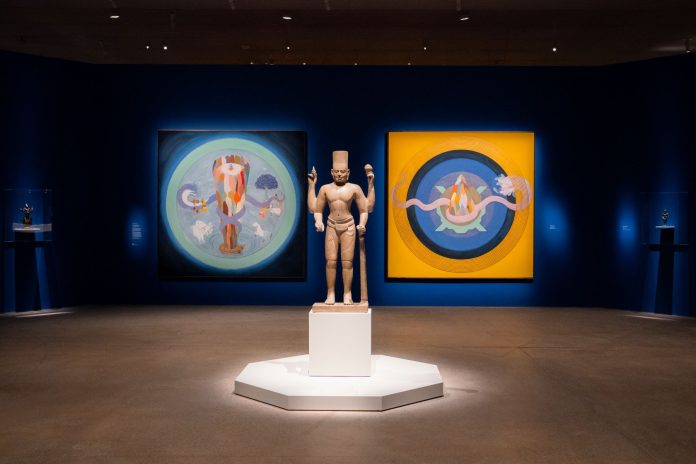
The Art Gallery of NSW’s latest exhibition, Avatar: Forms of Vishnu, explores how tradition and spirituality can help people make sense of a changing world.
Featuring almost 200 South and Southeast Asian artworks from the past 15 centuries, Avatar: Forms of Vishnu offers an expansive journey into the Hindu deity Vishnu and his primary avatars.
Alongside traditional artworks brought together from Australia, Cambodia, Switzerland, India and the United Kingdom, the exhibition displays contemporary pieces by nine artists who have reimagined traditional stories of Vishnu and his avatars.
In Hindu tradition, Vishnu is known as the preserver, descending to Earth in different forms, or avatars, when the world falls out of balance. Each avatar represents a different response to restoring peace.
Beyond its scale and historical depth, the exhibition asks what ancient stories can teach us about living through uncertainty today.
Walking through the exhibition, that question becomes clear. The five interconnected spaces move between devotion, protection, conflict, love and restoration, showing that Vishnu’s story extends beyond worship and demonstrates how people respond to disorder.
Contemporary artist Desmond Lazaro, whose work appears in the exhibition, said: “These stories are not over. They live on.”
“They are ultimately stories about human experience.”
His work reflects one of the exhibition’s strongest ideas: that tradition should not be seen as separate from the contemporary world, but as a way of understanding it.
“Through the contemporary, you can access tradition, which is what makes it relevant today,” Lazaro said.
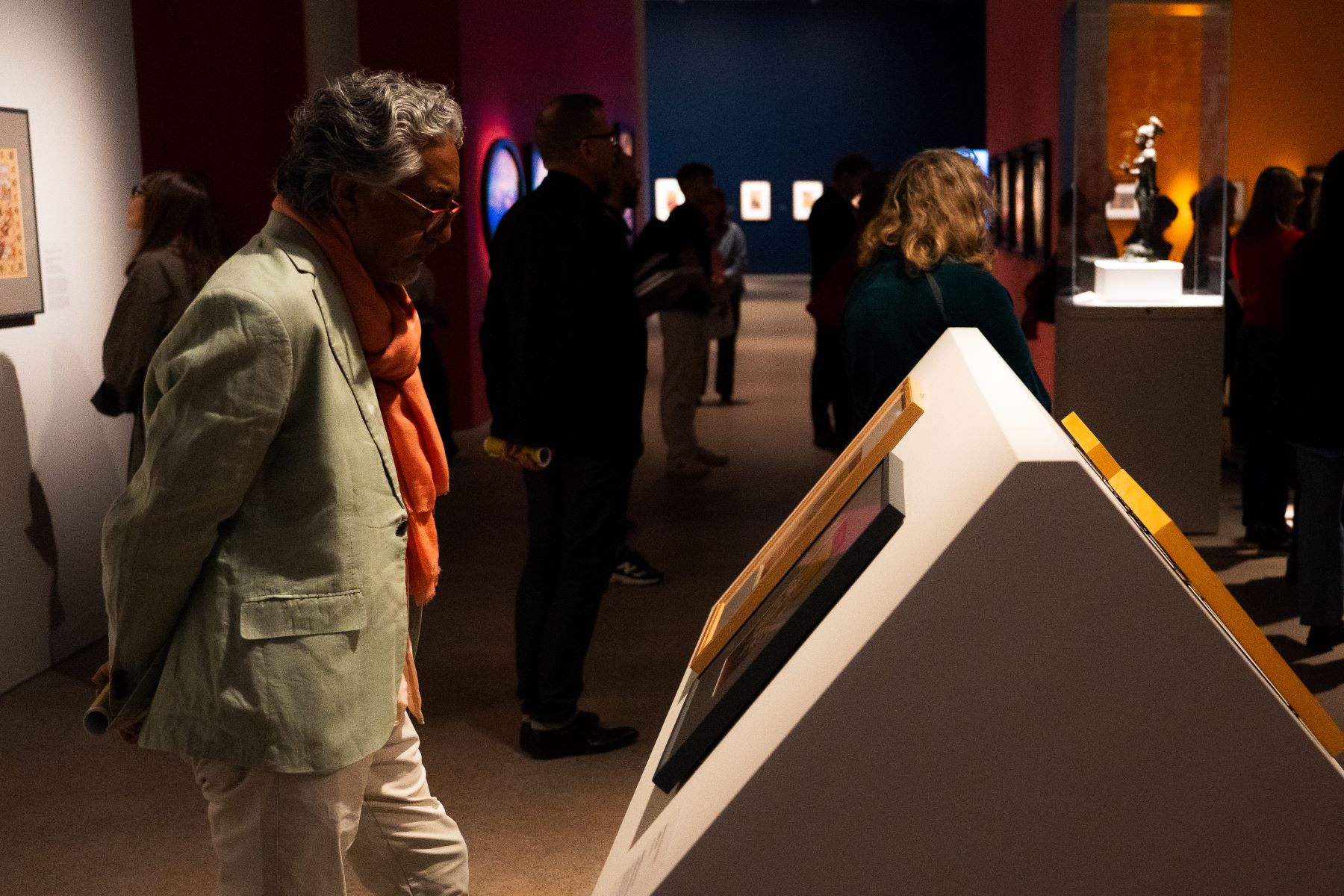
The exhibition is most successful when it allows old and new works to speak to each other. Historical sculptures, garments and paintings sit alongside contemporary interpretations, creating a conversation across centuries.
The inclusion of contemporary artworks shows how inherited stories can be reinterpreted without losing their meaning.
Lazaro explained that his work comes with tremendous responsibility. Having been immersed in the tradition for much of his life, he said he has “always had an inherent devotion with Krishna,” one of Vishnu’s avatars.
That sense of devotion is visible throughout the exhibition, where audiences can feel the care taken to connect them with the stories behind the works.
At times, the depth of the subject matter may feel overwhelming for visitors unfamiliar with Hindu traditions. However, the exhibition’s structure gives enough context for audiences to follow the idea that Vishnu’s avatars emerge when the world needs restoration.
The exhibition carries significance beyond the artworks themselves. Art Gallery of NSW Director Maud Page said the gallery wanted communities to “come and see themselves represented.”
Co-curator Melanie Eastburn also shared that staff had been working on the show for three years and three months.
At a time when the world can feel fragmented, Avatar: Forms of Vishnu reminds audiences that tradition can be a way of finding direction and understanding our place within something larger than ourselves.
In Lazaro’s words, quoting the Sufi tradition, “There is nothing more timely than the timeless.”
Art Gallery of New South Wales, Naala Badu, lower level 2
20 June – 5 October
Tickets: Adult tickets are $35, with concession, member, family, youth pricing and ticket offers available.
Extra sessions: Exclusive daily early-morning sessions are available for an additional cost. Bookings are required, with the option to join a guided tour.





We totally agree 🙂
Great debut article from Carelle, such an easy and enjoyable read, will be on the lookout for anything else she does!