Suntanning remains prominent in Australia, yet the dangers associated with this culture are embedded in patriarchal and racial connotations.
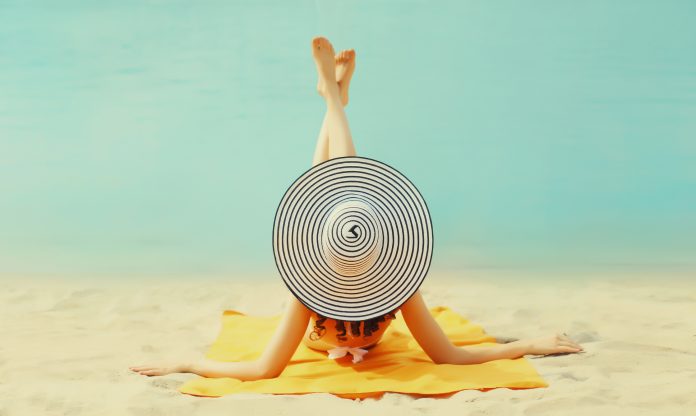
As we leave October and the heat begins to surge, it is common to hear young people express excitement at the prospect of a bronzed tan by intentionally lying out in the sun.
However, as a tan operates as a prominent standard in Australia, heightened by our geographical position and some of the world’s most renowned beaches, the normalisation of tanning and a desire to fit in often prohibit any genuine reflection of what the standard truly represents.
Gendered connotations – standards that harm women
Research shows that suntanning is predominantly undertaken by women. According to a 2024 study by the Australian Bureau of Statistics, in the 12 months prior to the study’s release, approximately one in four young women aged 15-24 had participated.
When referring to suntanning, this does not mean simply going to the beach for a swim, going for a walk, or playing sport in the sun. It refers to spending hours lying out in the sun, often with minimal protection, with the intention of acquiring a tan – increasing health risks.
These risks are supported by research into skin cancer and melanoma. According to Cancer Council NSW, two in three Australians will develop skin cancer in their lifetime. In 2024, approximately 1,340 Australians died from melanoma. It is also recorded that 95 per cent of skin cancers are caused by UV radiation exposure.
Research also shows that sunscreen while tanning acts only as a filter, reducing your chance of skin cancer by around 40 per cent. Your skin is still subject to UV exposure, which causes the tan by releasing melanin. This is why you have probably heard the phrase a ‘tan is a sign that your skin cells are in trauma,’ even if your skin has not burnt.
The deadly nature of intentional tanning, intertwined with high participation rates among women, is a byproduct of broader patriarchal standards that invite the suffering of women.
An academic study conducted in 2015 found that the repetitive portrayal of famous white women with a bronzed tan in media cultivated public perceptions of tanning as desirable among young women.
In detecting the prominence of this standard today, I interviewed a 16-year-old teenager who chose to remain anonymous. She revealed that most of the tanning-related content she had seen was on TikTok and Instagram, prompting her to suntan herself.
Since gaining a painful, blistering sunburn that debilitated her for three to four days, she now says she no longer tans.
“I would often see thirst traps of people with noticeable tan lines or videos of people saying that they love when the UV is high so they can tan. Most of the comments underneath were filled with people complimenting the creator on their tan lines.”
These compliments link to a pattern where a common portrayal of what is deemed attractive in mass media is often attained through physical pain. For example, having an idealised nose or jaw in media is increasingly attained – outside of health reasons – by plumping or surgical reconstruction, to the point where facial expression can become limited.
The idea that women must be slim with a flat stomach is often attained by undereating, over-exercising or surgery, posing major health concerns.
When women garner acceptance, male attention, popularity or a lack of shame by conforming and painfully partaking in their own dehumanisation, it raises questions about whether these examples are truly a product of attractiveness – a term formally defined by subjectivity in relation to a person.
When features that define our physical and natural personhood are altered, advocacy for these features represents a desire for control, established by an attempt to keep women insecure and limit their individuality, disguised as attractiveness.
As the above paragraph explores extreme physical alteration, the point is that suntanning – particularly in Australia, with alarmingly high UV rates – is a beauty standard associated with immense risk. Even when fake tanning is used as an alternative, discourse often frames it as preferable to a sun tan because “it looks better”.
Capitalism also thrives on our susceptibility to suntanning – for example, tanning oils, balms, exfoliants and moisturisers are advertised and sold to help you tan. Companies that sell these products perpetuate the idea that women must prioritise their physical appearance despite risk, keeping us distracted while they attain profit.
However, this does not call for shame among women who participate. As a desire for belonging and acceptance is human, it is understandable that participation in extreme examples arises in a society where acceptance is achieved by conformity to these standards.
This is why women must work to accept these standards for what they are – and publicly condemn these mechanisms of attainment. A short-term tan is not worth the perceived risks of skin cancer later in life.
Racial and colonial connotations
It is also necessary to explore how this standard carries contradictions and racial undertones by resembling a desire to appear darker.
According to the 2015 study referenced above, the majority of women idealised for their tanned skin were white women. Yet if darker skin were the standard, why were women of colour often shamed and excluded from media attention?
This contradiction also applies to Australia. Tanning is not a new trend; according to the Guardian, baby oil was commonly used as tanning oil in the 1970s – a time when the Stolen Generations were coming to an end and Indigenous Australians had only recently gained the right to vote.
Today, the ongoing effects of colonialism remain prominent, through staggeringly high incarceration rates despite a small Indigenous population, as well as Australia’s disdain for an Indigenous advisory body in parliament. Physical features of racially oppressed people have been stolen and distorted as white beauty standards, as supremacy is built on insecurity.
Tanned skin is not the only feature of Black people imitated by white people. With women of colour genetically more likely to have fuller lips and curves, Botox and Brazilian Butt Lift (BBL) surgeries have risen to attain these features. In 2023, data indicated that 82 per cent of Botox patients in the United States were Caucasian.
I came across an article where the writer, Rayham, defined this as “blackfishing”. She emphasised that while Eurocentrism should not be the norm, it becomes problematic when white influencers imitate these features but fail to use their platforms to address racial discrimination. This devalues the fact that Black people experience struggles due to their appearance.
What can we take from this?
The act of imitation by white women, while failing to recognise racial disparities in their nation, only creates further division between Black and white women, serving the patriarchy.
The patriarchy thrives on division, inviting women to adhere to painful and dangerous standards while devaluing the experiences of women of colour. This exemplifies how the patriarchy affects all women, but its effects are enhanced for women of colour, as these features are primarily deemed attractive on white women – which are then often attained unnaturally and painfully.
Women must support, unite and uplift each other. Most importantly, we must divert our attention towards understanding the deep-rooted issues that dictate our lives, and away from promoting painful or potentially life-threatening means of physical alteration. We are so much more than beauty.