The Face of Jizo
Writer: Hisashi Inoue
Director: Shingo Usami and David Lynch
Seymour Centre
August 21 – September 6, 2025
Set in 1948, three years after Hiroshima’s bombing, The Face of Jizo explores how survivors adapt mentally to the challenges of their devastated city. Instead of dwelling on the dark and dire aspects of the bombing, the play conveys a sense of warmth, humour and hope, via the two excellent lead actors. The “Jizo” of the title is the guardian of children, an important Buddhist deity.
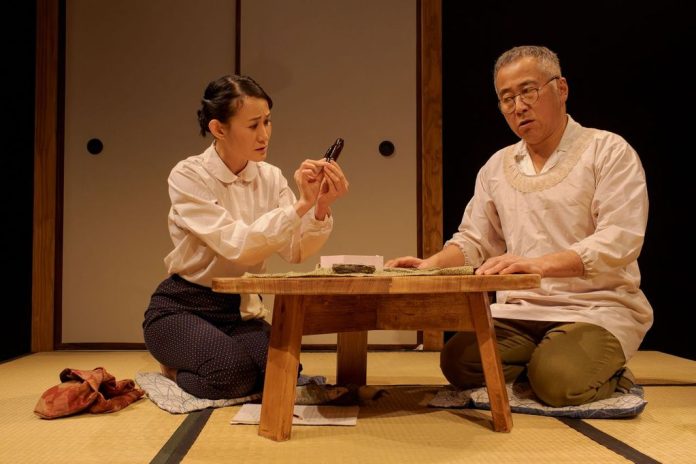
When Mitsue (Mayu Iwasaki), a young librarian, returns home during a thunderstorm, she reacts with terror to the lightning flashes and noise – a legacy of the bombing. So does her father, who appears to be hiding in a cupboard. She tells us he was killed at the time of the attack. So has her father returned as a ghost to guide his daughter? Or is the ensuing familial banter just a soundtrack in her head, her remembrance of him when he was alive?
Whichever the case, her father Takezo (Shingo Usami), comes across as a warm, humorous force, intent, via some gentle badgering, on propelling his daughter to overcome her fears and embrace her post-war life. Mitsue’s struggles are a mixture of severe survivor guilt, the trauma of having witnessed the horrors inflicted by the attack, and anxiety about a burgeoning romance with a young man, Masa, whom she has met at the library.
Why, she questions, has she survived when others have died? Her anxiety is further compounded by occasional bouts of radiation sickness, which leave her doubtful of committing to a relationship.
The cheerful back-and-forth banter between father and daughter is charmingly entertaining – providing a humorous comfort zone and creating the perception of them as likeable, caring, human beings. The set is a spare shack-like construction (Tobhiyah Stone Feller) reminiscent of the era, but with homely touches of favourite domestic objects.
Takezo continues a gentle but relentless onslaught on her resistance to move forward – to overcome fear and despair, to rebuild what was there before. Responding to her father’s hints that “perhaps there could be a grandchild, perhaps even a great grandchild”, Mitsue begins to sense that, as a survivor, she has a duty to the future. His argument eventually penetrates Mitsue’s doubts, and she decides, happily, to accept her young suitor.
This play, which highlights the implacable impetus to survive in the face of stark tragedy, is deserving of the many accolades it has garnered. It is a fine achievement, giving prominence to the tender, heartfelt strivings of the human spirit.