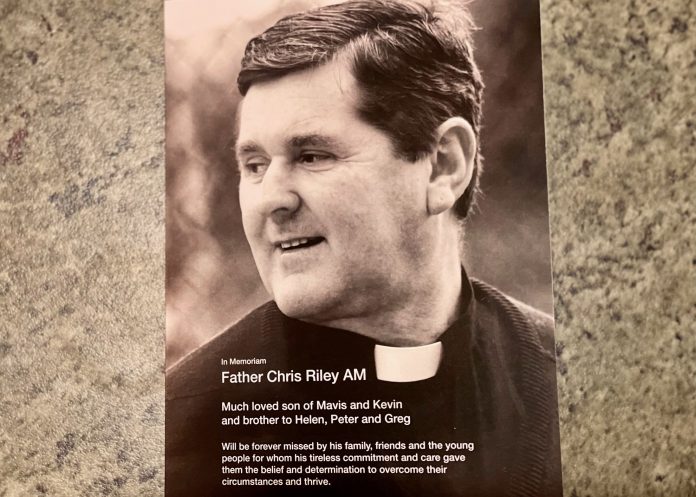
Father Chris Riley AM (1954-2025) grew up on a dairy farm in Echuca, Victoria, before answering a vocation inspired by the 1938 film, Boys’ Town. At 15, he resolved to become a priest to care for young people cast aside by society. He dedicated more than three decades to education, housing, counselling and rehabilitation services for vulnerable youth in Sydney and beyond.
From 1991 to 1996, I worked alongside Father Chris – “Farv”, as we all called him – at the beginning of what became Youth Off The Streets (YOTS). Back then, it was St Vinnies for Youth, a refuge in Marrickville for young homeless people. Our small team helped build the refuge and its programs from the ground up.
Farv was entirely devoted to the young people he called “my kids”. He saw potential where others saw risk or despair, and he carried that vision into every action, every decision, every long day.
I first met him at the St Vincent de Paul Society offices in Lewisham for my job interview. He was intimidating – direct, laser-focussed, resistant to sentimentality. I soon understood the fire within him: not self-importance, but a relentless determination to create real opportunities for kids who had been left behind.
Staff meetings were a revelation. Farv read aloud from saints and liberation theologians, and I discovered the church as refuge and resource, the gospel as good news for the neglected and addicted.
Some criticised the work as “band-aids”, but Farv knew better. It was about cultivating the good in each young person, freeing them from fear, shame or abuse, and involving families and communities wherever possible.
His style could be fierce. He never seemed to sleep, and he made high demands of both staff and young people. “Whose needs are being met?” he would ask – pressing us to look beyond our frustrations to what a young person truly needed. He could be angry but he was never indifferent.
And yet he had humour, too. He laughed easily, sometimes even while distributing the sacrament. He loved basketball and football, adored his Great Dane Collingwood, and played his 12-string guitar, singing songs by Roxette, Michael Jackson and Jimmy Barnes.
The work was raw, often heartbreaking. We lost kids to overdose, including one whose life story we found on a computer after his death. Each loss devastated him, yet he carried on for the sake of the others.
Farv’s guiding wisdom (I learned at his memorial service on August 18) was the Circle of Courage – rooted in Native American traditions, emphasising belonging, independence, mastery and generosity. Every program reflected this: refuges, schools and rehab centres, op shops, farms, cattle drives, overseas missions, art and music.
Music was central to the refuge. We formed a band, The Forgotten, busked at Central station, and played gigs at schools and community halls, Martin Place and Deniliquin. Kids who had been told they were nothing stood tall as rock stars.
He carried both grief and hope. Migraines sometimes left him bedridden, yet his room – lined with books – was a place of study, reflection and prayer. He often said, “There are no bad kids – just bad situations.” His faith was simple, practical, always rooted in action.
At his ordination in 1982, he chose a quote from Dom Hélder Câmara: “God permit that the symbol of my life be a candle, that spends itself while there is still wax to burn.” That candle was his life: consumed for others, illuminating paths where there seemed only darkness.
For six unforgettable years, I saw that flame up close – flickering, fierce, sometimes fragile, but always burning for the kids he loved. The light he kindled continues to burn in countless lives, guiding, warming and inspiring all who follow in his footsteps.