The softened cloth with its faded hues and simple repetitive stitching touched a nerve. I realised how “old and tattered” could be truly beautiful and how this slow process of preservation was a striking counterpoint to consumerism, which vaunts the quick, the new and the disposable, and wastes so much.
In the Amuse gallery I learned that, throughout Japanese history, rural women repaired noragi (farm clothing) and household items (like futon covers and aprons) by patching scrap fabric over the worn parts of the material. Boro patching both extended the life of the items and added layers for warmth.
Indigo dyes were also thought to contain properties that naturally repelled insects and snakes, which made them perfect for clothing worn in the fields, and for bags that stored grain.
In mountainous regions, if a woman’s needle snapped, she would wail with grief at the consequences. A needle was difficult to replace: Without a needle, she and her family could freeze to death in the fields or when trying to restore their energy through sleep for the next day’s tilling.
Starvation was a stitch or two away.
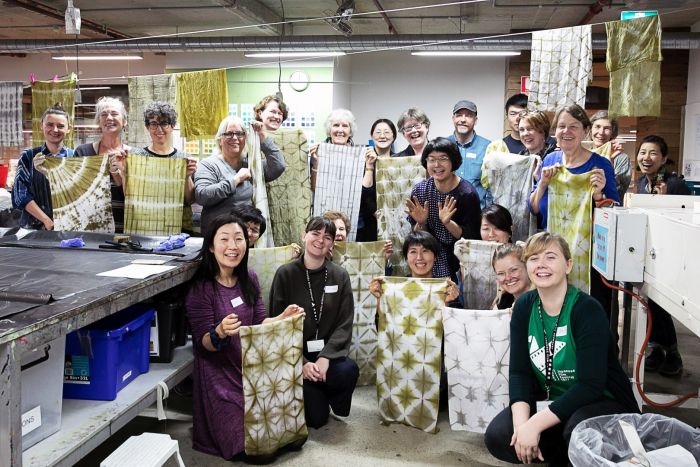
Shibori was the next slow and ancient Japanese art that got under my skin. Shibori is a Japanese term for dyeing cloth by binding, stitching, folding, twisting or compressing the fabric to create unique designs.
Indigo dyes are used in shibori – and the results can be stunning.
The shibori and boro items on display in The Intuitive Thread exhibition at the Japan Foundation Gallery in Central Park, Broadway, as part of Sydney’s Craft Week in October, reinforced my love of these ancient processes.
The exhibition featured four emerging artists from Japan whose work (according to the blurb) is “grounded in slow, disciplined, age-old processes, while at the same time challenging convention”.
Chiharu Ohgomuri’s art spoke most powerfully to me. She uses natural dyes and shibori techniques, as well as freestyle staining, to fashion her creations – and the results are captivating.
Chiho Sasaki’s use of boro was also moving. Sasaki believes the rough beauty of old textiles offers warmth, and the faded colours and frayed threads “evoke a feeling of the past”.
I tried to enrol in Chiharu Ohgomuri’s natural dye workshop in Sydney in mid-October but I was a late starter and it was full. Instead, I asked her some questions via email and a translator about her work with natural dyes and as founding director of the Japanese textile design studio Takarajima Senkou.
Ohgomuri speaks of how art and product design go hand-in-hand in her practice, and how by layering indigo (as she does in her art) “the blue becomes deep but also clear”. The way indigo fades gradually “like the life of flowers”, she says, is another unique element of the dye, which is sometimes seen as a flaw, but can also add charm.
I wish I could talk with her further about the Japanese concept of mottainai – the feeling that comes from the awareness of the interdependence and impermanence of all things. Mottainai is a term that expresses regret at wasting the intrinsic value of a resource or object, and it can be translated as both “what a waste” and “don’t be wasteful”.
While I suspect it may be too late to learn this wisdom in the Western world, and in Australia in 2018, I still long for it to be possible. Imagine if we mended the broken and valued each needle? Imagine if we patched garments and quilts to make them warmer and more beautiful? Imagine if we dyed and stitched our way to ecological sustainability? Imagine.