A few years ago I was asked by some volunteers, “Why do we work with young people?”
I came up with some cheesy response about “leaders of tomorrow”. But then I remembered a conversation I had with a teacher, who started an Amnesty group at the boys school he taught at, after being inspired by our Stop Violence Against Women campaign. His thoughts were that by engaging these young men in a conversation about violence, they could both participate in activism and also learn about the nature of violence – this meant they were less likely to become victims or perpetrators.
So that’s why we do this, to inspire activism but also to create a culture of human rights within Australia and beyond.
The first article of the Universal Declaration of Human Rights (UDHR) says that “all human beings are born free and equal in dignity and rights”, therefore ensuring that people’s basic rights should be respected and that everyone should have access to them. That is why Amnesty International works wherever these rights are not honoured.
Amnesty International is funded completely by supporters, globally and here in Australia. They can be people who give us a big donation at one time, fundraise by holding events or completing challenges (recently a team climbed Mt Kilimanjaro), or who donate money regularly. This means that wherever we are, we retain independence from government and business.
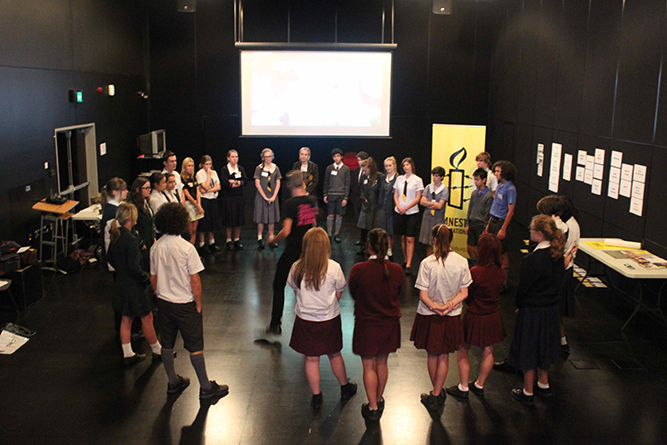
We also have impact through our amazing volunteers who contribute their time and their skills. They do this by taking on leading volunteer roles, starting school action groups (groups that meet and take action on different human rights campaigns), organising and hosting events and by taking action in the community and online. By having these groups and volunteers, we are trying to build a movement of people who work together towards creating a world where human rights are a reality for everyone – here in Australia and on a global level as well.
We see this everyday in the work we do on Aboriginal rights in schools and communities. Recently I ran a series of workshops with young people explaining the background on the “Declaration on the Rights of Indigenous Peoples”, its history and why the United Nations’ member countries decided to establish a document that detailed what governments’ obligations should be to their First Peoples.
Having this conversation allowed us to explore with young people the impact that colonisation had on Australia’s Aboriginal population, and the ongoing effect that this has had on them. I vividly remember former Prime Minister Kevin Rudd’s Apology. I was in Redfern in Sydney at the time and I remember being so happy when the announcement was made.
The Apology was a good first step in publicly recognising the impact colonisation had, and still has, on Australia’s First Peoples, but the apology is only a starting point in a longer journey towards reconciliation. Unfortunately, despite this progress, the disadvantage and discrimination faced by Aboriginal and Torres Strait Islander peoples in Australia remains widespread. The figures we have on Indigenous and non-Indigenous health and social outcomes make this clear. For example, the Indigenous population in Australia is 2.5 per cent of the population, yet Indigenous youth make up 58 per cent of the total national juvenile incarceration rates. This is just one of the many things Amnesty International is calling on the Australian government to address in terms of Indigenous disadvantage.
Working towards addressing these issues, Amnesty International Australia has for the past three years campaigned with Indigenous communities living on their traditional homelands to ensure their culture and traditions remain respected, protected and strong. This is important because homelands are communities established to enable Aboriginal peoples to maintain connection with their traditional, ancestral lands. These communities have lower levels of social problems and significantly better health outcomes, and are home to around a third of the Aboriginal population of the Northern Territory.
Thanks to our network of volunteers, supporters and members, campaigns like this have positive outcomes that make all our hard work worthwhile. In March of 2012, the federal and Northern Territory governments announced $221 million in funding over ten years for homeland communities in the Northern Territory. This was committed to fund basic services like water, garbage collection and sanitation. The federal government went on to make a further commitment of more than $4 million in new funding for much-needed housing and infrastructure upgrades for the Utopia homelands in the Central Desert, Northern Territory. This was recently followed by the news a further $8 million is being committed to housing works in homeland communities.
As an activist who works in lots of different places for a global human rights organisation, I recognise that being a caucasian man in Australia comes with a certain amount of privilege.
I can openly protest and state my opinion about things happening in my country without fearing persecution or vitriol. I am very lucky to have that privilege, but in my view that privilege comes with responsibility, the responsibility to work with others to make sure that everyone has access to human rights.
There are so many ways you can get involved in our domestic and global campaign work. Within the youth portfolio we have networks of young people in every state going out and having these human rights conversations with young people, we have local groups in communities coming together and taking on the fight for human rights, and we have contributors who give us money and time.
Our movement is vibrant and incredible and by being a part of it you can help us make the incremental change to make the world better. Either flick us an email or jump online and find out how you can get involved.