


Working in Redfern, twenty-odd years ago, I used to wheel around from Renwick to Regent Street around 12:30 daily to grab myself a salad roll from a Vietnamese bakery. I’d then maybe pop in to the Aboriginal Housing Company office to discuss whatever community art project we were working on, or for a catch-up at the now residentified Bite Me Café opposite, on Lawson Street.
To challenge my possible recollection bias that there was hardly any foot traffic on the Eveleigh St side of Lawson Street during my trips to the AHC, I’ve checked the online Street View from the years in question, and I’m not wrong.
Walking around the suburb at the time and particularly crossing that invisible line of cultural lands divided by the Lawson St overpass, the place had the air of a mutual tension between the Housing Company side and its Indigenous residence, and the general, mixed populous of Sydney on the station side.
It disheartened me, and I wished for a world of healing and happiness, but I wasn’t blithe enough to think I could affect any significant, immediate change on my own. I’m a twenty-first century hippy. I still want all that peace and love to happen. I still turn to music, and the like, in the belief it can be part of it, but see myself as a link in the chain of change, quietly inspiring others for the possibilities that can come from their own creative actions.
In that moment in time, heading towards the 2010s, I figured if I could do something to contribute towards the long-term healing of mistrust that hung over Redfern, even in a small way, I wanted to do it through optimism and engagement. I kept this resolve in the face of knowing that to many on the Eveleigh side, I was also an interloper and being there, even by invitation, made those who hadn’t directly invited me uncomfortable.
This went right to the top, among the Elders who begrudgingly accepted explanations from my hosts that I was there to do good things at the request of the community, and from unseen eyes I felt on me as I walked across the emptiness of The Block, down the hill towards the gym where I had offers to train. I felt the static that yelled “You’re not welcome”.
That is a deeply uncomfortable experience, of course, but our world gains nothing if we give in to mutual separation. The whole MO of the Housing Company was to combat things like active and unconscious discrimination towards Indigenous people in the rental market etc.
In those moments I was aware that I felt something of the daily experience the Housing Company was fighting to change for Indigenous people, but it only touched me because I was choosing to go somewhere that carried suspicion of me, not because it was something I could never escape from.
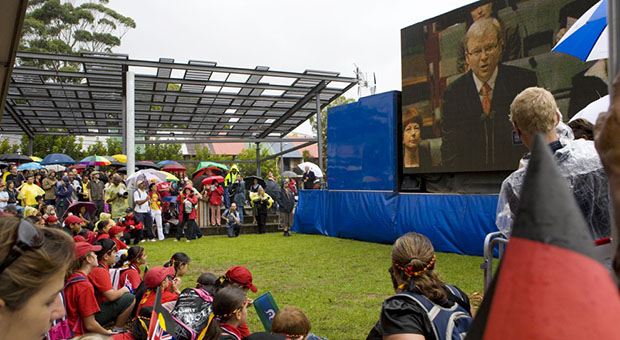
That said, in 2008 all my work colleagues and I did walk down to The Block together to experience a bigger moment in history than my art projects could generate. It was a moment, I recall, that gave us a chance to cut through the static.
We went there, as part of the open invitation of the AHC, to watch Kevin Rudd’s ‘Sorry’ speech on a big screen. In terms of flash points and historical places in urban Australia, steeped in relevant significance, there are probably few more telling than where we got to stand to be part of that moment.
For me at least, looking around at the location and community I was actively trying to be a part of through my art and politics, I recall thinking, “I wonder whether the non-Indigenous people here are going to take this as an opportunity for absolution, or this moment as the spark of inspiration to get involved in the long-term change that can come of it?”
Certainly, we were all standing there with that choice to consider, in the wake of the preceding decade’s strategies of deliberate inaction to avoid thinking anything about the needs of Indigenous Australia.
All we’d heard for twelve years were the protestations of John Howard that “The past was terrible, but if we weren’t there committing crimes why should we apologise?”.
It was a flat-footed refusal that threw a shroud over empathy and effort, and achieved its aim of nothing being done to break down those invisible lines (like the one splitting the street we had just crossed) on a national scale in policy and on a micro-scale in our individual hearts.
Howard talked so the past injustices towards First Nations Australians would continue unchanged. In his worldview, there is no need for self-reflection, for questioning whether our present levels of personal responsibility actively contribute to the injustices some people complain about, because those injustices happened way before we were around. By craft, logical extension creates absurdity. If you’re going to buy into an argument that we should deal with the “sins of the father”, where does that start and end over the history of humanity we are connected to? It’s all patently absurd, so it’s best not to go there. Better to deal with something we can control. Let’s say… franking credits.
But in 2008 we moved past that misdirection and stood side by side on The Block, as a leader facilitated something, talked about his own journey of listening, and showed the tears that came from that. A leader who talked without buying into the dichotomy of “You can feel bad or not feel bad. Which one do you want?” or by selling a form of medieval indulgences to cleanse us of sins.
I felt pride in that moment, not because I was freed of a burden I didn’t like carrying and now didn’t have to do anything more about it, but because I realised that the triumphs that feed into our national identity don’t just have to be cherry-pickings of sporting success; they can also include things such as collective pain and the drive to deal with that.
In the reflections I took away from that experience, I came to better define my pride in contrast to the one that is dominated by the ugly nationalism of exclusion, something that continues to plague our politics and our national soul.
You can absolutely love your country, its people, cultures and environment without being a jingoistic nationalist. We live in a truly marvellous time and we are given great scope with our freedoms, health and resources to dedicate energy and goodwill to seeing that those who have less get a chance, through the efforts of us giving people to redistribute the power in our possession.
This is a broadening of the general conventions we have come to accept though when asked what makes us proud to be Australians. Typically, when you ask someone what they love about this country you’ll hear about the great athletes, the cultural triumphs of artists and heroes, and our natural wonders. What you don’t get is a preparedness to have an ownership of shame in equal measure.
It’s ultimately convenient for us to trawl through the past achievements of others and claim that as our uniting identity, but at the same time not take any ownership for the wrongs too.
I’m not suggesting a balance would be to trot out a list of mistakes each time there is a conversation about celebrating identity. You’re never getting invited back. But if we’re going to truly digest what it means to be whole people in this country, and find a way to address things such as Indigenous marginalisation and general disrespect towards Aboriginal people, then we need to recognise in our Now, in a time of ongoing disenfranchisement of Aboriginal people, there remains a journey to take in the hearts of each non-Indigenous person who loves their country for the right reason.
A journey that contributes to the restoration of a balance and working out how we do that when the inequality seems so insurmountable; when non-Indigenous people who really care are the ones who feel we are opened up to being crushed by the weight of impossibility.
I continue to draw strength and motivation from the moment Kevin coordinated for us, for which we were all able to watch together as a nation as it unfolded, and which I got to do standing literally on the battleground for change in Redfern.
Then and now, his speech wasn’t just a speech for me, it was an example of completing one necessary stage in a journey that takes a lifetime. Before that day, Kevin hadn’t just been sitting around crafting some wonderfully evocative words, he had been travelling near and wide, seeking permission to sit, listen and talk with Aboriginal people.
He opened himself up to not only heartbreak but, impossibly, resilient joy and deadly humour still finding a way through a world of injustice.
The possibility I took was the revelation of how each of us can take that journey of love for our land, ourselves and others. A journey of love that involves, not least, the Indigenous people of this land whose historical and present cultures non-Indigenous people, like me, have the privilege to seek out and learn from.
Kevin’s speech showed that we do not need to circle the wagons around our hearts and protest about shared ownership of a shameful past and present. It’s there, man up, accept the good with the bad and show your love and courage by recognising that identity isn’t all about the good bits, but that the trust and respect you earn from laying yourself bare as a co-owner of a past and present makes up what you are as an Australian. Do that and you’ll find something more than guilt and shame.
You’ll hopefully find that your journey is not one of washing your hands of concerns and worries, will involve tears for the then and now, and will also be one that nourishes your desire to contribute what your heart prompts to the restoration of balance for Indigenous Australians.
Looking at Street View now of Eveleigh St, and seeing the fulfilment of the Pemulwuy Project that AHC was dedicated to realising as I sat with them, it’s a marvellous realisation of the path forward Kevin’s speech promised, as much as it was an acknowledgment of past wrongs.
I am proud I got to stand there with my colleagues and others on that cultural pivot, taking the past on board with pride, even if it hurt, because we can only be where we are today by accepting that being patriotic means owning the bad with the good and ever pushing forward for better.





This is super deep. The transitioning from nature to human behavior then distant and time speaks volume.
You just know how to play with words Joel
Beautifully written and deeply felt Joel. Your ability to traverse truth and light and darkness and possibility along with reflection and frankness was not only inspiring it was nourishing. Your continue work as an artivist for lack of better words is a gift to our country and I’m grateful for your service to support our collective and individual journey’s to move towards being whole — with one foot in the present, the other in the future and our hearts in the past. Thank you ❤️
Another wonderfully witty and deep article by Joel O’Connor. Definitely worth the read!