


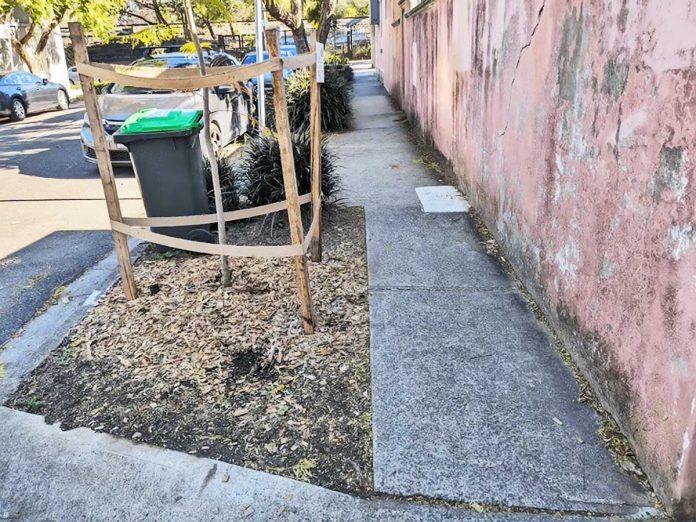
Have you noticed that many footpaths throughout South Sydney have been narrowed in recent years to make space for new garden beds? That some are now too narrow for a wheelchair, or for people to walk side by side or overtake? Not to mention the advertising signs, share bikes and parked cars blocking footpaths.
Greening our streets is welcome, of course. It cleans our air, provides cooling, and reduces flooding. But it needn’t compromise accessibility, which is a fundamental human right. About 80 per cent of a typical residential street is roadway, leaving only 20 per cent for footpaths. If garden beds were built out into roadways instead of in footpaths, accessibility could be maintained, and the resulting traffic calming would make our streets safer and quieter.
A particularly callous example of council’s footpath-narrowing agenda can be seen in Bridge and Ashmore streets in Erskineville. These connect fast-growing residential areas with Erskineville’s station, schools and shops.
While the NSW government recently spent about $20 million on accessibility upgrades for the station, the council has been busy making the surrounding footpaths inaccessible – narrowing them to as little as 70cm in places. A wheelchair needs 85cm and council’s own accessibility guidelines stipulate a minimum width of 180cm (allowing two wheelchairs/prams to pass).
In a breach of its own Community Engagement Guidelines, council staff did not consult the community before undertaking these works.
In response to community anger over the footpath narrowing, the Lord Mayor and council staff attended an on-site community meeting earlier this year. They saw how the narrowed footpaths were forcing commuters and schoolchildren to share the roadway with traffic.
They agreed to investigate options to make it safer for people to walk on the roadway, and to create a few short passing bays on the footpaths. But they refused to reinstate the footpaths to the minimum width. They also confirmed they would continue to narrow footpaths across City of Sydney without consultation.
Intentionally degrading access for people with disability is unlawful under Australia’s Disability Discrimination Act. That’s why I’ve referred the council to the Australian Human Rights Commission.
_______________
Dr Chris Standen is a research fellow in urban development and health at the University of NSW.





Curious would u like to do an article on housing forcing people to live in mould and trying to get away with coverups and dodgy works in order to do so DR standen??