This article is sponsored by the University of Sydney. Authorised by Vice-Chancellor and President Prof. Mark Scott. Enquiries: 9351 2000; info.centre@sydney.edu.au
_________________________________________________________________
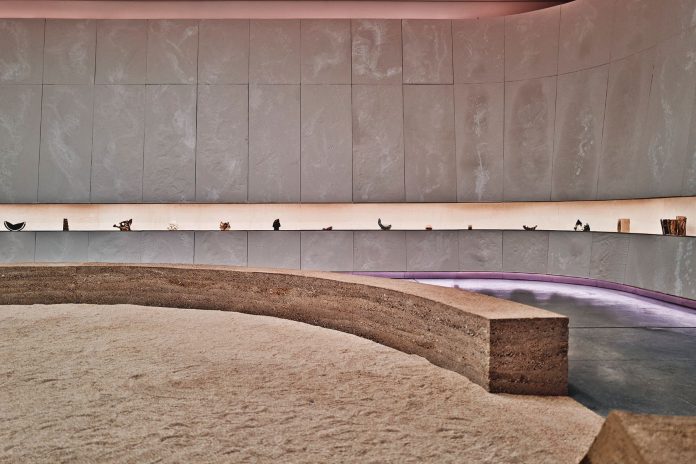
The University of Sydney is proud to be the Exhibition Partner at the 2025 Venice Architecture Biennale, where students from the School of Architecture, Design and Planning are currently exhibiting work in the Australia Pavilion.
The international stage of the Biennale now hosts HOME: Country as Creative Process, a landmark exhibition exploring the concept of belonging through the eyes of 125 students from 11 Australian universities. At the heart of this cross-university initiative are the University of Sydney’s very own students, who are not only exhibiting their work but also actively shaping global conversations around home, culture and identity.
Led by Dr Michael Mossman and Elle Davidson from the University of Sydney’s School of Architecture, Design and Planning, the project has offered students a once-in-a-lifetime opportunity to contribute to one of the world’s most prestigious architecture events.
So, what does home look like to a student today? For First Nations Bachelor of Architecture and Environments student Cilicia Christy, it’s a living, evolving concept. Her work, now on display in Venice, uses weaving and natural materials – maireener shells, seed pods and plant fibres – to explore her Palawa and Ngāti Kahungunu heritage. “Home is something we carry, shape, and keep building over time,” said Cilicia. “Weaving has become a meaningful way for me to reconnect with my culture and reflect on the art of where I come from.”
Fellow University of Sydney student Candace Dinkha, a first-generation Australian, explored the role of language and memory in defining home. Her piece, also selected for exhibition, honours the cultural thread carried through the Assyrian language – often in non-verbal ways. “My work examines how language lives on through gestures, rituals, and domestic labours. It’s a tapestry of shared experience, passed down by the women in my life,” she said.
As Exhibition Partner, the University of Sydney has played a central role in not only curating the Australia Pavilion but in shaping an educational experience that goes beyond the classroom. Over months of workshops, cultural immersion and collaborative making, students engaged deeply with the concept of Living Belongings – physical expressions of personal and cultural connections to place. Each piece reflects the maker’s story, identity, and ties to Country or heritage.
Dr Mossman, who is also the Creative Director of the Australia Pavilion exhibition, said involving students in this global event was integral to the project’s vision. “We wanted students to be at the heart of HOME. The Biennale offers them an unparalleled opportunity to connect with international audiences and contribute meaningfully to the architectural discourse on culture and identity.”
The collaboration also deepened students’ understanding of Indigenous knowledge systems, emphasising learning through making, place-based research, and storytelling through materials.
“Creating this unit of study across 11 universities required careful coordination, but it built a truly special learning community,” said Dr Mossman. “Students embraced Indigenous ways of knowing, which shaped a powerful and shared experience of belonging.”
Running from May to November 2025, HOME: Country as Creative Process invites thousands of international visitors to reflect on the diverse meanings of home. The student contributions from the University of Sydney form a core part of this rich, layered exhibition – offering personal narratives that transcend borders.
As Exhibition Partner, the University of Sydney is proud to champion student creativity, amplify First Nations perspectives, and foster cross-cultural learning on one of architecture’s most important global platforms.