


The Wall. The tariffs. The kidnapping. Greenland. And now, the assassination of a foreign leader. Donald Trump appears increasingly unrestrained – unshackled from convention, untempered by advisers, unchained from the normal guardrails of governance.
For many watching from afar, the question is no longer whether the world is destabilising, but how far we are from the brink. World War III no longer feels like dystopian fiction but like a headline waiting to be printed.
Only days ago, Volodymyr Zelensky told the BBC: “Putin has started World War III.” If that is so, then Trump is now pulling up a chair at the same table.
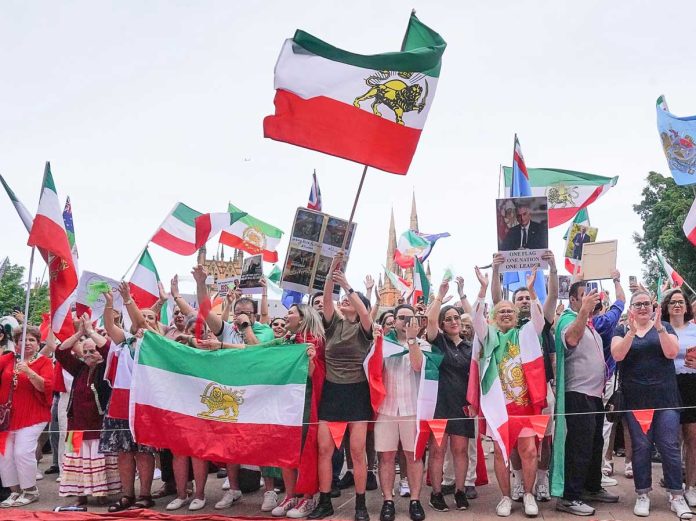
The assassination and subsequent attack were met with celebrations by the local Iranian community in Hyde Park on Sunday 1 March. Meanwhile in Melbourne, there were anti-Israel protesters chanting “death to the IDF”.
But why now? We were told last year that Iran’s bunkers had been neutralised, that nothing remained. So why escalate now?
We reached out to David Smith, associate professor of American politics and foreign policy at the University of Sydney, to try and gain some perspective.
He explains, “Trump was threatening to attack Iran during the protests in December and January, but there are reports he was dissuaded back then by both Israel and Arab states. Israel wanted more time for military preparation, as did many of Trump’s advisers in the US. American media is suggesting that when intelligence reports showed there would be a large gathering of Iranian leaders at Ayatollah Khamenei’s compound on Saturday morning, Trump and others decided they should take advantage of that to launch a ‘decapitation’ strike.”
A pre-emptive decapitation strike is a tactic associated with Israeli military doctrine, used effectively in the 1967 Six-Day War, the 1981 strike on Iraq’s nuclear reactor, and the 2007 destruction of Syria’s suspected nuclear facility, among others. The logic is brutal but simple: remove the head, and the body falters.
But was it regime change or something else? In the hours after the attack, Trump was urging Iranians to rise up and seize control of the government. That, however, already appears unrealistic. Smith continues: “It’s often hard to follow Trump’s exact reasoning because it changes so much. In the hours after the attack, it was all about regime change. Now he’s talking about ending Iran’s nuclear program and severely limiting its military capabilities. And then there are suggestions he would like a Venezuela-style situation, where someone else from the regime takes over, but is more willing to cooperate with the US. Again, not very realistic.”
Vladimir Putin quickly condemned the assassination as “a preplanned and unprovoked act of armed aggression against a sovereign state.” The irony is unmistakable. Smith believes Putin’s condemnation is designed to emphasise what Moscow calls Western hypocrisy over Ukraine.
This attack on Iran also creates a convenient precedent for Xi Jinping, who may now argue that great powers act first and justify later. Numerous analysts have warned that sustained U.S. operations in Iran could deplete critical ammunition stockpiles, potentially limiting America’s capacity to defend Taiwan in the event of a Chinese invasion.
For decades, the United States has been regarded as the world’s police force. That perception is shifting. Dr Emily Crawford, professor of international law at the University of Sydney, argues: “The US now has a diminished role to play in world security due to the policies of the Trump administration. Increasingly, middle powers are starting to pivot away from the US, given the destabilising impact of recent decisions in Venezuela and Iran, and the hyperbole around Greenland.”
Surely Trump is now as reckless as Putin?
Crawford responds, “I think US presidents have always utilised the tools of office to eliminate people they see as threats. It’s just that Trump is more blatant and openly unapologetic about it, which does bring him closer to Putin. The difference is Putin tends to not own these acts and prefers to disguise them as accidents or poisonings.”
Two international principles are now under strain. Comity – the mutual respect between sovereign states – depends on restraint and recognition of sovereignty.
Perfidy, under international humanitarian law, refers to betraying protected status during armed conflict, such as feigning surrender or misuse of protected symbols.
If indirect peace talks were underway in Oman at the time of the strike, as reported by Al Jazeera, critics will argue this represents a profound breach of diplomatic good faith. Whether the assassination meets the strict legal definition of perfidy is debatable, but politically, the perception is corrosive.
There are two ways to interpret this moment: The world has just become significantly more dangerous, or Trump – volatile, ambitious, and seemingly unchained – has decided that the rules binding others do not bind him.
Perhaps both are true.




Thank you Deb for this comment. Agreed about Trump sadly…
Excellent overview – sadly I feel most of this is true and the world is much less stable place due to Trump’s unshackled misbehaviour.