


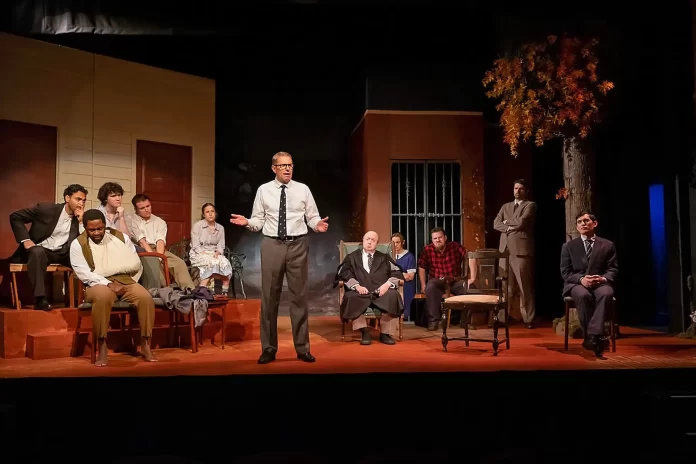
To Kill a Mockingbird
Adaptor: Christopher Sergel
Director: Theo Hatzistergos
Genesian Theatre, Rozelle
30 May 30 – 4 July , 2026
Harper Lee’s celebrated 1960 novel To Kill a Mockingbird, set in the fictional town of Maycomb in 1930s Alabama and faithfully adapted by Christopher Sergal, has come under some severe revisionist criticism. However, by drawing the audience into the stagnating world of Maycomb, director Theo Hatzistergos encourages reflection on the parallels between the harsh realities of prejudice, inequality and social injustice in the play and our own disturbed and disturbing times.
Basically a traditional coming-of-age story, the action is triggered by the appointment of lawyer Atticus Finch (Barry Nielson) to defend Tom Robinson (Ibrahim Conteh), a black man, against the charge of the rape of Mayella Ewell (Courtney Miller), a white girl. Atticus’s teenage children, Jem (Reuben Hann) and Scout (Brigid Jeffries), begin to receive some flack at school and events that follow cause them both, especially Scout, to question the values of reason and empathy she has learned from Atticus.
Her innocence is at the heart of the play. When her father is confronted by a mob intending to kill the imprisoned Tom, one of the men is recognised by a bewildered Scout as Mr Cunningham, who previously brought a bag of winter greens to the Finch household to honour a debt. Innocently, she presses him to acknowledge her, and her insistence forces him to acknowledge himself and feel ashamed. At issue is whether Scout will lose her cheerful hopefulness, the symbolic song of the mockingbird, after she witnesses her father and truth defeated in the courtroom.
Scout is given support by wise neighbour Miss Maudie Atkinson (Sarah Marie Stubley), who holds similar values to Atticus. Important to the play in her role as narrator, giving unity to what otherwise would be fragmentary, Maudie’s reflections on life in Maycomb bring some of the warmth of feeling that gives Lee’s novel its charm. Her character is possibly a foreshadowing of a future Scout, or Jean-Louise, as Scout becomes at the close: observant, witty, sometimes sharpish, able to see both the positive and negative sides of Maycomb, and of the world in general. If so, Atticus is not defeated.
Initially, the thoughtful staging, costuming and not always consistent Southern accents make it seem as if we are watching a period piece and congratulate ourselves on living in a more enlightened time. However, strategies like having the actors often enter and exit from the auditorium, and the use of overhead vocal responses, create the impression that the audience are implicated in the action. Gradually, the parallels between our own world, riven as it is by racial prejudice, mental health problems, a hardening of class lines and legal justice being the prerogative of the rich, emerge. We are placed in the position of the young Scout, coming to understand that the way of life we thought of as decent and fair is, in reality, neither.





Brendan Layton is outstanding, he projects clearly and commands the stage space in his role. Would like to see him in more stage productions.