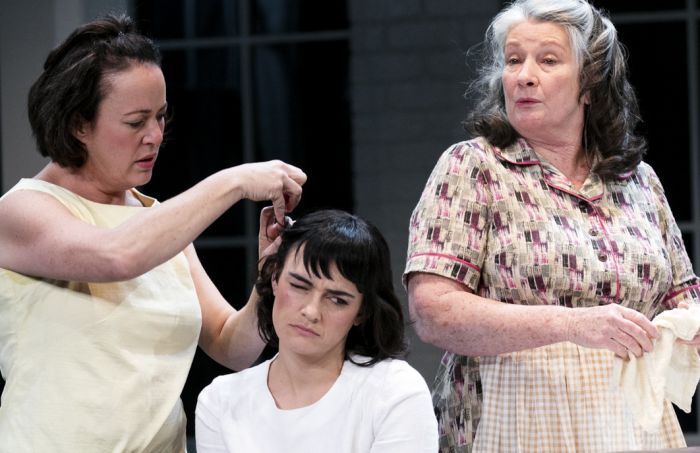
Venue: The Belvoir Theatre, Surry Hills
Written By: Alana Valentine
Directed By: Sarah Goodes
The Belvoir’s choice of Alana Valentine’s The Sugar House, set in the once working-class industrial and port community of Pyrmont, is timely in view of the gentrification of the nearby locality of Redfern-Waterloo. While change is inevitable, Valentine reminds us that the new middle-class Australian city needs to establish more than a cosmetic connection with its old working-class past.
Beginning in the present when renovated history (so beautifully conveyed by the minimalist former factory setting) is a popular apartment choice, we are quickly introduced to the conflict between change and tradition. Real estate agent Prin (Nikki Shiels) has all the right phrases but no factual knowledge of the former Colonial Sugar Refinery she is selling, telling prospective buyer Narelle (Sheridan Harbridge) that “it was a pretty scungy area but they’ve cleaned it up. Changed the character of the place.” Narelle reacts to Prin’s airy assumption of the worthlessness of an historically important area, and so do we.
Valentine does not romanticise the past, and in a clever segue, we move from redevelopment chic to the factory floor with its deafening noise and unhygienic conditions. Narelle is now an eight-year-old hanging out with her poppa (Lex Marinos), a fitter and turner at CSR, badgering him with precocious questions as she reads from a newspaper about the execution of Robert Ryan. The remark that Ryan has “bad blood” – the belief that criminality is genetic – unsettles Narelle, and when we meet her nanna (a powerhouse Kris McQuade) it is apparent she believes the law can be used to criminalise the poor.
Both issues are important to the play as a whole. Nanna, June Macreadie, although a strong woman holding together a troubled family and determined to forge a better life for the future, is haunted by her past. She finally comes “clean” with Narelle (and the audience) admitting that her brothers joined a razor gang to get “easy money” because they had seen how work on the wharf physically penalised their father. The second generation, her children, repeat the pattern but in a more subdued manner: her son, the cheerful but irresponsible Ollie (Josh McConville) going to jail for minor crimes, and her emotionally neglected daughter Margo (Sacha Horler) settling for an unrewarding marriage that only reinforces her lack of self-worth. June’s hopes now rest on her granddaughter, “the sugar in her tea”.
When Narelle tells June that the other kids at school say she is full of dirty blood, June is swift to counter the myth. There is “no bad blood”, she says, only “bad decisions”, nevertheless she urges Narelle to “get educated and sophisticated” so that she can “get up and out of here”. When Narelle does go to university, Margo is worried that “she will never just fit” and accuses June of being scared that Narelle’s “new-found middle-class life will just be a thin layer of topsoil over her ugly, ignorant, bad-blood life” and easily blown away. She questions, as Narelle is to do later, why someone from “here” has to be “polished” or refined (like white sugar) before their memories or sense of belonging are considered worthwhile.
Narelle does rebel against her destiny, and after Ollie has bounced her, June has administered her own kind of shock treatment and Margo plays her sad trump card, Narelle finishes her degree and takes an internship. While in her rebellious phase, and in a very funny scene, Narelle has sugar cubes tattooed on her backside, in private acknowledgement of the past’s indelibility. However, as a barrister, and working within the system, she can protect her Uncle Ollie from losing his job, defend those whom the law despises and enlighten the redevelopers about the importance of the past. She can do more than rant, the favoured mode of her family, her class. Narelle is June’s legacy, and she will reclaim the past but freed from its burdens.
The director, Sarah Goodes, has done justice to the complexities of The Sugar House (and much time could be spent in unpacking its metaphors, for instance, the unconnected plumbing, the bees, the processing of sugar) and found a perfect balance between the play’s personal and political concerns. The actors are excellent, and while McQuade is a powerful and unforgettable figure, the sad Horler and the conflicted Harbridge are equally memorable. McConville makes a very likable Ollie (and Zee, the tattooist) and Shiels is lovely as the ditzy girlfriend who becomes a centre of calm in a volatile household. Marinos is remarkable, endowing his several roles with a particular personality.
In addition to the clever set (Michael Hankin), both highlighting the Belvoir’s industrial origins and permitting the swift creation of many different locations, the well-chosen costumes (Emma Vine), the use of soundscapes (Michael Toisuta) and the inclusion of songs (words, Valentine, music, Steve Francis) make this a very engaging production. There is not a second in Valentine’s The Sugar House in which the audience is not listening, looking wide-eyed, laughing or grieving.