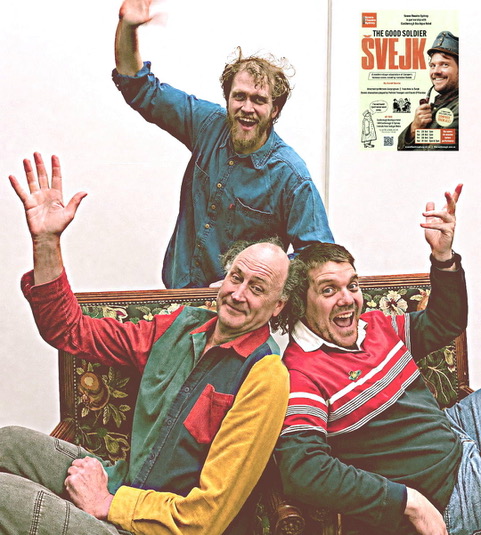
The Good Soldier Švejk
Writer: adapted by Carol Dance
Director: Michele Conyngham
Castlereagh Boutique Hotel, Sydney
October 23 – October 31, 2026
The novel, The Good Soldier Švejk, by Jaroslav Hašek and published in 1923, stemmed from a compilation of short satirical Švejk stories that appeared in a Czech newspaper.
The stories detail Švejk’s adventures as a soldier in World War 1, revealing the comedic situations that arise from his penchant for obeying orders to the letter, exposing and subverting the world gone mad around him.
With so many hilarious stories to choose from, adaptor Carol Dance has succeeded admirably in crafting an entertaining 90-minute production, which Michele Conyngham must have found delightfully rewarding to direct. It certainly shows in the results.
The character Švejk is so beloved that many statues of him exist in Eastern Europe. The appeal is understandable. Despite the series of bizarre adventures he experiences as a recruit in the Austro-Hungarian army, his smile never falters, and his determination to serve is unwavering. European readers warmed to his everyman resilience. As a slightly shady Prague dog dealer he is not exactly top drawer socially, but he is cheerful, unshakeable, unpredictable, seemingly simple, but above all, he survives.
Theo Rule creates a wonderfully relatable and hilarious Švejk. While a range of authority figures try to bring him to heel, in the most breathtakingly absurd situations, he continues smiling with equanimity. He is brilliantly supported by fellow cast members Patrick Trumper (Mrs Muller, Palivec, Reverend Katz and others) and Ciarán O’Riordan (Bretshneider, Dr Grunstein, Lieutenant Lukash and others).
We first meet Švejk, happily romping with his dog (played with canine enthusiasm by Ciarán O’Riordan). News of the assassination of the Archduke of Austria motivates Švejk to sign up for military service but after making some politically insensitive remarks, he is arrested and sent to an insane asylum. Here he is questioned by a doctor who sounds certifiable himself; eventually he becomes a batman to Lieutenant Lukash and is at last headed for the front, but wherever he ends up he leaves chaos in his wake. And his smile never wavers. His seeming simple-mindedness begs the question — is he really an imbecile, or is he just craftily undermining the war effort?
Jaroslav Hašek may have had first-hand experience of the war as a soldier himself; at other times he was also an anarchist, a Bolshevik, an itinerant, but mostly a writer. Mainly his story emphasises anti-war themes, exploring the futility of conflict in general.
The show closes with a medley of nostalgic songs of young men yearning for their loved ones — “Lili Marlene”, “It’s a Long Way to Tipperary” and “We’ll Meet Again” — a poignant finale as, due to the horrors of war, many would never return home again.