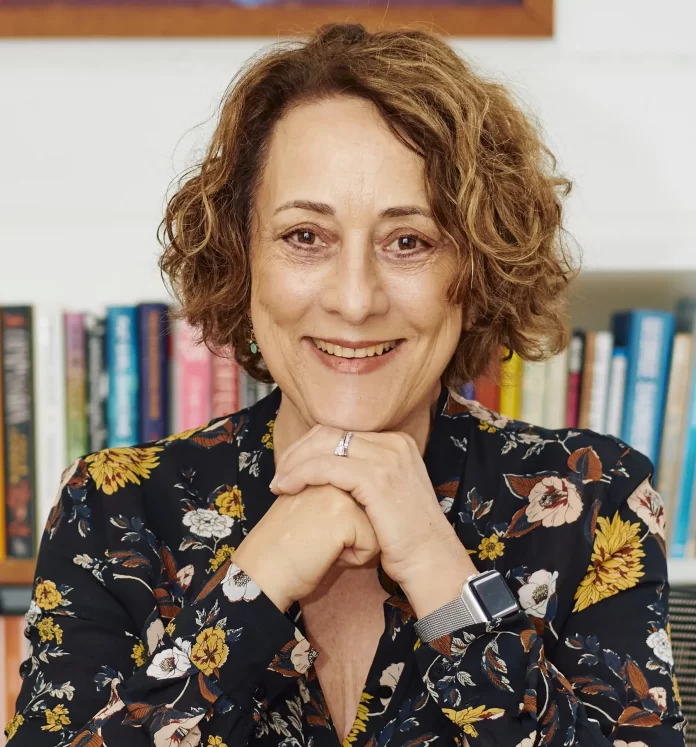
Raven Mother is a thought-provoking and moving account of navigating family stories in the face of wider, complex historial events. Set across multiple time periods and world events, from pre-war Berlin to Tel Aviv and present-day Melbourne, Jane Messer seeks to retrace not only her own family’s experiences, but also the journeys of thousands of Jewish and Palestinian families.
In the book’s opening, Jane explains that Raven Mother gets its name from an “old German expression for a mother who is harsh and who abandons her children.” For much of her life, this is the image she had of her grandmother, Bella. In conversations, Jane’s father, Michael, would describe the abandonment he experienced after Bella had left him in pre-war England in the care of total strangers. Curious about the past, Jane always had an inkling that there was more to the story than what her father had told her.
Raven Mother began as a quest to explore Bella’s life and the decisions she made during a time of constant upheaval. But with Jane’s expertise as a writer and researcher, it has become a wider exploration of estrangement, Jewish identity and untold stories.
In the lead-up to the Sydney Writers’ Festival, Jane Messer spoke with Holly Haisman about the themes she explores in the book as well as the rigorous process of writing a memoir.
Was it your intention to write a father-daughter story or did that come about through the process of writing?
“It wasn’t my intention at all. It began with me wanting to find out more about my grandmother and the stories I’d grown up with. My mum and dad talked at the dinner table and my dad would tell stories about his childhood, which I’ve only now realised he needed to share. I was really lucky that he did want to talk about his past with us.
“Very quickly, once I started doing more research, I realised the project was going to be bigger than an essay. I had no idea what form the book would take and I think that’s probably what makes the best memoir writing work. The writing changes you. As you reflect, put things down on the page, ask yourself questions and bring in voices that don’t necessarily agree with yours, you really change as a writer.
“Once I started to get an idea of [Bella], I realised there were different ways of seeing what had happened. Then it became a father-daughter story, when really what I was trying to show my dad was that he had been loved, even if he couldn’t remember it, even if he couldn’t feel it.”
Was there a particular moment in your life when you wanted to know more? Has it always been there?
“I’d say in the beginning, I didn’t want to know more. It’s part of me, and I think it’s not uncommon. I associated that Jewish part of my history and the family story with some kind of failure. Who wants to be part of a group that no one liked? I think as I’ve gotten older and I’ve become more compassionate and empathic, and less self-centred as you often are as a young person, I became more interested.
“Those feelings deepened once I became a mother myself and was madly in love with my daughter. After that, both my son and I developed an increasing interest in the research I was doing. My academic focus shifted toward narratives about work and narratives about women and work.
“Then I started to become more interested in migration, refugees and war. We had the Tampa Affair. The Liberal government was accusing refugees – who were trying to make it to Christmas Island – of intentionally throwing their children overboard to draw the rescue boat in to save them. To me, it was realising that women and men (but mothers were my big focus) have to make really hard decisions during war; about who will be saved, who will be fed, who will be put on a boat and hopefully sent somewhere safer than where you are. I started to see Bella as part of a big eons-long history of women making decisions during wartime.”
Did you have any written documentation of Bella’s life, or were you mostly relying on photographs?
“We had a few letters, I had her passport, her address book. I’ve got some letters where she’s talked about briefly by another relative. I had my aunt Ruth’s memoir, which was not as long as I would have liked but was pretty informative about aspects of Bella’s life. I interviewed a couple of people who had either known Dad or had known [Bella] in Melbourne. They knew my father when Bella was alive and could kind of remember him a little when he was very young. Luckily, I interviewed all these people early on because I was aware that they were all getting old.
“The rest of the research was reading. Then I started to realise I have the story of a life.”
I thought that your descriptions of pre-war Berlin were very vivid and detailed. Was it a hard process, combining your own family history whilst researching these wider historical events? How did you go about it?
“It takes a lot of detective work and a lot of reading to frame these tiny, personal clues that I had. I wrote about Berlin in various ways, and it was quite hard because to understand the context, you needed to see that Berlin politically was a time of violence and conflict and extremes. There was incredible poverty but also moments of wealth. It was a lot of rewriting and trying a lot of different ways and working out how to bring myself in. I lived twice in Berlin, for two consecutive years, but for the sake of the story, I collapsed that into one.”
You mention in the book that while you were in Berlin, you felt as if you were living in “two different time frames.” Is this something you wanted to include in the book, the link between the past while writing Raven Mother in the present?
“I think people can be informed about what Berlin was like through other means and other Jewish or non-Jewish stories and history. What makes my book special is: what do I make of that now? What makes it relevant now in terms of what Berlin was like then and what is it like now? That’s what I think becomes interesting. How does it affect me now and what would I like to say about it? Just as going to Israel and my encounters with people and places. I think ultimately that’s what makes me really proud of the book.”
During the research process, you went on three separate trips to Israel. What was that process like? How did you learn to engage with so many different perspectives and histories in your research and writing?
“The first visit was a discovery, as I’d never been there before; I have two cousins who live there. I knew it was a very special place for many Jewish people I had known from Australia, who had worked on a kibbutz. I just got a sense of the place and I liked it a lot; even though I didn’t speak Hebrew, I looked at the people around me and so many of them looked like me.”
“The second visit was more focused; I worked with a different research assistant. We went to the archives and the Hebrew University, so that was more of a research trip.
“On the third visit, I thought very consciously: ‘I want to know the Palestinian story.’ I had started to become aware of it during my second visit. I went home, did more reading and realised, ‘if I read a Jewish history of Palestine and Israel, they erase the history of Palestinians.’ Because I was a trained researcher, I knew I had to sort this out.
“The research got very tricky because I was translating from Arabic and Hebrew maps or working with English, Israeli and Palestinian history and there were always things missing. What I was trying to do was understand. Why are you afraid? Why do you hate the other? What’s the history? Every racism has its own history that we need to pay attention to and once we understand individual histories, maybe then we can find a way to a more peaceful future.
“I did not start the book with these sorts of ideas, the book has made me into a different person.”
I am also Jewish and grew up with grandparents who had similar war stories. I often wonder: how can we start our own family conversations?
“Somebody asked me how to have these conversations and I think, looking back, they started quite tentatively. I didn’t just say, ‘Tell me your whole life’; it was more like, ‘Oh, what happened here?’ I did a lot of audio recordings and kept a chronology in an Excel spreadsheet. I put in significant dates for Dad and his family as well as significant world events in Europe then looked at how they interacted, how the big event cast meaning onto the family and the individual experience. I think it’s important to start earlier rather than later so you have the time for conversations.
“As you get to know more things yourself as the interviewer, you can ask a new question but often it takes a while to even think of that other way of asking the same question, which brings out a new memory. With your grandparents, sometimes it’s best to start with little questions. If the conversation ends after 15 minutes, it doesn’t matter. Come back to it again later. It doesn’t have to be the ‘big interview’.”
How has writing the memoir helped you to position yourself in relation to your own history and the present time we are living in?
“It has affected me because the war continues and people keep dying, it’s just a grief and a fear that I wake up with every day now. I’m a writer, I can talk and I will focus on depth of conversation over frequency. If I only produce one or two things but they have value, that is more important than dropping posts. In a book, you have the space, you have the time and you have the reader’s attention so what I was trying to do was to reflect but also to comment: there are facets to it, and literature gives you the opportunity to explore those facets.”
Jane Messer is the author of Raven Mother (2026, UNSW Press). As part of the Sydney Writers’ Festival, Jane will be giving an author talk at Margaret Martin Library in Randwick on 24 May 2026.