


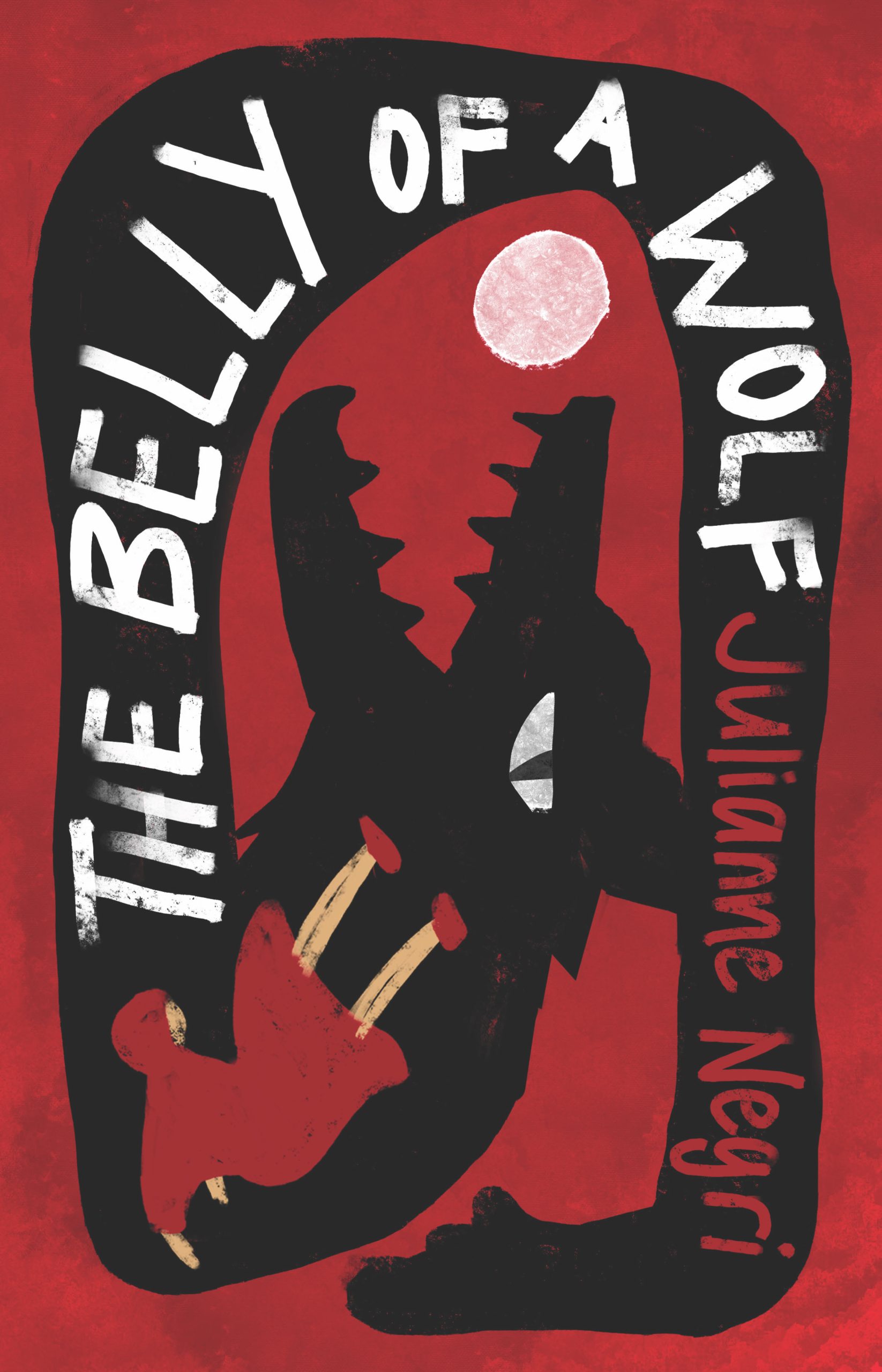
The Belly of a Wolf is a moving verse novel written by award-winning Australian writer Julianne Negri. The novel follows our protagonist, Red, as she navigates life after the death of her best friend Wolf due to suicide. While The Belly of a Wolf is predominantly set in high school and is classified as a young adult novel, I think it’s one that adults can enjoy and learn from all the same.
Negri’s use of the poetic genre works incredibly well for the subject matter, as the fragmented structure reflects the non-linear nature of grief. I was lucky enough to ask Negri about her choice of poetry, and she said she “used old diaries and letters” from her teenage experience of grief, which helped inform Red’s journey in the novel. The fragments also jump between times, peeling back the layers of Red and Wolf’s relationship over a ten-year span from childhood to the present, from adolescence to adulthood. Within the first few poems, readers find out that Red and Wolf’s names were coined when they did a production of Red Riding Hood, which was the catalyst for their friendship. These names simultaneously act as a metaphor for Red’s grief, as Wolf lured Red into a friendship that eventually leads her into darkness after Wolf’s death.
The Belly of a Wolf uses incredibly vivid imagery, painting a clear setting that blends biographical elements from Negri’s life. She stated that she “wanted to communicate the way landscape permeates identity”, and her connection to the story is beautifully evident throughout, making the novel’s impact even more emotional and inspiring for readers.
One of my favourite parts of the novel was Red’s journey with music as a coping mechanism and relief from her sadness. Red meets a new friend through music and discovers the magic of piano, which I appreciated and related to as a fellow pianist. Negri’s musical experience shines through here and encourages readers to find their own way of self-expression, as grief is something that needs to be explored in order to move forward.
Overall, this novel is a tragic, but beautiful tale of friendship, loss, and identity. It is an honest and respectful depiction of grief and raises awareness for youth suicide, a topic that is lacking representation within media.
The Belly of a Wolf
Julianne Negri
UWA Publishing, 2026
After reading The Belly of a Wolf, Julianne was kind enough to answer some questions I had about her writing process. As an aspiring writer myself, her responses were so insightful and I’m very grateful for the time and consideration she put into each question.
I thoroughly enjoyed the novel, but the experience of reading it was emotionally tough. What was the process of writing The Belly of a Wolf like for you? Was it hard to push through?
I can guarantee the experience of writing it was emotionally tougher than reading it! To write authentically required plunging into the depths of my own teenage experience. This book is fictional but based on what happened to me and my best friend when I was fifteen. The thing with trauma is that your brain doesn’t understand time and is snagged on these moments so it reexperiences them as if you are there. It was hard. A few times I wanted to give up. One time I did give up – even told the publisher I wanted to get out of the contract! I’ve learnt that while writing about difficult experiences can be cathartic, getting the work ready to be shared with a wider audience and to a publishable standard can be re-traumatising. Both emotionally and in terms of writing craft, this is the hardest thing I have done. What I realise now that the book is out there, is that emotional truth comes through and readers like you are responding to that authenticity.
What drew you into verse novels rather than traditional fiction? I found that the more fragmented structure was a nice way of mirroring the grieving process, was that intentional?
The poems about grief bubbled up inside me. I wrote the fragments down on scraps of paper. Over time I had quite a few. When I saw other people experiencing the complicated grief around suicide, I realised I could throw light on it and perhaps raise awareness. When it came to building a narrative around the short poems, I didn’t want to stay in the traumatised space for sustained periods, so the verse novel structure was a way to deal with that while still packing an emotional punch. I also used old diaries and letters from that time and used things I had written at fifteen or sixteen years old. I think the fragmented structure also reflects the push and pull/climb and fall that the main character Red struggles with. Grief isn’t a linear experience. The challenge was to create a forwardmoving narrative for the reader to be compelled to keep reading while still having this structure.
Did the novel begin as an adaptation of Red Riding Hood, or was that a later addition?
The incorporation of Red Riding Hood did come as a late addition. I wanted to capture being 15/16 years old, where all you have behind you is childhood and the cultural references of childhood – the stories/school/games. And how it’s through these references you interpret the world. At first I used a classic picture book to convey this, but I wasn’t given permission to use it. Even though that felt like a disaster at the time, it turned out to be a good thing. When I replaced it with Red Riding Hood, I was able to draw out symbolism that resonated better with the story and felt more true to my experience.
Why did you choose to use nicknames for the majority of characters, rather than assigning them full names?
To be honest, I’m not sure. It was instinctive. I think it sits well with names in fairytales and archetypal characters – Grandma, the Woodcutter etc. Perhaps it was also because I was in that teen headspace too. It reflects high school and small town attitudes where we are often labelled as ‘the jock’ ‘the prom queen’ ‘the weirdo’ ‘the goth’ – all those ways we stereotype each other. It is part of the reduction of existence that Red and Wolf find so stifling and want to escape from.
The imagery in all of the poems was so vivid, but especially in Wide Open Road. Were any of these scenes or settings biographical?
Most of the settings are biographical, especially the bush settings. The poem you mention is about the school bus ride from my small country town to the larger town where we went to high school. I have travelled that road so many times. I can see it so clearly in my mind. I wanted to communicate the way landscape permeates identity. How the thoughts and ideas we have while in these places seep into who we are. How they become landmarks in our memory and in our personality. Wide Open Road seemed like the perfect song for being on the cusp of growing up with a boundless mind while also still restricted by a small town school bus, a single road bus route and high school timetable.
I loved the way you titled your poems after songs, and I found myself researching the ones I hadn’t heard of to see if the lyrics matched the respective content. What inspired you to title the chapters this way? Was it to reflect the musical discovery that Red experiences with Music Girl?
I’m so glad you loved that! At first, the song titles were my own code. I had a playlist that accompanied me and helped me feel less upset while writing. Listening to the songs was a way of sucking me into the emotion of each poem as I was working on it but also a way for me to glance away from my own emotion. I know that probably doesn’t make sense! That it could be both drawing me in and holding me away. I guess it was an added structure around the story. Something I could grasp onto that was outside of myself. It was in part, self-protection. Listening helped me feel better. I kept the titles in because it did reflect Red’s experiences with Music Girl and with Wolf. Building a culture of shared music and art and books is a way of building friendship. It also reflects Red’s realisation that through art – be it painting, music, writing – she finds expression of her grief and relief. There was a quote from the poet Carolyn Kizer that I had on my wall while I was writing: “Perhaps the only way to deal with sorrow is to find a form in which to contain it.” The song titles are an added layer that readers can pick up on if they wish.
I loved the last poem and the resolution of the novel. Did you have this ending in mind while writing or did the conclusion come to you at the end of your process?
The last poem came very late in the process. In the last draft. My editor, Kate O’Donnell, had been encouraging me to lift the ending and deliver some hope. When I rewrote the book with
Red Riding Hood references, the themes took the story in a different direction and informed the ending. Right at the end of the process, when I had been really immersed in the book, I wrote the third last poem, I’ll Be Your Mirror. The last poem kept bouncing around in my head until it coalesced together one morning and I rushed to get a pen and paper to get it down. Which is what is so brilliant about creativity – that you intuitively and unexpectedly uncover ideas. It felt like arriving at the destination you couldn’t find on a map. And it was also the perfect song title for that poem.
I’m currently studying poetry in my university course where we focus heavily on Australian poetry. Are there any particular Australian poets or verse novels that inspired you when writing The Belly of a Wolf?
That course sounds really interesting! The verse novels that I read and loved are Ruby Moonlight by Ali Cobby Eckerman and the extraordinary Catcher Teller Crow by Amberlin and Ezekial Kwaymullina. Both are by Indigenous Australian authors. Jeanine Leane is another Indigenous poet I love to read. Another excellent verse novel is The Poet X by US author Elizabeth Acevedo. There was a quote I used to underpin a section of the book by Australian poet Alan Jefferies and another poet I found inspiring was American poet Megan Falley. Dorothy Porter, Omar Sakr are other Australian poets I read but I’m afraid my education in poetry is pretty limited and I just explore and feel my way around the poetry space. Feel free to recommend some poets to me! Verse novels for young readers are having a moment in Australia. I can also recommend Little Bones by Sandy Bigna, The Foal in the Wire by Robbie Coburn and Birdy by Sharon Kernot.






Great review – I want to read the book!