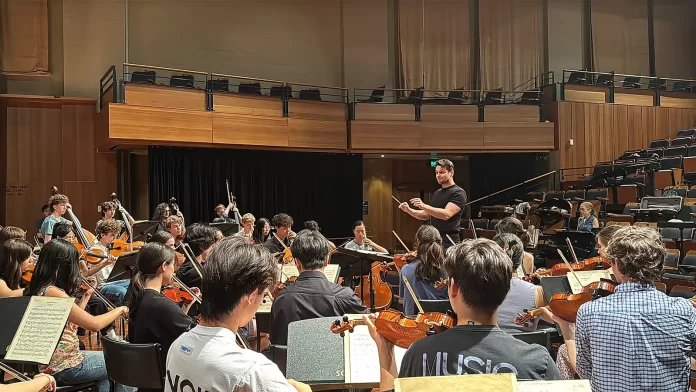
Students at the Sydney Conservatorium of Music are flocking to conducting studies, prompting the tertiary school to put on extra classes to meet demand.
Enrolments in the undergraduate conducting course have increased six-fold from 2019 to today.
In 2026, the Sydney Conservatorium of Music has also introduced a pathway for undergraduate students to complete an honours degree in conducting. This opens doors for the students to progress onto postgraduate studies in the profession.
“It is extraordinary and pleasantly surprising,” said Dr Elizabeth Scott, who is a lecturer in conducting and an acclaimed conductor in the music industry.
“The increased demand could be due to students wanting to increase their skills for the future. If they have the skills to conduct a school band, orchestra, choir or a musical theatre ensemble, it makes them more employable.
“Conducting is an exciting field of music, and it attracts leaders,” said Dr Scott.
Leadership is an important part of learning to be a conductor, said Professor Benjamin Northey, who joined the teaching staff at the Con in 2026.
Professor Northey is an in-demand Australian conductor who is currently Conductor in Residence of the Sydney Symphony Orchestra and tours regularly.
“It’s really good for your musicianship to stand up in front of a group of your peers and to be able to try and communicate your ideas, whether it be verbally, whether it be physically, with the technique of conducting,” he said.
“But also it connects you with the idea of yourself as a leader. We don’t train to be leaders, we just expect that leaders will emerge, and I think conducting is one of those things that really taps us into what it feels like to step into that leadership position.”
Third-year student Bea Chaston, from south-west Sydney, chose to take the conducting class because she knew it would be fun.
“Finding out that Liz Scott was our professor was amazing because I’m familiar with her conducting style and know first-hand that she is incredible at her job, plus she is a wonderful person so immediately the class promised to be very fulfilling,” Chaston said.
“Another reason I chose to take the conducting class is I’m a singer and a violinist, and you work with so many conductors and all their styles are different, with stylised beat patterns, conveying what they want from you in dynamics, phrasing and character and I wanted to find my own conducting style.
“It’s so interesting to see the differences between you and your classmates and you all learn from each other and build each other up! We laugh a lot and it is such a space of community because we all have our own reasons for doing the class.”
Chaston added that although it would be fun, she knew it wouldn’t be easy.
“When you’re learning everything that goes into preparing a work, the background research, preparation for a practice, overall knowledge of the ensembles and instruments, the list goes on and it really puts into perspective how much goes into being a great conductor,” she said.