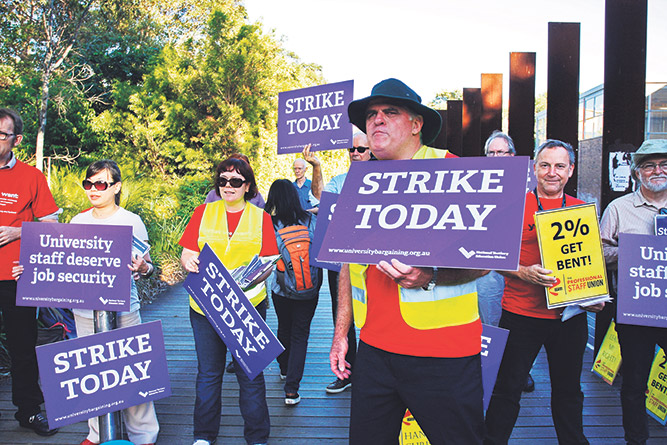
The dispute is over the new Enterprise Bargaining Agreement (EBA) between the National Tertiary Education Union (NTEU) and university management. The two parties have met several times since last August. NTEU Branch President, Michael Thompson, said: “Management still wants to slash our conditions, attack the quality of education and increase its power to undertake changes, like the job cuts in 2011-2012.”
The union is pushing for a 7 per cent per annum pay rise and greater job security at all Australian universities. University of Sydney management claims it cannot afford the pay rise. Union supporters point out that the university produced a $93 million surplus last year.
Management has offered a 2 per cent pay rise, and, according to the union, is attempting to abolish restrictions on overtime and all commitments to prevent discriminatory employment practices, to weaken Intellectual Freedom protections and remove restrictions on casualisation. The university executive, it is claimed, is using the EBA to force through a series of anti-union clauses – the removal of the NTEU as a party to the Agreement; removal of obligations requiring management to consult the union on university policies; removal of rights to challenge management decisions, hold members meetings and have a physical presence on campus.
A spokesperson for Vice-Chancellor Michael Spence says the union has been very selective in the way it has portrayed the issues. “What we have proposed is that the existing arrangements that provide free office space and resources and subsidised salaries for union officials be discontinued. These are costs to the University. Every other part of the University pays for office space and the use of facilities. It is only fair the unions do so too.”
According to the VC, staff will continue to have access to union officials on campus, and unions will continue to have the right to hold meetings on campus and have access to workplaces as provided for under the Fair Work Act. Unions will have the right to choose to be covered by the Agreement (and have all the rights that attach to coverage including enforcing the terms of the Agreement) as provided for in the Fair Work Act.
The proposed changes come after cuts to staff and courses in 2012. The union argues that as enrolments soar, student-staff ratios continue to rise, and conditions and the quality of education are deteriorating. Of particular concern is a perceived bias toward teaching-only positions on campus, at the expense of research. Staff at the university fear that if the union is destroyed, staff will have no voice and no way of protecting themselves against such actions in the future.
Rejecting the claim that the EBA threatens intellectual freedom, the VC said: “Academic freedom is at the core of all we do, but we don’t see it as a matter for an industrial agreement.”
However, following some staff concerns, the VC did write to all staff on February 20 this year, stating: “I am writing to let you know that, as I shared with the Academic Board this afternoon, I have decided to recommend to the Human Resources Committee of Senate that we amend the University’s draft Enterprise Agreement in relation to the removal of the clause about intellectual freedom. This change to the Agreement had only ever been proposed on the basis that the clause was redundant, the principle being thoroughly covered already by the Senate-endorsed Charter of Academic Freedom and relevant Board and University policies. Nevertheless, I accept that its removal from the draft Agreement has caused unnecessary anxiety and suspicion among some staff and for that I apologise. I am happy to agree that our next Enterprise Agreement will again contain a specific statement in support of intellectual freedom, a principle which, as a community, we must support at all costs.”
The spokesperson also addressed the issue of increased casualisation. Other universities may be increasing casualisation, the VC concedes, but not Sydney.
“The unions claim massive increases in casualisation of teaching over the last decade, with up to 40 percent of all teaching done by casuals. In fact, the percentage of casual academic staff at Sydney has declined steadily since 2001, from 24.7 percent of the academic workforce to 19.9 percent last year. Similar claims are made with respect to administrative and professional staff. The fact is that there has also been a decline, although a much smaller one, in the percentage of casual staff, from 14.9 percent of all professional and administrative staff in 2001 to 14.5 percent in 2012.”
In response to staff feedback and action, university management has made 18 changes to its original proposal, including proposing to maintain review committee provisions to protect staff and retaining the NTEU and CPSU (Community and Public Sector Union) as parties under the Agreement.