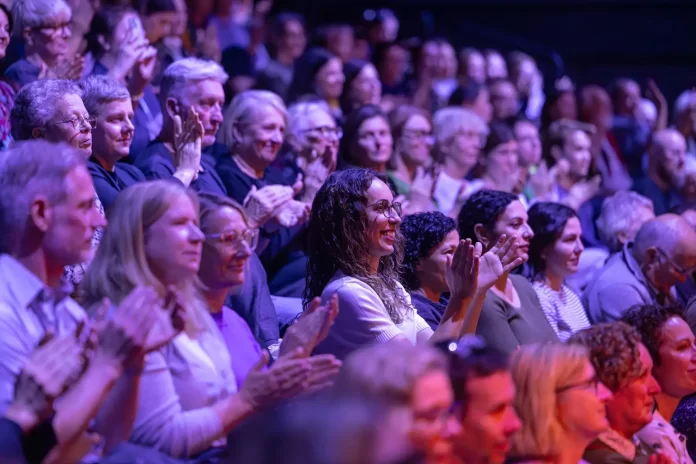
This year’s Sydney Writers’ Festival broke the record for sales and attendance. Over 100,000 people joined the events and workshops and bought books during the week-long gathering held at Carriageworks every May.
It certainly felt like there were more people and a greater sense of buzz and excitement this year. It could have been the unusually dreary Sydney weather, perhaps mimicking the gloomy world forecast, that brought so many people together. Or perhaps it was readers making their voices heard above the lament that “People are not reading anymore” by voting with their feet.
Over 250 writers and thinkers presented at over 200 events for the “southern hemisphere’s biggest literary festival”, according to the festival organisers.
This year’s theme was Show me the Truth. Many of the interviews, workshops and panels were guided by the underlying question: What is truth today? Philosopher A.C. Grayling spoke about the future of democracy in the context of the rise of authoritarianism. He lamented the polarisation between political parties and communities and our loss of the ability to have civil conversations with one another, creating fertile ground for authoritarianism. Grayling doesn’t believe society needs to be homogeneous but that harmony needs to be practised continually to preserve democracy: “The price of democracy is eternal engagement.”
In a session titled The Future of Truth, Wikipedia founder Jimmy Wales expanded on this by explaining that the success of the online open encyclopedia was its ability to cultivate trust in the community.
As an example of our inability to find nuance and complexity in conversations, the panel of Jewish authors in the session Holding up the Mirror shared how their identity is misunderstood, homogenised and judged by people without the opportunity to share the diversity that exists within the Jewish community.
In another gripping session, Dark Materials, authors spoke about the dark side of truth. How do you write about the abuse, violence and hatred we increasingly see in our world today? Where do we find hope in this context? Panellist Michael Mohammed Ahmad spoke about his latest novel, Bugger, a work of fiction that draws on his experience of family violence and abuse. Ahmad believes that a writer’s responsibility is to “break the cycle of trauma” through their writing.
Fortunately, other sessions delivered hope in our climate of eroding democracies and fragile ecosystems. In the session Radical Hope, two younger authors, Jack Toohey and Natalie Kyriacou, said that radical hope today means slow activism – a commitment to acting continually, in small ways, for peace and change.
Finally, in Wisdom of the Ages, Indigenous leader Paul Callaghan, Japanese author Hiroko Yoda and Stoic practitioner Brigid Delaney spoke about their theory and practice drawing on ancient teachings that can sustain us in a world that is weary, fragile yet so full of promise.
Yoda left the audience with a grounding reminder that “nature is cyclical and never-ending”, an encouragement to many of us in a world that sometimes feels on the verge of collapse.