Recently I read an article in the news about Sydney’s iconic cinemas that are in danger of completely disappearing.
Cinemas had their heyday in the 1920s when going to the cinema on a Sunday “outstripped church attendance” at the time. In the 1950s and 60s with the emergence of TV, videos and other challenges, cinemas struggled to remain popular. Now in a post-pandemic world, streaming services readily available and price hikes for movie goers, Sydney old-style cinemas are becoming a thing of the past.
I remember going to the Roxy at Parramatta when I was growing up, the Cremorne Orpheum, the Chauvel in Paddington and The Verona which only recently closed down – they are all under threat of closure.
There was a comment in the article that “Australia has a pretty poor record of recognising the importance of visual heritage.” Agreed. I’ll return to this.
However, the Roseville Cinema seems to be doing well in the midst of this malaise. The Cinema is owned by the Addario family (there’s a clue to its success). Ms Addario says “People love that there’s somebody at the door to greet them and rip their ticket….we’ve kept an aspect of the 1930s”. Another point made by a cinema owner was that nostalgia doesn’t always translate to “bums on seats”. Eddie Tamir of the Ritz in Randwick says “When they close down, people say, what a pity, such a beautiful place.” But did they go to that cinema in the last 10 years? Often not”. Fair point. Why do we cry foul when these old places close yet we didn’t frequent them very often?
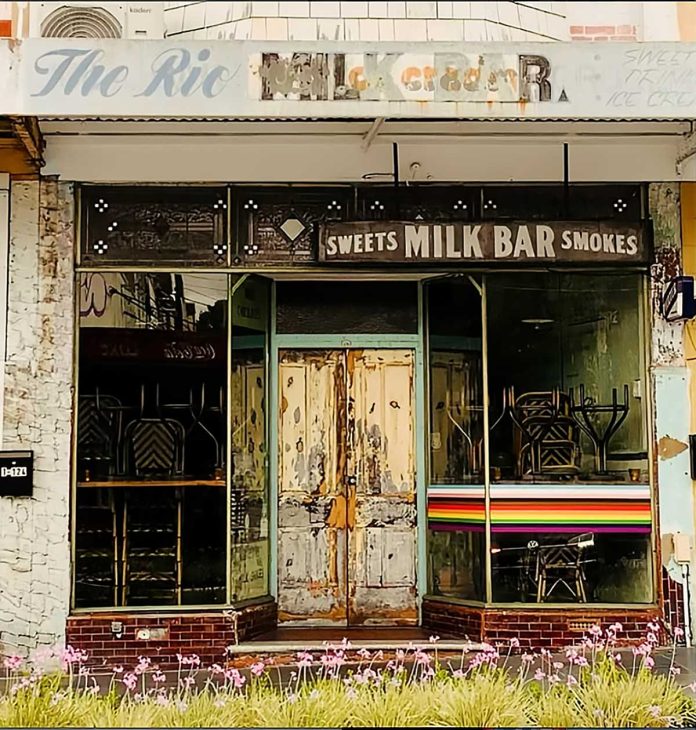
I’m again thinking about the world that is disappearing around me in my neighbourhood. I live in the inner-city of Sydney and I must sound like a broken record, but I am continually stunned by the changes that are happening to the urbanscape which most of us are feeling as a loss but also have a sense of powerlessness; we can’t do much to stop the visual curating for the worst of our city.
I’m also wondering if this sense of loss and feelings of powerlessness something that many people around the nation are experiencing – the loss of an aesthetic that came with certain values – like relationship, connection, meaning – which we are now waving goodbye to as though we are passengers on the harbour watching a cruise ship sail off into the distance.
In another article there is a live discussion occurring about whether there will be a “lazy space tax” imposed on buildings that are not being used.
There is one such building near where I live – the Hopetoun Hotel which used to be a vibrant music venue decades ago. Like everyone else, I walk past this now derelict building which certainly doesn’t make our neighbourhood look appealing and think “What can be done here?” But the dark fear that sits in most people’s hearts that I speak with is “What monstrosity will be built to replace it?” Given the choice between a derelict building that sure, looks pretty terrible – but reminds us of a unique and meaningful time in our city’s history – and a boring-looking structure owned by the elite, super wealthy of Sydney who want to capitalise on a property rather than tend to the culture and soul of a neighbourhood and city – well, I know what I’d choose.
What’s missing here?
We need to think more carefully about what venues, businesses and other spaces are closing down and what is taking their place in Sydney neighbourhoods. This is not about NIMBYism or idealising the past. There is a sense however of saudade for me at least – the Portuguese term which means something like nostalgia, melancholy, the sense of losing something that you might never again see.
Preserving the soul of a neighbourhood or city is important to locals – many of whom carry the history of the place in their memory and bodies – but is also important if we want to keep people coming in to the city to visit. People come to my suburb in Surry Hills for instance because they find it attractive – the lacework on the terrace houses, the tiny laneways, the heritage buildings and the hole in the wall cafes, many run by locals though increasingly less so. This brings in the tourists – domestic and international. But what happens when everything begins to look the same?
I’m not against the so-called “lazy space tax” but if we are going to force people to sell unused buildings that hold the soul and character of a city, we need to also think carefully about what will replace it.
Sadly, this is not normative thinking in Australia as it is in other parts of the world where heritage, history and visual sculpting of public places is carefully considered. People today are yearning for fragments of the past that meant something. For instance, have you noticed how younger people are being drawn to albums, cassette players, old movies and songs? All remnants of bygone decades. Why is that? Why is there a yearning in them for times that they did not even inhabit?
Since governments are not helping or are lacking vision, or we ourselves don’t seem to be able to gather collectively to make decisions on this (Are we too busy? Fragmented? Have we given up?)
I think that one solution lies in collectives – like the family that owns the Roseville Cinema. Perhaps families or groups of people can purchase places, businesses, venues within the city and a vision for that venue or building can be carefully thought through, curated and kept.
This is not simply about the preservation of the past, but it is an acknowledgement that the past is important and contains some truth (and beauty) worth holding onto, as does the shaping of the present and future. And… wouldn’t it be great if we had some government funding and vision for this kind of thing too?