The strike quickly spread from the railways to other industries including maritime, stevedoring and mining industries as well as many individual firms who declared goods carried by the railways by scabs as “black”.
At its height the strike involved 97,000 employees, the vast majority of whom were located in NSW. The Great Strike went for six weeks in the railways and tramways and longer in some other industries. Those workers who remained on strike in defiance of government and employer threats became known as the “lilywhites”.
Unions NSW and a range of organisations including Australian Technology Park, Carriageworks and the City of Sydney Council are marking the centenary of the Great Strike with various celebratory activities including an open day at the Eveleigh Locomotive and Carriageworks on Saturday August 5.
The reverberations of the strike were felt in NSW political and industrial circles for decades. The viciousness of the NSW conservative government’s response to the strike was unparalleled. Twenty unions were deregistered, scab unions were established with government and employer support.
Several thousand railway and tramway employees were victimised and refused reemployment, with their works cards marked “not to be re-employed”, or suffered reductions in seniority, promotion, pay and conditions. Striking dray driver Merv Flanagan was shot and killed by an armed “volunteer” outside the Children’s Hospital in Camperdown.
The “lilywhites” included several Labor politicians. Engine driver and future Labor Prime Minister Ben Chifley, and NSW Labor Premier J.J. Cahill, who was employed as a boilermaker at the Eveleigh Locomotive Workshops in 1917, were dismissed.
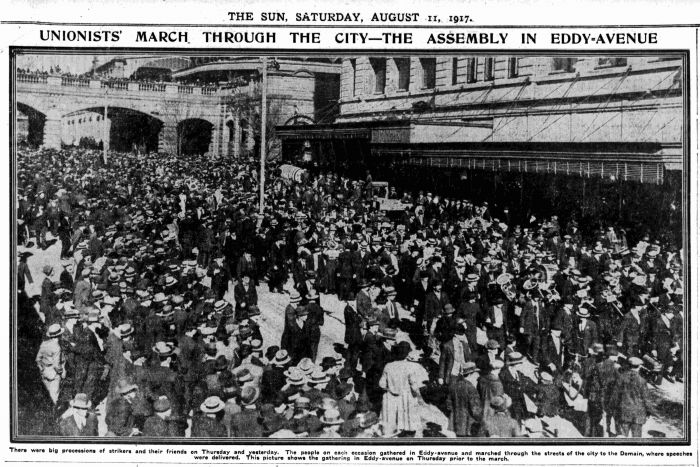
A feature of the strike was the strong support that working-class communities across Sydney extended to the strikers and the broad working-class mobilisation that occurred, including huge demonstrations of over 100,000 involving proportionately more people than any time before or since.
In 1917, the Eveleigh Locomotive Workshops were the heart of the NSW transport system and the railways were one of the largest employers in Australia. They acted as the hub for Redfern and surrounding industrial suburbs. The rhythms of life in Redfern were in many ways defined by the echo of the workshops’ whistle at the start and finish of the working day.
Redfern and surrounding suburbs were dominated by blue-collar workers. They were tightly knit communities bound by workplace, neighbourhood, churches, pubs and clubs. The permanent nature of the work in the public sector meant that working for the railways was intergenerational, with strong kinship ties. Shared experiences of working-class life were enmeshed with industrial life, unions and politics.
Do you or your family have stories or memorabilia of the 1917 strike?
We would like to hear from community members with family stories or memorabilia. Please contact organising committee members Roger Jowett (Rail, Tram and Bus Union – Retired Members Association), Geoff Turnbull or Kim Elliot .