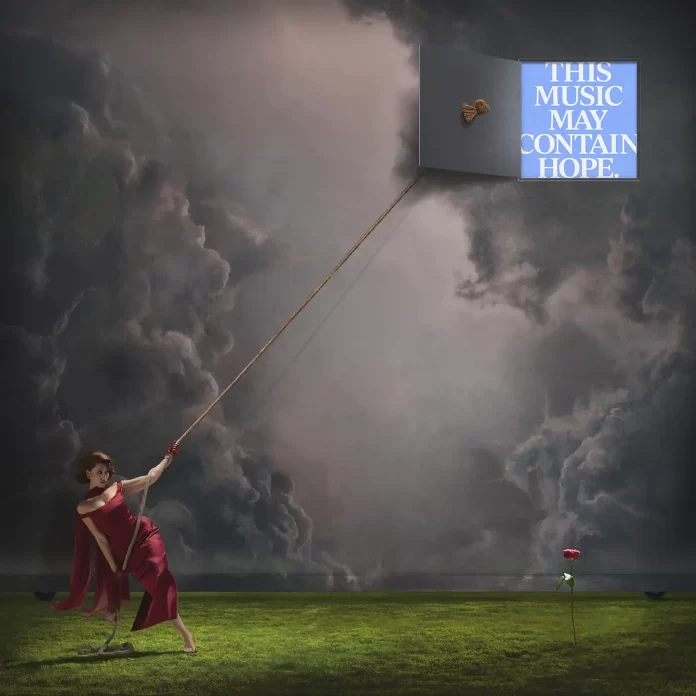
This Music May Contain Hope
Raye
Human Re Sources, 2026
This album came to me the best way possible. In a time where the algorithm and socials constantly shove new music at you, numbing you with choice, I was sent This Music May Contain Hope by a close friend. It was just a link to Click Clack Symphony and the immortal words: “You HAVE to listen to this, and it has to be loudly.” I usually tap play on my phone there and then, but this time I saved it. Headphones on, sitting on the edge of my bed once I got home, I immediately understood why it had to be loud, why I had to bathe in it.
From the first orchestral swells and Raye’s spoken-word scene setting, you can feel her going for broke: a 70‑plus‑minute, 17‑track, four‑act pop epic that veers from jazz-club swing to big‑band razzle dazzle, orchestral melodrama, club beats and classic soul without ever losing her as the blazing centre. It’s gloriously excessive in the best way, the kind of maximalism that feels less like indulgence and more like a dam finally breaking.
When Click Clack Symphony finally arrived in the running order, it felt like the album’s thesis in miniature: a La La Land-esque five‑minute musical that moves between breathless narration, orchestral surges and brassy, strutting release. Hearing it in context, threaded with melodic and emotional motifs from earlier tracks, it somehow became even more incredible than it was in isolation, a payoff that has had me looping back to the beginning and starting over and over again all week.
Like Beyoncé’s Lemonade, this record has that stealth catharsis. A strange, disarming feeling of realising you were carrying pain you hadn’t named until an artist held up a mirror and started healing in front of you. Raye’s narrative of heartbreak, self‑doubt and spiritual exhaustion, complete with voice notes from family and a grandmother who calls to say “we need to pray,” turns the album into a public exorcism that somehow feels infinitely personal. It isn’t perfect. It’s sprawling, messy, often too much; but that’s also why it’s such a phenomenal listen.
I Will Overcome is an early summit, a swaggering self‑pep talk where she drags herself home alone, counts her steps in her head, and then throws a one‑woman victory party in the wreckage of a bad night. It’s an anthem of stubborn survival that feels half show tune, half late‑night diary entry, and it lands like someone gently but firmly taking your chin and reminding you you’re still here.
Later, Life Boat arrives as one of the album’s most devastatingly intimate moments, stripping back the large-scale spectacle to something raw and confessional. In an album teetering joyfully on the edge of too-muchness, its emotional clarity hits like cold water. A reminder that beneath the big‑band dance-scene-on-the-roof theatrics is a writer mining very real, very recent wounds.
By the time the credits literally roll and she reads out everyone who helped her get here, you feel less like you’ve heard a collection of songs and more like you’ve sat with Raye through a storm and watched her insist on her own sunrise. This music doesn’t contain hope; it drags and dances you toward it.