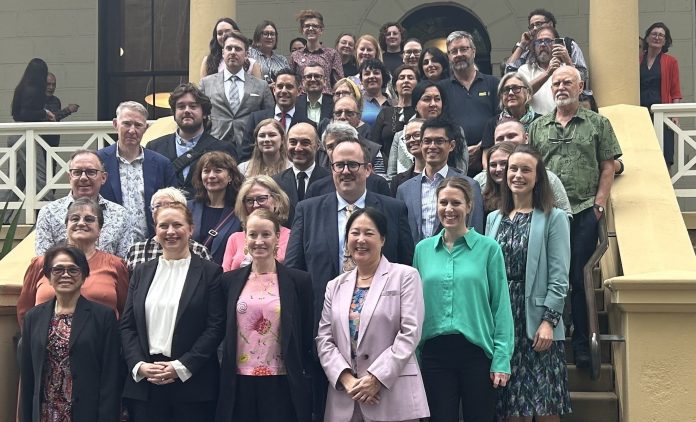
On October 23, Greens MP and Member for Newtown Jenny Leong introduced the Human Rights Act Bill 2025 in the NSW Legislative Assembly.
The bill requires NSW Parliament to consider how laws and policy decisions will impact human rights. Courts will have power to determine whether laws are compatible with human rights standards and to order remedies if they are violated.
“A human rights act is a powerful way of protecting and promoting human rights, a tool to ensure dignity and respect for everyone in our communities is at the heart of decisions,” said Leong.
The act was drafted over several months in close collaboration with the Human Rights Act for NSW Alliance, composed of more than 100 organisational members.
Genevieve Henderson, the NSW branch president of the Australian Lawyers Alliance, said that “human rights laws are positive and effective mechanisms for safeguarding the dignity and well-being of everyone in a healthy democracy.”
“Human rights legislation in NSW would not only deliver protection and freedoms but ensure that governments and leaders are accountable to the Australian people.”
Enshrining international law
The International Bill of Rights, as set out by the United Nations, establishes the civil, political, economic, social and cultural rights everyone is entitled to. They protect rights including the right to life, the rights of children, and freedom of religion and opinion.
However, countries are not required to follow these core United Nations treaties unless they are ratified into national laws. Australia does not have a national human rights act, and there is currently no requirement for policymakers in NSW to consider the impact their decisions will have on the state’s people.
Tim Roberts, president of the NSW Council for Civil Liberties (NSWCCL), says “a NSW Human Rights Act would create a legislated framework that articulates and protects human rights for everyone in NSW based on Australia’s international legal obligations under core United Nations treaties.”
The ACT, Victoria and Queensland introduced human rights acts in 2002, 2006 and 2019 respectively. The Alliance is urging NSW to follow.
“It would significantly improve the way our parliament, government and public entities develop laws, policies and make decisions. It would also create accessible pathways that everyone in NSW can use to take action for a solution if their human rights are breached,” Roberts said.
What is included in the bill?
The bill seeks to establish a Parliamentary Joint Committee on Human Rights and a New South Wales Human Rights Commission. The committee would examine whether bills and statutory rules are compatible with human rights and report their findings to Parliament.
It would be the Commission’s role to efficiently deal with human rights complaints and provide remedies for breaches of the Act. The Commission would have powers to advise the Attorney-General to review the policies and operations of public entities. They would also have a role in educating the community about human rights.
All bills put forward to Parliament would have to include a statement of compatibility assessing whether they comply with human rights. To monitor the effectiveness of the legislation, public authorities would be obligated to prepare an annual report detailing the actions they have taken to further the Act’s objectives and to report any human rights complaints they have received.
Leong said a key part of the bill’s review process is finding ways to amend the Act to strengthen the rights of First Nations people.
“Nothing about human rights protection should sit stagnant, but should be part of an ongoing dialogue … with the community and indeed with people that are impacted,” she said.
By the community, for the community
Leong stressed the importance of public engagement in developing legislation that protects the rights of all.
“Any potential human rights legislation needs to be the subject of robust public inquiry so that feedback can happen from as many stakeholders and diverse community members as possible, but also so people feel part of a human rights act [themselves],” Leong said.
She said a human rights act is a powerful tool for people and groups at risk of being mistreated by policy systems.
Karly Warner, CEO of the Aboriginal Legal Service NSW/ACT, said that “the human rights of Aboriginal and Torres Strait Islander people are violated too often in NSW prisons, policing and child protection systems. Enacting a Human Rights Act for NSW could provide much-needed protection and recourse for when these rights are not upheld as they should be.”
Megan Spindler-Smith, acting CEO of People with Disability Australia, said that “existing human rights frameworks in New South Wales do not provide adequate protection or stop the violence, abuse, neglect and exploitation people with disability have endured for far too long.
“We need a human rights approach that ensures people with disability are not forgotten or left behind.”
Leong said that while the bill cannot stop Parliament from passing certain legislation, it will “create a conversation and expose the fact that actually the government is making a decision that will be contrary to the human rights of the people.”
Towards the future
In 2024, the Minns Government’s NSW Labor Platform supported a community consultation into the introduction of human rights legislation.Leong and the Human Rights Act for NSW Alliance are urging the Labor Government to follow through with this promise.
“We bring forward this Human Rights Act as a way to try and unite communities, to recognise that everyone has access to these rights, to be treated with dignity and respect.
“The time to progress this historic reform is now,” she said.