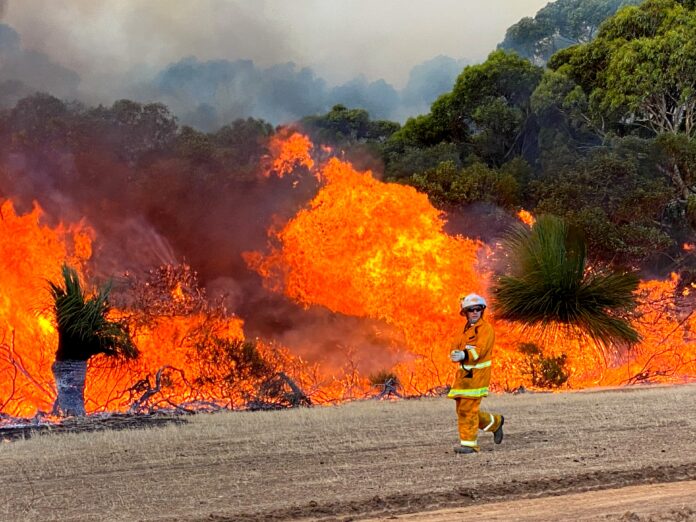
The Australian bush was not always as it is today. Recent research has shown that British colonisation imposed drastic changes in the vegetation, with consequences for the intensity and scale of bushfires that we now experience with increasing severity.
Bushfires are part of life for many Australians. Over the last few decades, they have been particularly intense and have grown to engulf enormous areas. Consequently, lives and properties are lost, animals and plants are decimated, and those living close to fire-prone bush brace themselves every year as summer weather sets in.
Scientists have long demonstrated the link between climate change and catastrophic fires. The vicious circle that ensues is tragically illustrated by the 2019-2020 Black Summer bushfire season in Southeast Australia, which released so much carbon into the atmosphere that it almost doubled the country’s carbon emissions that year, worsening climate change.
In October, Australian researchers, along with the Gunaikurnai Land and Waters Aboriginal Corporation, showed that bushfires became more severe over time for another reason: the post-colonisation loss of Indigenous land management practices.
Before British colonisation, forests of Southeast Australia mostly consisted of open grassland, shaped by Indigenous practices of small, patchy, and relatively cool (temperature-wise) backburning. After invasion, flammable eucalyptus and acacia species were favoured, the traditional way of managing the land was suppressed and soil erosion began, fueling bigger and hotter bushfires. To draw their conclusions, the team analysed pollen seeds, sediment cores and charcoal within Croajingolong National Park (Gippsland), traditionally owned by the Gunaikurnai people, and reconstructed the history of fire seasons over the past thousand years. They found that the number of eucalyptus trees more than tripled between 1840 and 1970. The vegetation also became much denser post-colonisation, meaning that fires had “more fuel” to consume.
The transformations imposed by British colonisation even changed the nature of this bush: under Indigenous-only management, this region was in fact not a forest, but a woodland…
The team’s message is clear: restoring Indigenous practices could help mitigate fire risk. While they do not pretend that it will be easy, they urge Australia to trust both scientific research and longstanding Indigenous knowledge to lower this burden.