Next to Godliness
Playwright: Alastair Brown
Director: Maddy Withington
New Theatre, King Street, Newtown
October 6 – October 31, 2026
Next to Godliness is a wicked pleasure. How does anger repressed over a lifetime, or over centuries, manifest itself? The play asks the question, and by setting it in an absurdist context, Alastair Brown prompts the audience to consider the answers while making them laugh at what is, or maybe isn’t, a preposterous premise.
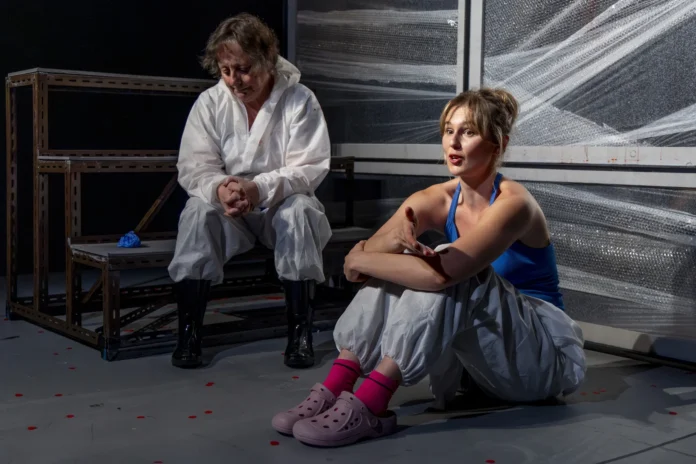
The plot is set in motion quickly as two crime-scene cleaners hired by criminals arrive on stage to clean away the blood and bodies after a gangland shoot-out. The younger of the cleaners, the ebullient Erin (Aisha O’Brien), a CSI fan, is keen to picture how the massacre occurred, while the older and irritable Sophia (Alice Livingstone) just wants to get on with the job. Unfortunately, Goon No. 7 (Brendan Kater) is still alive and abusive, presenting the two cleaners with a problem, and how they solve it drives the action of the play.
Modern-day audiences, accustomed to TV police procedurals and the concept of perpetrators sanitising the crime scene, might find this scenario a source of humour but almost too easily imagined. However, an intriguing opening scene in which gunned-down, balletic gangsters transform into underworld spirits introduces a darker element. Taking on the role of the chorus in Greek tragedy, the three admirably implacable furies, Jessica Carter, Harrison Collis-Oates and Sophie Newby, reference instances of justifiable female vengeance and vengeful female monsters, the Sphinx and Medusa.
The solution to the problem, provided by Sophia, turns out to be Ferryman of Ferryman Solutions, who may or may not be such a vengeful mythical monster. The interchange between the efficient, power-dressing Ferryman, an outstandingly convincing performance by Sonya Kerr, and her victim, an alienatingly smug Nathan Farrow, is the high-point of the play. It is both outrageous and hilarious, shocking and guiltily funny, but the authoritative Ferryman may well be a common female fantasy.
The play takes a turn from fantasy to grim reality as a depressed Sophia confides her secret to Erin, and the play concludes on an inevitable and ambiguous note. Is a demoralised woman who harbours murder in her heart a monster? How can justifiable female anger for centuries of abuse be appeased? Having the chorus behind the semi-transparent screens at times suggests the deep-seated forces that govern human emotion.
The performance is excellently staged. The stage design by Tom Bannerman is classically simple, and when demanded, Julian Dunne’s lighting renders it ominously threatening. The pools of gore, showers of “blood” and blood-stained garments create a predominant impression of red, the colour of anger, which the director, Maddie Withington, clearly wishes her audience to feel. At the same time, Withington’s production is witty and smart, appealing to the audience’s sense of fun.