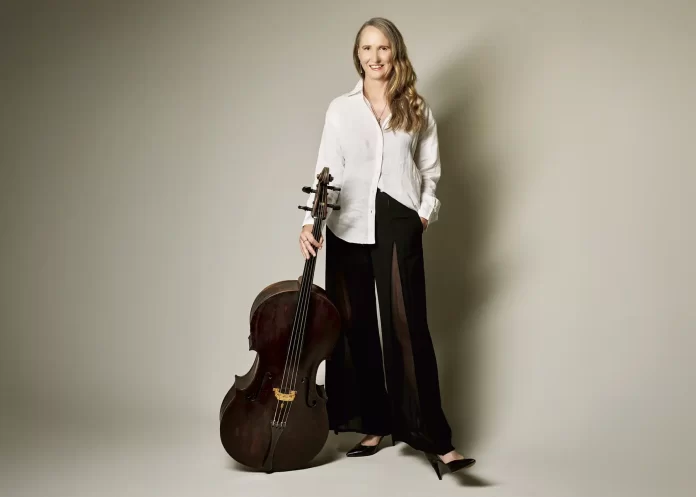
Newtown resident, cellist and psychologist Anthea Cottee will join some of Australia’s finest baroque instrumentalists in June when Bach Akademie Australia presents Collegium Musicum, a three-stop celebration of music and enlightenment.
Cottee has lived in Newtown for 27 years. She brought her children up there and said she loved how vibrant the area was.
“It’s a really lovely place that’s full of creative people and has a good sense of community.”
Cottee performs on a variety of instruments, from modern, baroque and classical cello to viola da gamba, lirone and basse de violon.
She has worked as principal cello for Sydney Philharmonia Choirs and performed in many ensembles, including the Australian Brandenburg Orchestra, Bach Akademie Australia, Orchestra of the Antipodes and Pinchgut Opera.
Last year, she performed in Belvoir Street Theatre’s production of The Spare Room, with Judy Davis, which she enjoyed, particularly since Judy Davis wanted the viola da gamba as an expression of her inner world.
Recently, Cottee performed the Duruflé Requiem and Poulenc’s Gloria with Sydney Philharmonia Orchestra at the Opera House and Mozart’s Requiem at St Paul’s College, University of Sydney.
In June, she has Verdi’s Aida with ChorusOz in the Sydney Opera House Concert Hall and the Bach Akademie’s Collegium Musicum concerts.
Cottee said, “Bach is always really lovely. In fact, he’s probably my favourite composer. He wrote some of the most profound and gorgeous music around.”
Yet Cottee has been enjoying a bit of variety in her musical life.
“I do about half and half baroque and modern cello so, obviously, things like the Duruflé and the Verdi are modern cello, but I play baroque cello and viola da gamba as well.”
She said her various instruments sounded different and required different techniques.
“If I go back to the baroque instruments – the baroque cello is like a modern cello but it has beef gut strings and a different kind of bow.
“It’s a very different tension in the strings and a different feel to the sound. We also don’t have a spike so you hold the instrument.
“The viola da gamba, which was the French equivalent of the cello during baroque times, has seven strings and frets. The clef is different, the strings are different, the fingerings are different and you hold the bow the other way around so the bowing is upside down.
“I like to call it my dementia prevention device. I have to think really hard about things because my default is an 1836 Hill cello with steel strings and a spike.”
Cottee said baroque music was special because it was based around the bass line.
“Structurally, with basso continuo, the bass section – which can be a double bass, or violone, a cello, or gamba, harpsichord, organ or lute – we all play from the bass line.
“It’s very satisfying music to play from a bass perspective. You feel like you’re in the engine room of the music.”
Cottee said she thought the cello was an emotionally connecting instrument.
“Even in films and TV, when you hear the cello solo coming, you think it’s love or death, or both, coming your way.
“I can’t tell you the number of times when I’ve caught a train with a cello case on and people tell me it’s their favourite instrument.
“I think it’s got that very human shape and size, and it’s vocally in a really nice register. It seems to have a sort of soulfulness about it that people really respond to.”
When reminded of the popularity of “The Swan”, best known as a cello solo from Saint-Saëns’ The Carnival of the Animals, she said it was a beautiful piece with a lovely, calm cello line over the top with the piano “noodling away like the swan’s feet underneath”.
“That contrast between the calm on top and the very busy underneath resonates with my life as well.”
She said people who hadn’t played music might not understand the hours and time that go into the skill of playing an instrument like the cello. “There are times when it’s hard work and struggle but I think people see the beauty of it.
“I guess that comes back to the swan: it’s like, there’s a lot going on underneath but what we want you to listen to is this beautiful thing on the top. It’s a good symbol, that piece.”
Cottee studied her Postgraduate Diploma of Psychology at the University of Sydney, with an Honours project adapting and implementing a sports psychology program for groups of young musicians.
She said there was still an overlap between her work as a psychologist and performing at a high level as a cellist.
“In terms of being able to manage those high-pressure situations, I use a lot of what I would tell people in the room. And I work with a lot of people, including some creatives, who are navigating that space.
“There’s a lot of feedback between those two areas. I have the privilege of hearing people’s inner worlds and struggles, and what goes on for them.
“And there’s the incredible experience of all of us sitting in a room together, the Opera House perhaps – all these people who bring their own inner worlds and struggles and things – and we sit there in a communion of listening to music, and we all experience a similar emotional space.
“Just through physics, through the playing of tones – loud, soft, high, low – that we hear together, the impact of that emotionally on people is really profound. It blows me away.”
She said there was absolutely a role for music in healthcare.
“There’s been increasing research in terms of dementia, disabilities … people accessing a part of their brain through music that’s difficult for them to find in a different way; how that affects memory, cognitive function and emotions and mood. It’s really fascinating.”
Cottee said she prepared mentally for high-pressure performances through a lot of visualisation, imagining things going well, and a lot of practice.
“You need to get it under your fingers and feel confident with it, but also to practise the feeling of confidence in your body. As a psychologist, that’s one of the areas of interest for me and something I’d certainly talk to people about as well.
“It’s embracing the adrenaline of it rather than trying to shut it down. Just allowing the excitement and allowing the energy to be there.
“As time goes on, you learn the kind of things that work for you, the preparation and then being able to enjoy it, remembering that you’re communicating to people who are wanting to hear you and leading them into the emotional language of the music that you’re playing.”
Physical conditioning was also required, she said.
“I’ve had experiences with my body where I thought I might not be able to still play, so I’m conscious of maintaining it.
“Playing the cello, like playing any musical instrument, is a very specific physical task. It has certain challenges that require working out, listening to the body, working out what it needs, and keeping it in shape.
“I’ve always been aware that playing an instrument is something that’s a bit fragile.
“An accident when I was young meant I wasn’t able to play viola and I had to find my way into a different instrument. That taught me a lot about how much it means to me and how much I wanted to be there; how much I love playing. And how important it is to look after yourself in order to be able to do it.”
Was there a performance she still thought about?
“The one that comes to mind is a performance I did many years ago, in Germany. It was on tour with the Australian Brandenburg Orchestra. We were doing a concert with Andreas Scholl when I had just found out some difficult news from home.
“There was a real sense of collective energy and support and beauty with the people on the stage. It was a profoundly moving moment. I felt really nurtured, supported and held with music.”
Could she see herself playing longer, maintaining the practice that would be required?
“I feel so lucky because I’ve always had this awareness that, physically, it may not be there. I’m just delighted to still be playing and to be playing the kind of repertoire that I like doing, with people who I really enjoy working with.
“That just feels like such a joy to me. So, I’ll keep doing it as long as people ask me to.
“I think making music has always been really fundamental to me. I can’t really imagine life without making music. I can’t imagine being without music.”
________________
Catch Anthea Cottee with Bach Akademie Australia in intimate performances of works by Bach, Telemann, Fasch and Vivaldi at the Mosman Art Gallery (12 June), The Neilson, ACO On the Pier (13 June) and Bowral Memorial Hall (14 June). Book tickets here.
She will also be appearing with Sydney Philharmonia Choirs in ChorusOz: Aida at Sydney Opera House (7 June). Tickets available here.