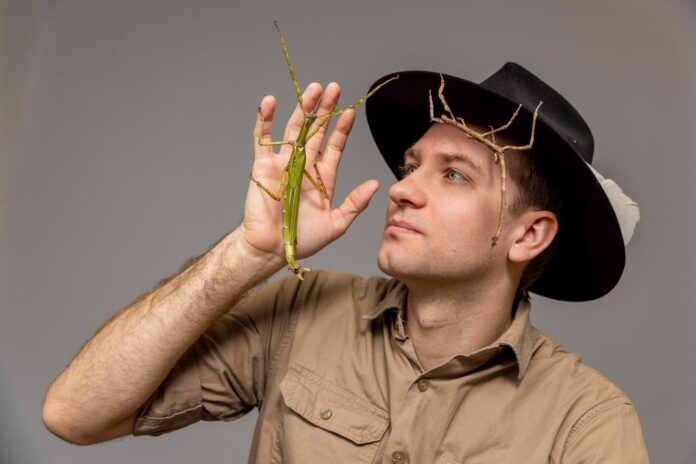
Insect ‘detectives’ have discovered two new types of large stick insects, showing scientists are still uncovering new species in some of Australia’s most well-studied landscapes.
Researchers at the University of Sydney have revised the Australian representatives of the stick insect genus Anchiale, identifying two new species, one with unique ‘lidded’ eggs. They also reinstated a third species that had been hidden in plain sight for decades.
The findings reveal that what were considered two species are five distinct species stretching in range from northern NSW through coastal Queensland and into the tropical north.
Despite more than 1000 citizen science observations of stick insects through iNaturalist and the Atlas of Living Australia, plus decades of scientific study, the researchers say Australia is still only scratching the surface of its insect diversity.
Lead author Dr Braxton Jones from the Aola Richards Sydney Insect Hub at the University of Sydney said the discovery highlights how much remains unknown about our insect biodiversity.
“Taxonomy is often a bit like detective work. Even among some of Australia’s most photographed and frequently reported insects, we’re still finding species that have escaped scientific recognition,” said Dr Jones, a Postdoctoral Research Associate in the Molecular Ecology, Evolution and Phylogenomics Laboratory.
One of the biggest surprises involved a large stick insect long known to scientists and insect enthusiasts. After combining DNA analysis, museum collections, surveys, citizen science records and studies of captive populations, researchers discovered the insect had been misidentified for decades.
It is now recognised as an entirely new species, Anchiale robusta. The findings are published in Austral Entomology.
The team also described Anchiale mabiensis, a new species found in Queensland’s critically endangered Mabi rainforest on the Atherton Tablelands. Its eggs contain a structural lid unlike anything previously recorded in stick insects or their closest relatives.
The research has practical implications as well. A stick insect known for forming plague-like population outbreaks that can strip foliage from trees was found to consist of more than one species. Untangling those species relationships will help improve future management of impacts on forestry and agriculture.
The study even identified a likely additional undescribed species from Cape York, but more specimens are needed before its identity can be confirmed.
Dr Jones said: “These findings demonstrate the importance of protecting threatened ecosystems and documenting Australia’s extraordinary biodiversity before we lose species without us having even discovered them.”
Declaration:
The authors declare no conflicts of interest. Funding for this research was provided by Australian Biological Resources Study – National Taxonomy Research Grant of the Commonwealth Department of Climate Change, Energy, the Environment and Water, and by CSIRO – postgraduate scholarship.