Together for Humanity aims to demonstrate how people from different faiths and cultures can get along. Not just superficially, or when discussing easy, uncontroversial topics, but on the deeper level, even while discussing beliefs and values which are fundamental to our identity. We believe that forming real relationships and creating bonds of mutual respect with those of different faiths is the key to resolving societal conflict between diverse groups and fostering an inclusive, prosperous society. Although we aim to encourage positive interfaith and intercultural relationships in the wider community, much of our work focuses on schools.
This is because we believe that education is fundamental to reducing prejudice.
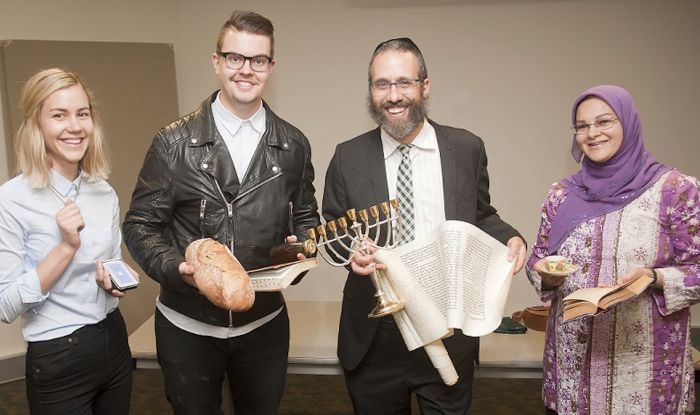
Our school programs involve a panel of presenters: a Muslim, a Jew, a Christian and occasionally an atheist. Simply having a representative from each of the major faiths in Australia physically present at the school is an extremely important aspect of our work. Many of the children may never have spoken to a Muslim woman or a Jewish man before and having this direct positive contact can help to humanise “the other” and create awareness of our many similarities as Australians.
Our multifaith presenters use a range of activities to encourage students to explore and understand stereotypes and assumptions as well as to teach them skills for negotiating conflicting narratives, understanding how conflict between groups arises and questioning prejudice. Another important aspect of our school programs is the Q&A section. In this part of the program, the students are given free rein to ask any of our presenters any question at all about themselves, their faith or their culture. This gives students the freedom to voice many niggling questions or beliefs they may hold about people of a certain faith or culture, without fear of being told that their question is rude or inappropriate. In fact it is not uncommon for children to ask our Muslim presenter, “Are you a terrorist?” While this question would certainly be offensive if asked outside of a controlled educational environment, when it is asked to our presenters, it is an opportunity for students to amend their understanding of Muslim people based on a real-life interaction with a Muslim person.
As well as these programs, we also run interschool programs which generally bring together two faith-based schools from different religions to participate in a workshop together. These programs focus on finding similarities, rather than speaking only about differences. Students are often amazed at the countless similarities between them and their new friends despite their often radically different faith, culture, geographical location and socio-economic status.
Oftentimes, society has inculcated children with the belief that, because they belong to a certain faith, they are destined to fundamentally conflict with those of another faith, making interfaith friendship seem impossible. These beliefs are often reinforced by religious conflicts overseas, or here in Australia. Our programs help children of different faiths not just to “tolerate” one another but to form real connections and friendships.
After one interschool program, one student commented: “There is no need for a barrier between us regardless of what is happening overseas. We are all Australian citizens and should embrace learning about people that are different from us.”
While another commented: “It changed what I thought about people from different faiths and cultures. They seem like us. Same hobbies, same likes and dislikes.”
We have big plans for increasing the scope of our engagement with students in 2016,
as we plan to host an Inclusive Communities Youth Summit at Parliament House, bringing together students from various religious and cultural backgrounds to workshop initiatives to make our society more inclusive. We have also introduced new Australian curriculum/NSW syllabus aligned workshops, “Celebrations of our Diverse Communities” and “Our Diverse and Connected People and Places”. Both workshops emphasise the importance of inter-cultural understanding and respect for diverse cultures. We now also have the privilege of being able to offer these programmes to schools free of charge, thanks to a grant from the Australian Government Department of Social Services.
As well as giving students the opportunity to broaden their horizons, we also offer both face-to-face and online training to teachers to equip them with the skills to positively navigate difference within the classroom. This includes running staff development programs, as well as our online courses and resources. Our three online modules, which are approved by BOSTES (Board of Studies Teaching and Educational Standards), help teachers to maintain their accreditation. Our educational site http://www.differencedifferently.edu.au/ contains learning resources not only for teachers but also for children and adults who would like to learn more.
Outside the classroom, we also aim to play a role in changing the narratives in the wider community about difference and diversity. Our national director Zalman Kastel participates in various interfaith panels and events and speaks publically about the benefits of embracing diversity. We also have a presence on social media which aims to spread positive messages and encourage constructive open dialogue between those of different backgrounds.
Ultimately, our message is that real connections and meaningful relationships are key to improving bonds between Australians of different faiths, preventing alienation and ultimately preserving social cohesion and security. But this absolutely must be mutual. While many of those who feel they are part of mainstream society may make demands that others assimilate or integrate into our society, this does not work as a one sided initiative. In our work we have found that it is often those who feel like “outsiders”, such as Muslim teenagers, who are the most motivated to form connections. Sadly the goodwill of the “outsider” is sometimes weakly reciprocated by those who already feel comfortable and included in Australian society. Therefore, the success of our work is entirely dependent on positive engagement from those from all areas of the community.