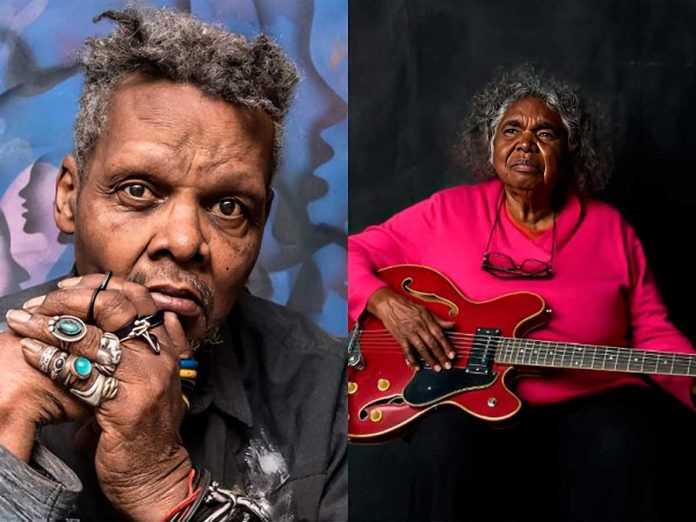
Since 1979, Lonnie Holley has devoted his life to improvisation. A survivor of Jim Crow-era Alabama, his practice was born from struggle and has grown into a lifelong expression of resilience and imagination. Across drawing, sculpture, music, film and performance, Holley transforms the everyday into something sacred.
That devotion to creation was palpable on Saturday 10 January, 3-4pm, at ACO On The Pier, Dawes Point, when Sydney Festival offered a rare kind of shelter: an hour of improvised music that felt like prayer – unshowy, unhurried and fiercely alive. The staging was stripped back: four chairs, a piano and synth, no light show, no spectacle. The focus was presence.
Holley – legendary for sculptures and assemblages made from found and discarded materials – brought that same spiritual practice to the stage: making something tender from what the world throws away. His voice carried the warmth of a street-corner prophet, greeting the room as “sisters and brothers … friends”, speaking of Mother Earth and Mother Universe in a language that refuses hierarchy.
“The Kind Spirit has brought us together,” he said – not a slogan, but an invitation.
Holley’s songs moved in one- and two-chord loops: open forms that could hold grief, humour, warning and praise. In one piece, he kept returning to the word “hallelujah”: a human response to pain or need, less triumph than truth. Then came the hard paradox – “the baby or the bomb” – a stark question about what we choose to build, what we choose to worship, and how empire trains our priorities. In Holley’s hands it wasn’t moral theatre; it was lament and clarity braided together.
On this occasion, Holley was joined by celebrated musician and activist Kankawa Nagarra, a Walmatjarri Elder from Wangkatjungka in the Kimberley, whose debut album Wirlmarni won the 2024 Australian Music Prize. Her songs carry deep ground and steady grace: blues, country and gospel infused with Walmatjarri songlines and a clear-eyed care for people and Country.
“I speak three languages,” she told us with a gentle smile. “English is one of them.” Her voice carried both tenderness and iron.
Standout songs included “Wirlmarni” (“disappearances”), “Tell You a Story”, and “Dollar Sign” – a protest against pastoral exploitation and the destruction of Country. Holley listened closely, adding percussion, high harmonies and whistles in unobtrusive ways, praising Nagarra as a bold and faithful artist.
Beside them, collaborators Darren Hanlon (who produced Wirlmarni) and Lee Bains (guitar, vocals, percussion) coaxed lead breaks, shakers, suitcase bass drum and soft textures into the mix – humble, gently encouraging, shaping the music without pushing it.
By the end it felt like nourishment: two wise artists from different continents, aligned in compassion, insisting – with hard-won integrity – that creativity can still be kindness, and kindness can still be resistance.