


Irish band Fontaines D.C. perfectly capture a laconic lean in their song Favourite, with the lines: “Shoulder bound to the frame of a door / Chewed into shape like a stone on the shore.”
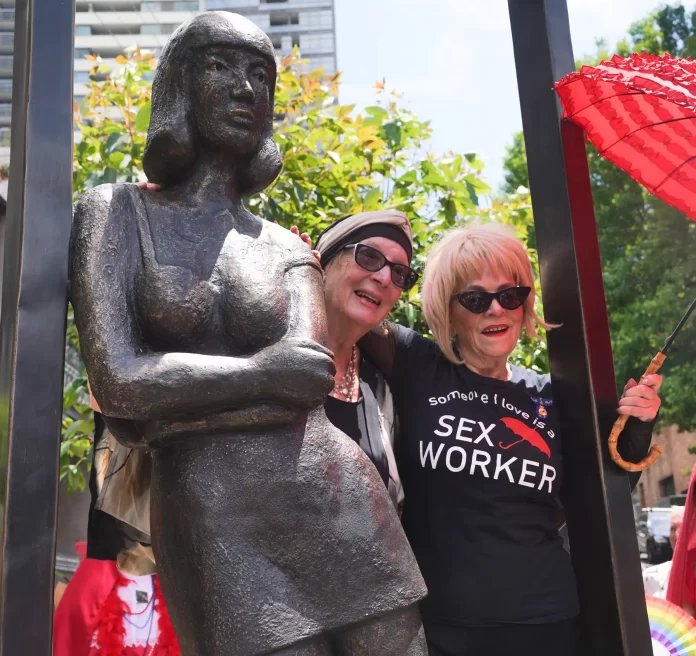
The statue of Joy, the sex worker, recently returned to her plinth in Darlinghurst after nearly thirty years, embodies exactly that. She stands with one ankle crossed casually over the other, her right bicep holding up her whole weight, expression neutral but with a distinct flicker of “Not taking any shit.”
Lose a staring contest with her at your peril.
It’s also the look actress Kerry Mack gives in the music video for Sharon O’Neill’s iconic early-1980s sax-driven song Maxine, filmed on the same inner-Sydney streets.
Maxine and Joy are bound together, not only as artistic representations of street-based sex workers linked to Kings Cross and Darlinghurst in the closing stages of the 20th century, but also as the creative legacy of the powerful women who brought them to life.
When you look at Joy today, you can see she is having none of it. And neither is Julie Bates AO, founder of the Prostitutes Collective, as she reflects on the long campaign with sculptor Loui May and her allies to bring Joy back where she belongs.
“We’ll put our red light on when we want to. It’s none of your business. We are not victims. Sorry, this is our work,” Julie says, taking a swipe at sanctimonious portrayals of sex workers, such as The Police’s Roxanne.
But rather than dwelling on rebuttals to the endless “you don’t have to…” narratives trotted out by Sting et al, Julie prefers to celebrate Joy’s return as a symbol of hard-won progress, from disposable object to an honoured public figure on a major city thoroughfare.
“It’s the cherry on my cake, in a way,” she says. “A statue of a sex worker supported by one of the biggest local governments on the planet. It shows we’ve come some way toward respect and equity.”
Sharon O’Neill, meanwhile, wrote Maxine to highlight the injustice and violence facing Darlinghurst’s sex workers in the early 1980s.
While the Bechdel Test that determines how often artistic conversation occurs between women, on a topic other than men, had not yet been invented, Sharon was already attempting something similar: creating space for women to speak to women about life choices and survival amid police brutality and the emerging AIDS crisis.
Sharon says the song still opens doors. “People tell me they’re glad I wrote it because they’ve known someone close going through that,” she explains. “It’s made them feel seen. It’s made it okay to talk about.”
Julie and Sharon have very different takes on the experience of The Cross’s sex workers at the time. One speaks from lived experience deep inside the industry, the other from living and creating art within Darlinghurst, absorbing the heartbeat of the place and filtering it into music.
Their perspectives vary sharply on the pros and cons of street-based sex work. Still, both women arrive, in their own way, at the same conclusion: they want you to feel the full humanity of the women portrayed, in contrast to the violence that surrounded them.
Julie argues that the greatest violence often came not from clients but from the police who were supposed to protect them. “In the 80s, the streets of Darlinghurst were actually one of the safest places to work,” she says.
She describes a strong community with safe houses along Liverpool Street, peer support, and a practical camaraderie. “It was a community way of organising. You could have a cup of tea, talk among yourselves, share ideas like how to negotiate with clients.”
Yet ending up in the police lock-up often led to being sexually assaulted by the very people meant to uphold the law. “The illegality of brothels at the time enabled corrupt behaviour by crooked cops. We were just trying to make a living. We didn’t want to have to associate with crooks and crooked cops, but that’s the way it was. And why should we, just doing our job, have to be working in those environments and be subjected to that kind of stuff?”
It is also the question Sharon places at the centre of Maxine: the “why?” of the distress she witnessed at the time and the air of brutality in a place where sex workers and everyone else should have been free to go about their business safely and unimpeded.
In imagining the best future for Maxine, she says, “what I wanted for her was for her to be able to live her own life… to walk without looking back. To be more of a free spirit.”
But that was not what she saw when she lived in Darlinghurst, and what drove her song. “The reality of what [the women were] going through really hit me when we did most of the video in The Cross,” she says.
“We had to use the cop shop for the girls in the video to get changed. While we were shooting, there was quite a police presence, the reason being that the pimps of some of the girls that normally worked in that particular area were getting pissed off with our actresses taking attention away from their girls and that they were losing business.”
While Sharon explains she could see it was a dangerous area, reality hit her hardest not because of the tension on the street, but when she was approached in the police station and told, “you are lucky you don’t have desk sergeant X on duty tonight. He hates women”. Sharon recalls taking that in and feeling shocked that the women working the streets existed in an environment of police hatred where they couldn’t rely on the law to protect them when they needed.
It’s not an irony lost on Julie who relays stories of her own brutalisation at the hands of the police, when I share Sharon’s anecdote with her. There is a heaviness in her voice when she tells me she still gives speeches at Qtopia which sits on the site of that decommissioned station. I can tell it is something she is committed to do, to ensure the knowledge of what happened at the hands of those police is not lost, although it takes a lot out of her to do so.
“The cops thought they could get free sex and money out of this, which a lot of them did, and that they could just treat you like throwaway scum. And that’s kind of the image that Maxine is. She’s throwaway scum, gonna end up dead in a dumpster. Who gives a shit? But, in my opinion, reinforcing that image [in the long run] does not help our cause.”
To Sharon, Maxine’s world was a mish-mash of contrasts she was drawn into at the time, to do her own musical work. Getting back to her hotel at 3am, after her gigs, she describes The Cross as “throbbing”, full of people, music and a city generally in full swing. But among it all the same still figure caught her eye, again and again, out the front of the now Westpac on Darlinghurst Road. The woman who inspired her song was often loaded, in her words, and at a loss. With all the noise and movement going on around her, and the dramas in the street, she was at odds with it all.
It left Sharon with more questions than answers and a weight of sadness. She found herself asking at the time, “what happened along the way? It is such a profound thing. It can’t be just all fun and games.”
It was not fun and games, Julie agrees. In response to Sharon, she says, “I was one of those women though. I was there, on the streets. I wish she’d seen me. I wish we’d met.” Still, she emphasises that, in her view, it was also not a situation she and the Joys of the world found themselves in without choice. They saw themselves as workers in a chosen profession fighting for better conditions, like any other group with vulnerabilities, and their push was, and continues to be, for respect and equality along with everyone else.
It’s the work of Julie and her allies, epitomised in the validation of public artwork like Joy, that provides an answer to Sharon’s wish for a safer and freer life for the Maxines of today and something she expresses that she would love to engage with and support also.
“I would love to see that sculpture. I think it’s great for it to be highlighted. It should be something that would help for these women. You know, it’s what they do. It’s not gonna go away anytime soon. So, it would be nice to have a little bit of respect,” Sharon says.
That effort in pushing for respect has seen brothels decriminalised, regulated and made safe so that the workers could come in out of the cold, in Julie’s words.
“We didn’t need to be standing there. Did you think we wanted to be? Do you think I wanted to be standing on the corner of William and Bourke Street seven hours a night, you know, six nights a week, the whole world going past looking at me? No, I didn’t.”
Not that that was going to change without unyielding lobbying and conversation from, in Julie’s words, “sex workers, sex health experts, lawyers, historians, and members of Parliament like Christine Harcourt”. Small wins like street-based sex workers being the first to champion the use of condoms, to get brothel owners to take out full-page newspaper ads requiring their clients to practice safe sex, to get lawyers and politicians to repeal restrictions.
NSW, to its credit, was the first jurisdiction in the world to decriminalise sex work in 1995, at the same time as the first statue of Joy appeared, but political attitudes settled for that as an accomplishment, rather than a step, which other places have now surpassed.
Julie believes Joy matters as much or more than ever today in telling the emotional truth of Darlinghurst and sex workers as part of a “greater narrative now around who we are, from so many more of us and our allies speaking about sex worker rights. But we can never rest on our laurels.”
Julie says, “we’ve still got unfinished business out there. We still don’t have basic anti-discrimination protections. If I am registering my child in kinder, I can’t put down that I am a sex worker. I can still be refused services or bank loans from banks. Victoria and Queensland have legislated anti-discrimination for sex workers but NSW hasn’t. Laws remain on the statute books. It’s still illegal to advertise. We need to repeal those last laws and to shift people’s ideas that we can be discriminated against.”
Julie sees the net benefit of those further legal changes as continuing to have the societal effect of reducing stigma. She says it comes with law reform first and a societal shift in attitudes.
“If the law doesn’t think we’re so bad and sees fit to decriminalise our industry then rights and respect will flow on and pejorative attitudes will be overcome. There’s a lot that can be achieved, and we can better ensure that things don’t go backward. There are always forces pushing back, like what happened to Alex Greenwich and with women’s rights in the US, among the North American women who really tried to advance the cause for sex worker rights. You’ve got to remain eternally vigilant. The whole LGBTIQ+ communities would say the same thing.
“Joy’s standing in the door, representing sex workers of all genders, in any field of endeavour in our industry. And she’s there now, accepted as part of the cultural art and the life of the city, and an indelible part of Darlinghurst and the crossover all that time.”
Joy’s influence continues to resonate beyond Darlinghurst too. Julie says, “now there’s also a statue in Amsterdam called Belle, inspired by our Joy. People around the world are inspired, it’s amazing.”
As to the original Joy, Julie says, “she couldn’t go back to that corner the way she was. That’s why she was removed, she was a temporary fixture. She was not going to weather well. She went to the sculpture garden at Macquarie University. And that’s where she lived for all these years. When we found her, she was not in a good state, her foot was broken and she was covered in cobwebs. Loui has restored her and she’s now on Wally’s Walk, which is the main thoroughfare through Macquarie.
“My next campaign is to name that little strip Joy’s Stroll. She’s standing in her original red doorframe, and I believe the paint they used is the same as the paint used on battleships. So, that will last forever. The patina glows in pink or gold depending on the light and sun setting behind her. It’s powerful. Beyond my wildest imaginations.”
As an aside, Julie and I have agreed to cast around for some musical support to write a response to Roxanne.
I’m delighted by the idea of an artistic adventure extending on my chance to interview both Sharon and Julie about the art they have created and played a part in getting on display, so intricately linked to the experience of sex-workers in Darlinghurst.
It was a similar flight of fancy that led me to chatting with Sharon a few years ago about the tattoo she describes Maxine having in her song. I asked Sharon what she imagined it looked like and worked with her on a design that matched her imagination and got my trusted tattoo artist to add it to my bicep so I have a bit of Maxine’s sax-soaked 80s nightlife of Darlinghurst always with me, and a bit of joy always in my life.





Beautifully written. I am so glad to see the women behind the works and their creations get the recogition they deserve