It’s Lunar New Year, and there are around 1,000 people in the restaurant. With everyone seated, trolleys laden with a huge variety of food begin to appear, distributed by white-jacketed waitstaff. Plump dumplings, chicken wings, steaming seafood, pork buns and stir-fried vegetables are brought to tables.
After a while, some of the diners recognise that not all of them are getting the same quantities, and some of the trolleys are arriving only partly loaded. They become a little unsettled when they realise there may not be enough for them to properly celebrate the occasion, let along take leftovers. Some tables only get a few pork buns, and they are the unhappiest of all.
In addition, for every load of food wheeled into the crowded but least attended area, where nearly 500 people are seated, another trolley goes into a small private dining room, its frosted glass windows denying view.
“This must be a massive room for so much food to be needed,” thinks one of the diners, finally raising the courage to peek through the doorway. In his brief glimpse, he is astonished to see only 10 people seated, surrounded by an ever-growing mountain of food. “Those people can never eat all that,” he thinks, “not in a year of New Years.”
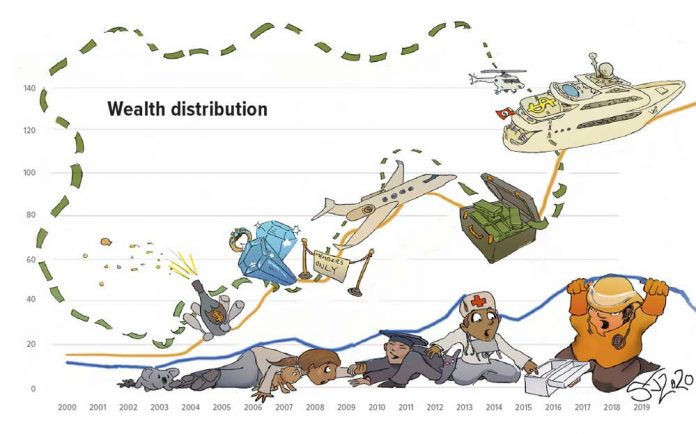
If Australia were that restaurant, then the people in the private dining room are the top 1 per cent, and together they own more than twice as much as the 500 people in the cheap seats combined. There are 36 listed billionaires in Australia, and in the last year (2018-19) their average growth in wealth was $667m each. Next Lunar New Year, they will need a bigger room.
The argument in favour of obscene wealth accumulation has long been that such concentration will lead to greater prosperity for all by “trickling down”. This has the strongest appeal to the other 490 people in the room, those in the aspirational middle; professionals, tradies, wealthy retirees and others mostly susceptible to the dangled carrot of comfort.
Rather than directly contributing to the common wealth by enforcing appropriate marginal rates of taxation, limiting tax avoidance measures by both individuals and corporations, providing a structure to ensure reasonable increases in wages in line with profits, and collecting appropriate royalties on behalf of the Australian people for the sale of mineral-rich dirt, the Australian government embellishes the fairy tale with marketing rhetoric about “having a go to get a go”, our version of the American Dream.
There is a storm brewing, with climate change the catalyst, which will threaten such privilege. Young people, largely deprived of the hope of city home ownership, pay scant allegiance to the dream offered them, and will be the agents of radical change. The visceral response of (mainly) aged white men to the passion and commitment of Greta Thunberg is an indicator that their threat is real.
See the Oxfam report on global wealth inequality released in late January for more information, including opportunities for action. Unlike many countries, Australia retains a reasonable well-functioning democracy, with people fairly elected to represent the citizens of a given area. The contact details of all such representatives are listed on the websites of the assemblies of all three levels of government.