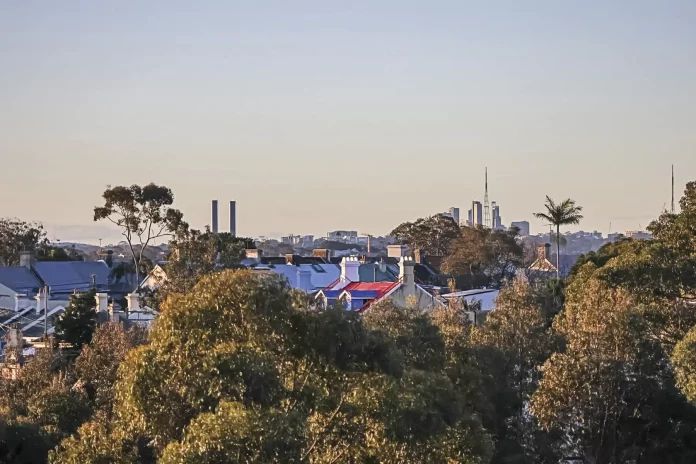
Trees are good for humans. For decades, we ignored this simple fact and stripped away vegetation to build offices, dwellings and shops with bricks, concrete and steel. It appears that the City of Sydney has acted to reverse this trend, as trees occupy an ever-increasing amount of space around us. At what price is the question.
According to a study conducted by local researchers in 2020, tree canopy benefits people suffering from hypertension, diabetes and cardiovascular diseases. Importantly, tall trees (producing a canopy) do the job, not cricket ground grass or low-level vegetation. Tree canopy is also excellent for thermal regulation, reducing summer air temperatures by up to 8°C at street level.
Sydney’s tree canopy has steadily spread, covering 15.5% of the LGA in 2008 and 19.8% in 2022. This increase over 14 years may sound small but it means that for every 100 trees present in 2008, there were an additional 28 in 2022. The city has set a target of 27% tree canopy in 2050 so that a Sydneysider born in 2008 would see tree canopy almost double in surface area between their birth year and their 40s.
While this is objectively very good news, we should not embrace the positive narrative without scrutiny. This is because the City of Sydney praises in its Urban Forest Strategy the rise in property value as a positive outcome of tree canopy expansion, despite the profound housing crisis we are currently facing.
Research conducted across several cities worldwide has shown that city greening often occurs alongside gentrification and is used by developers for financial gain. Of course, this happens at the expense of lower-income populations. Our very own local example of this issue is the Waterloo renewal project.
In fairness, the City of Sydney states that “the percentage of areas with less than 10% canopy cover was halved” since 2008, so that at least tree canopy is expanding “everywhere”.
Will trees become so common that people don’t need to indirectly pay for them anymore? I hope so. Meanwhile, allow me to be cautiously optimistic and ask whether inequality might be the price we pay for widespread shade.
References:
https://www.cityofsydney.nsw.gov.au/strategies-action-plans/urban-forest-strategy
Astell-Burt and Feng (2020). Urban green space, tree canopy and prevention of cardiometabolic diseases: a multilevel longitudinal study of 46 786 Australians. International Journal of Epidemiology 49(3):926-933 (https://doi.org/10.1093/ije/dyz239)
García-Lamarca M. et al. (2022) Urban green grabbing: Residential real estate developers’ discourse and practice in gentrifying Global North neighborhoods. Geoforum 128 (1-10) (https://doi.org/10.1016/j.geoforum.2021.11.016)