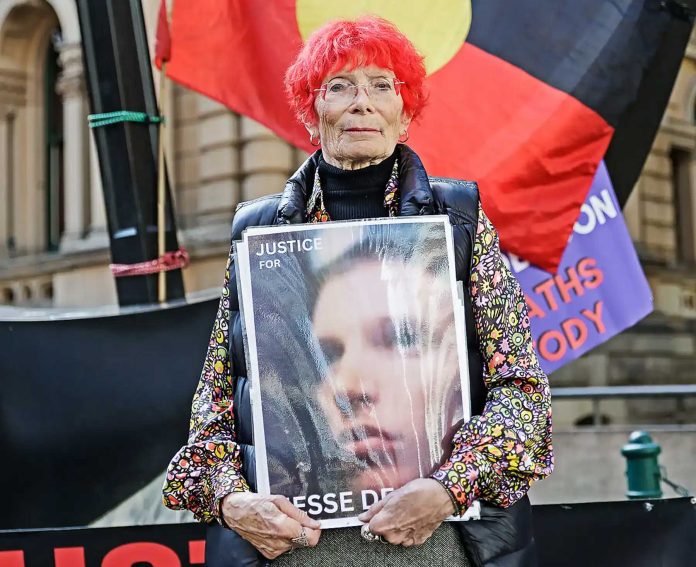
On Saturday 18 July, people gathered outside Sydney Town Hall to remember people in mental health crises who died during interactions with NSW Police. The rally was organised exactly one year after the death of Collin Burling following a police intervention at his home in Waterloo, and three years after the death of Jesse Deacon, who died following a welfare check by NSW Police in his Glebe home on 20 July 2023.
Collin Burling’s partner, Taite Collins, spoke at the rally, along with Judy Deacon, the mother of Jesse Deacon. They were joined by Leesa Topic, the mother of Courtney Topic (who was shot by police in Hoxton Park after a mental health incident in 2015) and Margarette Hill, the aunt of Todd McKenzie, who died after a confrontation with NSW Police in Taree, NSW, in July 2019.
Greens MP Sue Higginson also spoke, and a letter of support from Sydney Lord Mayor Clover Moore was read out to the crowd.
The memorial was held the weekend before the NSW coronial inquest into the death of Jesse Deacon was scheduled to continue, to ascertain whether any lessons could be learned from his death and to reduce future risks to people suffering from severe mental health episodes.
Jesse’s mother, Judy Deacon, represented herself at the inquiry in order to encourage improved planning and systems for various NSW government agencies that interact with people suffering from critical mental health episodes, with the goal of improving the outcomes of these interactions and avoiding unnecessary deaths.
At the rally, Judy Deacon described how her son Jesse died as a result of heavy-handed tactics by the NSW Police, who were called to respond to a welfare check on Jesse. Judy said that her son would still be alive if NSW Police had better policies, tactics and training for when they are called as first responders to incidents involving critical mental health episodes, a call that resonated throughout the memorial gathering.
Judy said that the rally could achieve effective change for the community throughout New South Wales.
“Without the community and people joining together to acknowledge and support the things that are missing and how they need to change, nothing will happen.
“This rally is also one of those messages to the wider community that this thing’s going on and we’re not prepared to accept. Somebody’s died as a result of ineptitude, lack of training, you name it, and we’re here, we’re not going to go away!”
She noted that often members of First Nations communities are impacted by deaths in police custody but that these deaths as a result of interactions with police also occur across the broader Australian community.
Judy said that the rally was for all the people who have been affected by deaths arising out of interactions with the police.
“Although it started out because of Jesse dying, it’s actually about all the people who died in the past and who hopefully will not die in the future.”
In the week since the rally, Judy has been representing herself at the coronial inquest into the death of her son Jesse.
“I’m not there to antagonise or put forward recriminations. I’m there to ask sensible positive questions that will help the coroner to put forward some recommendations that will actually further the changes that are required.”
Judy noted that a key change is being made by the NSW state government in conjunction with the 000 helpline: a fourth option will be added for callers in the near future and they will be able to ask for a mental health response in addition to the regular police, ambulance and fire brigade options. This will allow skilled and trained mental health responders to attend incidents involving people experiencing mental health episodes.
Taite Collins spoke about the impact of witnessing the death of his partner, Collin Burling.Taite said that Collin had called Fire and Rescue NSW to respond to an ongoing issue with a gas leak in his apartment but, when the team arrived, they decided that Collin’s agitation was the result of drug exposure (despite his autopsy later showing no signs of illicit drugs in his body on the day), so the Fire and Rescue team in turn called NSW Police, who attempted to restrain Collin, and during this attempt Collin died.
Taite described Collin as his “big strong cuddly teddy bear”, who was upset about the ongoing gas leak in his apartment. Taite thinks that the NSW Police grossly overreacted in trying to pin Collin to the ground. Taite filmed four NSW Police officers pinning Collin to the ground as he repeatedly called out, “I can’t breathe!”
Taite says that the police deliberately asked attending ambulance officers to hold up a white sheet to obscure their efforts to restrain Collin, but Taite was able to film the confrontation out of his flat window from above.
Since his partner’s death, Taite says that he has suffered ongoing harassment from local police and has repeatedly asked Homes NSW to be relocated to a different public housing flat away from the area, but this hasn’t happened yet.
Leesa Topic told the crowd that her daughter Courtney died when she “was shot dead by NSW police at 11.48am on 10 February 2015, whilst in the midst of her first mental health crisis. All calls that day were for ‘concern for welfare,’ Courtney’s welfare that is, and yet 41 seconds after arriving on site, NSW police put a bullet in her beating heart and she bled out on the grass verge on the corner of Cowpasture and Hoxton Park Roads, Hoxton Park.”
Leesa attended her daughter’s coronial inquest with one goal in mind. “We felt hopeful that Courtney’s senseless death had not been in vain. That, going forward, those suffering a mental health crisis would be safe when NSW police were called out. That they would be treated with dignity and respect as a human being first and foremost. That the police would ‘de-escalate’.”
Leesa Topic spoke about how cultural change is possible inside NSW Police when dealing with mental health crisis incidents; the key measures are training and cultural change around conflict resolution, especially when dealing with people suffering severe mental distress.
Leesa told the crowd that her daughter “Courtney matters and that is why I continue to advocate for tailored, fully funded legislated mental health training for NSW police.
“My view is that mental health callouts require a health response, not a police response. Mental illness is not, nor never was, a crime, but as the system currently stands, police need to be adequately trained for the jobs that they are called out to and mental health callouts are a huge component of their work each and every day. If they are not specifically trained in the exponentially growing area of mental health, then why are they attending mental health callouts?”
There are a range of de-escalatory strategies and tactics that NSW Police can teach to their officers to reduce the risks posed in tense confrontations with people suffering from mental health crises. Leesa and her husband have been actively involved with police training and skills development to enable more police to learn and use these de-escalatory tactics, rather than rely on traditional overpowering force tactics. However, there needs to be more of a cultural change in police ranks to see the necessity of employing non-confrontational, de-escalatory tactics.
Margarette Hill spoke about the anguish that her family suffered after the death of her nephew Todd McKenzie following a confrontation with police in 2019 in Taree, NSW, when police were called to do a welfare check on him.
She felt that better police training and the involvement of mental health professionals could have de-escalated the situation and produced a different outcome, and that Todd could still be alive.
Friends and family of the victims were concerned about police failing to follow procedures with body-worn video (BWV) cameras or when they don’t wear BWV cameras for operational reasons (as was the case with the special operations police who interacted with Todd McKenzie).
The rally called for four key changes to be made in both NSW Police and Homes NSW (which provides community housing services) to reduce the risk that people with mental health issues are exposed to when they are in crisis:
The group called for justice, restitution and compensation for the families of those who have died in custody.
They want police and emergency services to be made accountable and for independent investigators to investigate fatalities that have occurred during interactions with police.
A key call of the rally was that government-funded and specially trained mental health first responders must replace police and that a mental health response hotline be set up.
They’re also calling on the government to provide clean and secure housing for people in mental anguish.
After the rally, the main group of protesters led a march through the streets of the city centre, escorted by police, in an attempt to highlight their call to action.
Despite provocative banners and yelled chants challenging the police, the police remained stony-faced in silence as they led the protest through the streets.
Editor’s note: On 30 July, the NSW Government announced a new health-led response to mental health emergencies. More information is available here: NSW Government ministerial release