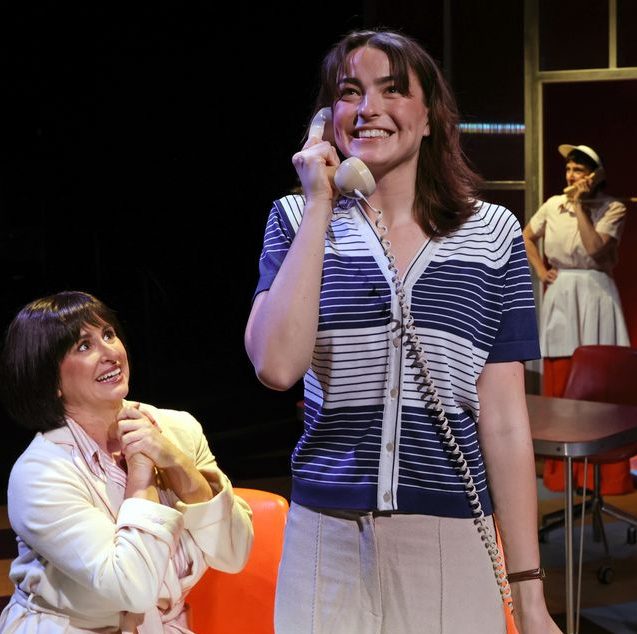
Fly Girl
Writers: Genevieve Hegney and Catherine Moore
Director: Janine Watson
Ensemble Theatre, Kirribilli
17 October – 22 November, 2025
Our first intimation of the fun ahead is hinted at by orange-clad air stewardesses, urging everyone to take their seats as ‘We are about to take off’. We could be forgiven for thinking this would be an air hostess saga of sorts – it is anything but.
It is, in fact, the turbulent story of Deborah Lawrie’s unrelenting determination to become a pilot in the late 70s. It was an era in Australia when the idea of women becoming airline pilots was inconceivable, especially to Reg Ansett of Ansett Airlines, with whom Deborah eventually locks horns in her zeal to achieve her goal.
The obstacles placed in her way seem unbelievable now, in these more equal opportunity times, but were considered valid objections at the time. Equipped with a science degree and impeccable aviation qualifications, her applications are constantly turned down. Why? Some of the reasons given, she said, were ‘that women did not have the strength, they would panic, they may get married’ – all related to female physiology.
Writers Hegney and Moore were initially ‘amazed and dumbfounded’ by Deborah’s experiences but have succeeded in crafting a highly entertaining work from a very complex set of circumstances, with legal, political and personal ramifications. It sets out the serious premise of discrimination, while still delivering a fast-paced, hilarious show. Director Janine Watson, equally, has the unenviable task of guiding the five actors through creating some fifty characters and, while retaining the balance of comedy and pathos, she does so with impressive control.
The action of the play moves at a clip, with an airport-style destination board informing the audience of scene changes. Cleo Meinck, playing the young Deborah, is believable in her depiction of the struggle against Reg Ansett’s implacable belief that women could not be pilots. The rest of the cast (Genevieve Hegney, Alex Kirwan, Catherine Moore, Emma Palmer) play a multiplicity of roles – parents, judge, pilots, lawyers, Reg Ansett, and more – changing costume and character with dizzying rapidity. The gender-swaps necessitated by a small cast add to the hilarity, especially in the ‘boys’ club’ drinking scene with some failing stick-on moustaches.
Deborah never gave up. After innumerable knock-backs, she endured an eighteen-month-long legal action against Ansett and finally won the right to be employed as a commercial pilot. Her success was aided by the recently formed Equal Opportunity Commission, who deemed her case to be one of sexual discrimination and ordered Ansett to employ her. On 22 January 1980, Deborah made her first commercial flight, co-piloting on a flight from Alice Springs to Darwin.
This triumph of the underdog against implacable odds seemed to leave the opening night audience in a highly effervescent mood. After this exhilarating theatrical ride, the excitement continued during the tumultuous curtain call when Deborah Lawrie herself stepped down from the audience to take her bow among the actors. The wild applause and standing ovation appeared to be unending – there’s no doubt Deborah’s story touched a major chord, a sense of fair play so dear to the Australian heart. This play, apart from the tremendous achievement of its stellar creative team, delivers an important message and deserves to be seen – don’t miss it!