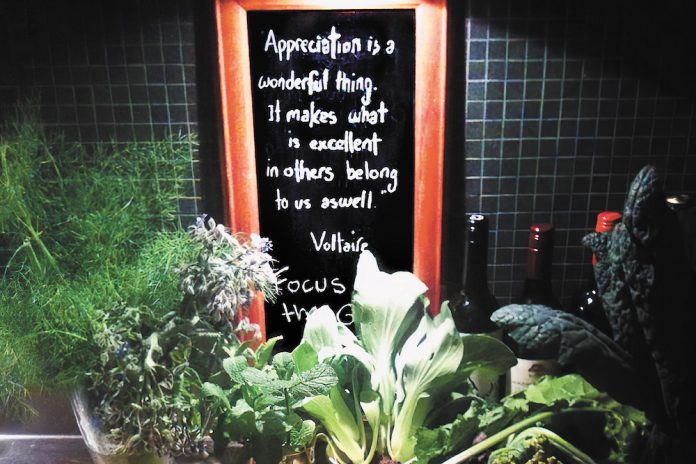
DARLINGTON: I first walked past Charlie’s Garden on Abercrombie Street with Erik the dog in 2011. At only 88m2 it is probably Sydney’s smallest community garden. However, if you take a bird’s eye view of this fenced-in space, the pathways and garden beds form the outline of a dragonfly.
My daily walks revealed that the garden needed love. There wasn’t much growing and, on closer inspection, the soils were light on nutrients. I did some digging to find out who was involved and soon got my hands dirty.
Charlie’s is open 24/7. Admiring the garden is for everyone, but planting and picking is for members only. A community garden is also both teacher and classroom. Here are a few things I’ve learned (mostly through failure).
People choose to be involved for diverse reasons. I wanted to grow tasty food, what I ate growing up. I assumed that other volunteers would want to learn how to garden. It is seldom the case. People are seeking community connections, a place to relax or somewhere to drop off their vegetable scraps.
Gardening is a way of seeing. From tiny leaf details to trees reaching for the sky. A skill that’s been eroded in the urban context. It takes patience, dedication and self-awareness of our connection to ecology to develop this renewed vision.
The problem is the solution. A purple mustard green springs up in the garden like a pretty weed and is allowed to flower and becomes infested with aphids. The solution is not seeing this plant as a weed, but as an ally. The purple mustard functions as a decoy, becoming an aphid trap for predators while the flowers provide bee forage. When aphids aren’t being eaten by predators the entire diseased plant is either a protein boost for compost or can be dug in to enrich the soil.
Take advantage of local resources. With thinking and planning, community gardens can become part of a local exchange system. Charlie’s has used coffee grounds from Short List café, eggshells from Darling Thai, and vegetable scraps from community-filled compost bins. Quality seedlings are sourced from the Eveleigh Market; Inner West Seed Savers provides an exchange for local, adapted seed; while the rustic Enfield Produce has a range of manures, soil additives and cats that love a pat.
Gardening approaches are complementary. Tending is a gentle practice – removing weeds before they seed, maintaining plant hygiene or ensuring airflow between plants to reduce mildew, pests and disease. The opposite of this is turning over the soil, digging in a green manure or soil additives when a crop finishes to clear the bed for the next rotation. Too much intervention turns your patch into a market garden with gluts of produce. Too little invites disease and low yields.
Gardens don’t care about your schedules. Regularity and rhythm are important but gardens ask you to respond to what is at hand. Harvest plants in their prime, remove fruit-fly bitten tomatoes before they infect others, share an oversupply of produce with a passer-by. Charlie’s maintained weekly Thursday gardening sessions for over five years and developed a crop rotation to maintain soil health.
You never know what impact you are having. Charlie’s has inspired a birthday party with a lady beetle theme, kids foraging mulberries or sorrel leaves, members leaving the city to start their own country gardens, too many tasty meals to count, and myriad conversations.
Charlie’s Garden was an apprenticeship for me in implementing the permaculture ethics of earth care, people care and fair share. Sustainable urban food growing requires a framework that favours the local over the bought, otherwise the joy of local exchange is replaced by consumption as normal.
A community garden is a place where we can learn from each other, and where, like the plants we are tending, we can grow.
_______________
Charlie’s Garden is currently following physical distancing guidelines that preclude meeting for weekly harvests or working bees. Please direct enquiries to: charliescommunitygarden@gmail.com