


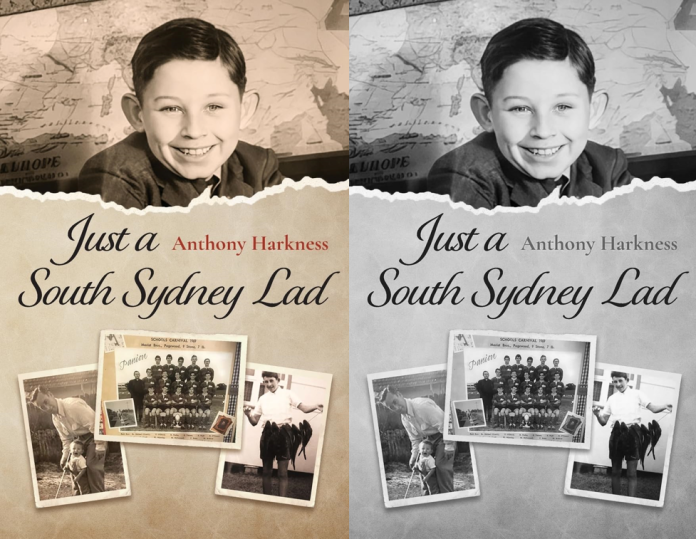
In his newly published memoir Just a South Sydney Lad, Anthony Harkness explores the importance of childhood and revisiting the past, in a world that is constantly changing. Written in first-person narration, Anthony walks the reader through his own childhood growing up in Maroubra during the 50s and 60s.
Anthony describes 1950s Maroubra as a humble, community-centred suburb. This is evident in his descriptions of Paine Street, the street where he grew up. “The street lacked elegance, snaking its way around houses, schools and parks like a badly bent boomerang.”
Still, the writing is filled with nostalgia, as Anthony describes the friends he made on that street, and the games they used to play together. It was a street full of cricket matches, friendships, and competitive spirits.
As Anthony reflects, it was a smaller, more compressed world than the one we know today: “It was a world that I could access on foot, walking to school each day, and to footy, and to church because there was no other way of getting around. Even crossing the Harbour Bridge felt like an adventure.”
In the second half of the memoir, Anthony writes about the societal changes brought on by the 60s. He recalls for example the first time TV was brought into his house, likening it to “a miracle!”
Amidst these changes, Anthony also writes about himself, growing from a young boy into a “more refined” teenager.
One of my favourite aspects of the memoir is Anthony’s stylistic choice. Whilst the memoir is mostly narrated from his present perspective, it is fused with the voices of ‘the older boy’ (Anthony as a teenager) and ‘the younger boy’ (Anthony as a kid). Throughout the memoir, the past and the present are in constant dialogue with each other, allowing the reader to make humorous comparisons between both.
Anthony comments that while it took him around three to four years to collect ideas and develop a structure for his memoir, the process has given him the opportunity to reconnect to ‘the older boy’ and ‘the younger boy.’
As he writes in the final chapter: “I began to sense that the Maroubra boy, whom memory had made a stranger for too long, was now ready to come home with me.”
Overall, Just a South Sydney Lad is a funny, yet poignant memoir that reminds us that we are never fully separated from our childhood selves, even when we are forced to grow up. In this complex, confusing world of 2025, Anthony’s words are heart-felt and nostalgic.
Just a South Sydney Lad by Anthony Harkness is published by Greenhill (2025).





Anthony Harkness’ book ” Just a South Sydney Lad” is a must read for any “Baby Boomer”. After reading it, I shared this book with a friend, who too was a child of the 50s. Immediately we reminisced about the wonders of what could be done with a ” three penny bunger” and how The Crisco Kid and Jim Reeves, the man of steel, opened up our worlds. We spoke of a time when a role of loo paper was not an essential item and Polio was the pandemic.
Like ” Over the Top with Jim” ( Hugh Lunn) and”Blessed” ( John Doyle), ” Just a South Sydney Lad” plays an important role in revealing the fabric of Australian family life more than half a century ago. Significantly, it speaks of the simple values that were cultivated within those walls of the Harkness’ family home in Paine St Maroubra, values that are now interwoven and bind much of our modern day society.
Congratulations Tony, a most enjoyable read. You’ve awakened dormant memories of my childhood, where a horse and cart delivered the bread and the iceman came each morning so we could keep our milk cold.
This book is a ‘must read’ for anyone who grew up in the 1950s and 60s. It triggered so many memories for me despite the fact that I grew up on a north coast dairy farm. Still we had much in common but our trifecta was different apart from the faith dimension. I read the book in a couple of days but have decided to re read it while on holidays. Thanks for sharing and triggering great memories Tony.
A great read that no matter where one grew up in Australia in the 50s 60s and 70s. Tony has painted a series of pictures and brought back the memories.
The theme of the conversation between the younger and older Tony really exemplifies the contrasts in what was a changing world.
There is a mixture of colloquial and conversational style peppered with extensive vocabulary and descriptive expression. Similes and metaphors that paint the picture of our youth.
Fantastic memories of the fabric of our lives with which our vintage can readily identify.
Well researched combined with the ability to retrieve memories lodged in the archives of the brain.
The importance of family that guides and supports us through the challenges of childhood and adolescence.
School days; sport competition and friendships; sibling rivalry; developing trends in music bands and concerts; the memorable impact of the introduction of TV and fast food outlets.
I’m sure the family (and others) will really appreciate the memories of growing up in Maroubra.
Well written and a very enjoyable read.
I grew up at Meerschaum Vale on a dairy farm, milking cows and travelling down a dusty lane to Wardell for Sunday Mass and primary school. Tony’s memoir’s, although worlds apart, takes one back to these wonderful childhood experiences ,
It’s a great read but I was disappointed that he didn’t venture into his college footy days where as a Tommy Rodonikus (sp?)like halfback he came up with the idea that any fruit call would indicate the backs were getting the ball. Apples or oranges were a reasonable call but other foreign fruits not intelligible to a dairy farmers son left his five eight somewhat perplexed! Nevertheless this is a truly captivating and delightful read. Congratulations Anthony
I just loved it as I grew up in the St George district in the same time and the memories Tony brought back reminded me of the very simple life we enjoyed. Congratulations on the research carried out and would recommend to anyone born in the fifties or early sixties. A real pity South’s could never win a premiership between 1955 and 1966.
Greg Seaborn
It’s a great read. I grew up in Merrylands, a long way from Maroubra, but there were so many similarities to my childhood experiences of the 1960’s and’70’s. It was a great reminder of how life was