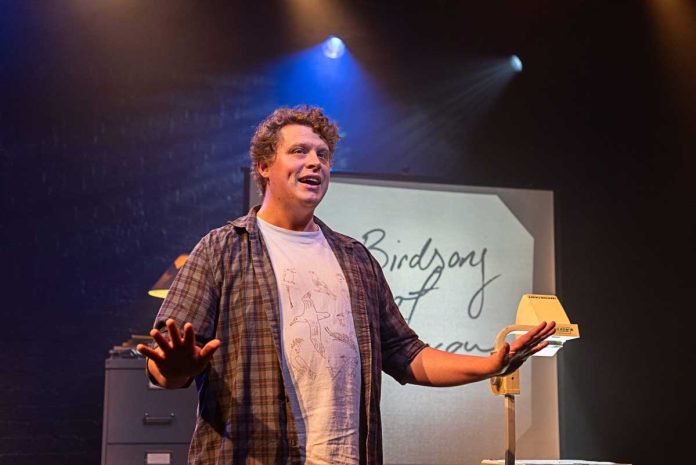
Birdsong of Tomorrow
Writer: Nathan Harrison
Director: Emma McManus
Old Fitz Theatre
August 24 – September 6, 2025
When reminded of the number of endangered birds or species that have perished, I immediately feel anxious and guilty. I wonder how I can contribute to preventing the further loss of biodiversity, and more painfully, whether anything can prevent what seems a headlong rush into depletion. In an increasingly impersonal and robotic world, it is easy to feel helpless to effect change, to experience the grief of powerlessness.
In just over an hour, Nathan Harrison’s monologue, a considered melding of autobiography and documentary, Birdsong of Tomorrow, brought comfort and inspiration. With the occasional and well-timed support of an unintrusive Tom Hogan, Harrison imparted a chunk of knowledge about the history of birds, enlivened by his infectious enthusiasm, and details supported by hand-painted images and recorded birdcalls of various species.
Harrison gleefully pointed out that the common belief in the annihilation of the dinosaurs is mistaken, as the birds we see every day belong to the theropod group of dinosaurs, including T. rex. He had his audience laughing uncontrollably at popular depictions of T. rex looking up as the death-dealing comet approached. “What would it have been thinking?” Harrison asked. By contrast, there was a hushed dismay as his audience listened to the extinct Huia, known only to the present through a Māori’s remembered imitation of its call recorded in the late 1840s.
The same skilful blend of playfulness with sadness characterised the more confessional side of Harrison’s performance. Mixed with recollections of punk band Frenzal Rhomb, enjoyed by Harrison and his best friend Andrew, and their own band Munching Limbs, Harrison admitted to times their friendship faltered, and the grief these memories occasioned.
“Hope is a thing with feathers,” wrote Emily Dickinson. Harrison’s love of birds and deep attentiveness to their song, their creativity, their memory, their form and flight offered a rich contrast to the polemical debates over “isms.” Simply presented, just a young man with a jumble of various recording paraphernalia and retractable screens, telling of his love for birds and his shock at personal loss, it was deeply moving to know how deeply someone could care.
It made me feel less powerless and more hopeful for tomorrow, and I gave heartfelt thanks to the team: Emma McManus, Tom Hogan, Solomon Thomas, Clare Britton, and Troy Reid.