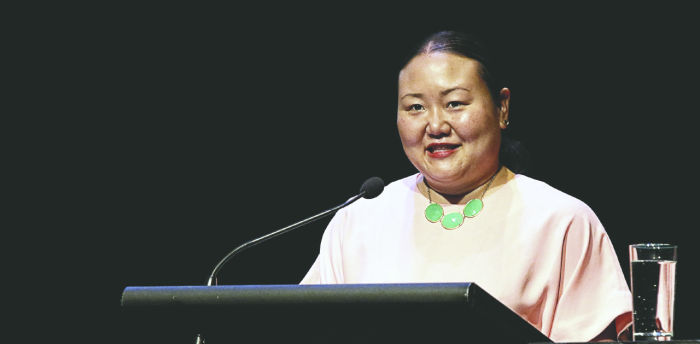
“There’s magic in the communal experience of listening,” she answered. “We come to experience our responses and feelings with each other. To speak freely and to listen attentively is to be human.”
The idea of the deep connection between writing and humanity was a thread woven throughout this year’s festival, with Bibliotherapy – the restorative effect of literature – being the overall theme.
Hanya Yanagihara noted in her closing address:“To read is to surrender to another person’s story and at the same time to activate that story by the very act of consuming it.” She talked of writing’s role in cultivating our sense of empathy and defended the place of violence in fiction and in her recent novel, A Little Life.
“The ultimate human act is to witness. To open our eyes wider and look at what we would rather not, to regard what we think we cannot endure. Once we limit what we can tolerate in literature and in art, we also start limiting our ability to see our fellow humans.”
This notion of seeing our fellow humans, of bridging the divide and finding a common connection, was central to journalist Stan Grant’s powerful talk about Indigenous heritage, racism and national identity. Grant’s own story is deeply rooted in Indigenous history and his personal recollections, much of which sprung from the pages of his memoir Talking to My Country, captivated audiences in his two talks at the festival.
On the same day, acclaimed American author Jonathan Franzen filled Sydney Town Hall for his entertaining talk with Australian author Anna Funder about his latest novel, Purity. Franzen’s frank yet measured responses to Funder and the audience’s occasionally probing questions traversed the novel, its characters, the writing process and the importance of risk-taking.
“Risk-free writing is writing that’s not worth reading,” he said, while noting the important roles of his editors.
Franzen also argued for the future of books, denouncing the “unfilteredness” of life documented by modern technology. “As long as you’re reading a novel, the world makes sense. It’s not the real world but you’re in a finite world,” he said.
Artistic director Jemma Birrell commented on the collaborative nature of this year’s event, with many of the writers attending each other’s sessions and festival-goers also connecting around common interests. “There really was something particularly special in the combination of people coming together,” she said.