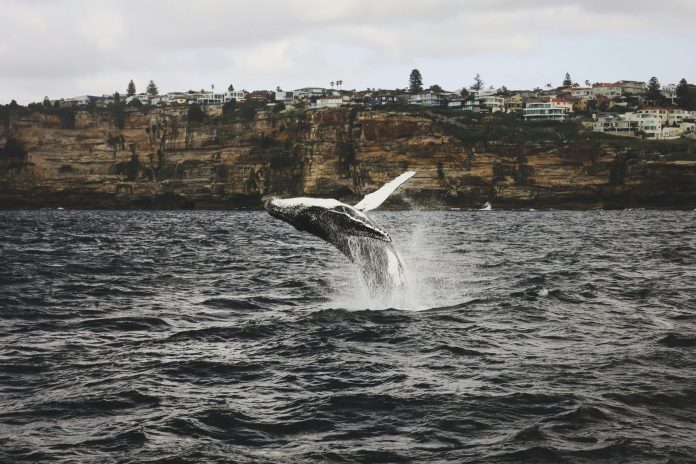
Every season has its charm and one of the biggest joys of winter in Sydney is heading down to Maroubra with a pair of binoculars, and trying to spot a splash in the water, no matter how far, indicating that a whale is passing by …
’Tis the season indeed, and a tradition for those who want to connect with the ocean.
The whales that many Sydneysiders love to watch along the coast are either humpback whales or southern right whales, who come to Australia at the coldest time of the year to mate and give birth. Both species follow a migratory route taking them from the nutrient-rich waters surrounding Antarctica all the way to the Australian tropics. This pendular lifestyle allows them to take advantage of very different ecosystems.
During the summer months, the adults can gorge themselves on the abundant food available in the Southern Ocean. Once they have accumulated a thick layer of fat, they start moving north. And while the water seems cool to us, by the time they reach Australia it is comparatively much warmer for them, especially as they usually give birth along the Queensland coast and within the Great Barrier Reef.
In nature, any trick to conserve energy is exploited. In that respect, being born in warm water is better, as the calves spend less energy to regulate their body temperature, and more to grow, than if they lived their first weeks on the planet in Antarctica.
Scientists also think that the mother-calf duo is more protected from killer whale attacks on the Australian east coast than in the Southern Ocean. Australian waters are calmer for the calves, and adult whales might even use this quiet environment to shed some of the dead skin that builds up on their body for months prior.
So here goes the nice and neat tale of why we see a couple of whale species go up and down the coast every winter … or is there more to it? The truth is, the “feeding then breeding” paradigm is perhaps a simplistic view, as new research has found that whales keep swimming north, even after giving birth, instead of heading down south straight away. They can also give birth in temperate waters, and not exclusively in the tropics.
These nuances could be seen as details of little importance. But in reality, they illustrate how much we do not know about what governs these animals’ lives. Whales are not important just because they make for a fun winter outing. Through their migration, they transport enormous quantities of nutrients from polar to tropical regions. They also feed other species, and contribute to the biodiversity of the deep ocean, as whale carcasses become homes to entire ecosystems that exist far from sunlight, only thanks to them.
And while protection measures have helped populations of humpback whales bounce back from the whaling days, scientists have recently reported that the southern right whale is showing concerning signs of decline.
So next time you make your way to the shore, and admire a puffy cloud springing out of the water from a distance, or perhaps (lucky you!) a whale breaching out of the ocean, remember that seeing even a glimpse of these animals is always a privilege, as each individual is evidence of one of the great animal migratory routes that we can witness every year in our beautiful city.
________________
Emmanuelle Botté is a science writer and editor, and former scientist at UNSW.
References:
Roman et al. (2025) ‘Migrating baleen whales transport high-latitude nutrients to tropical and subtropical ecosystems’, Nature Communications.
Grundlehner et al. (2025) ‘The end of an era? Trends in abundance and reproduction of Australian southern right whales (Eubalaena australis) suggest failure to re-establish pre-whaling population size’, Global Change Biology.
McPhee-Frew et al. (2025) ‘Humpback whales (Megaptera novaeangliae) continue migration after giving birth in temperate waters in Australia and New Zealand’, Frontiers in Marine Science.