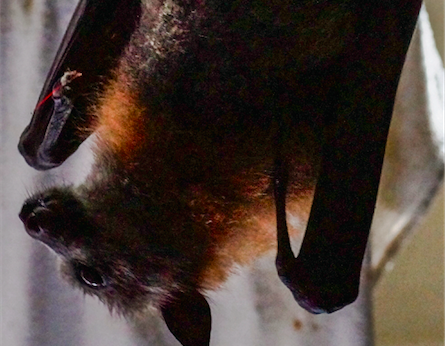
Housing up to 10 bats at a time, Morandir tells the sad tales of how each bat arrived on his doorstep.
“Pip” came into care because his mum was caught in power lines. He is staying in the bat cave until a spot arises at “crèche”, where bats are habituated to life without human contact and prepared for release back into the wild.
Sadly, Pip is not the only bat to have run foul of power lines.
“Seven” suffered an electric shock that ran through the top of her head down into her feet, resulting in burnt wings and damaged kidneys. She was sick for a long time and is lucky to have survived. Seven was so badly burnt that it was very likely she would be euthanised, but Morandir and his partner did shifts all night to massage her swollen feet so they wouldn’t fall off.
It is clear that Morandir’s life revolves around the protection and preservation of the bat population, and that he is well-informed about bat ecology. As he explains: “Bats are an essential keystone species. Bats are the only long-range pollinators of Eucalyptus trees. If there were no fruit bats in Australia, there would be no Eucalypt forests in 50-100 years. We have a slogan: no me, no tree.” And his response to bats being pests? “It’s ludicrous. Bats and humans like to live in the same areas, but it is easy for communities to learn to live with fruit bats.”
However, like animals and humans, bats do carry certain diseases and should not be touched. If you find an injured bat, WIRES requests people who are not appropriately vaccinated to avoid contact with the bat and to cover it with a box or towel until professional help attends. But with that in mind, less than 1 per cent of fruit bats carry the Lyssavirus and since 1788 only three people have died from it.
Yet the state government is tabling “shoot to kill” plans to eradicate bats, and local Councils are lobbying to reduce the numbers of bats in their regions. Morandir and WIRES representatives plead that people act with compassion and good reason to reject these harmful notions.