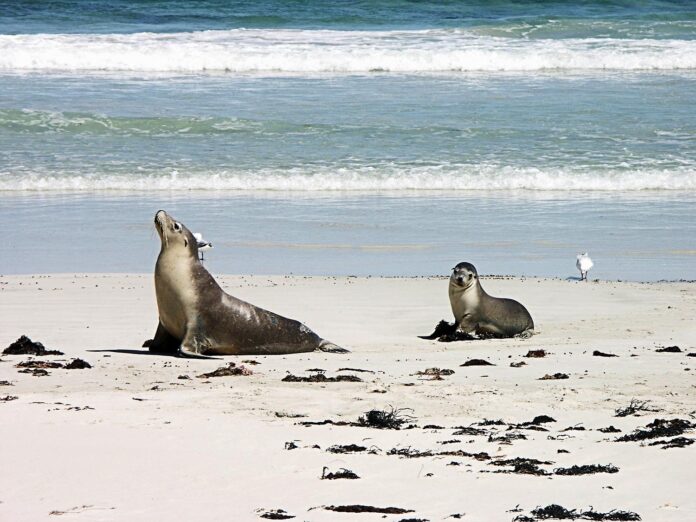
Since June, Australia has experienced its first outbreak of bird flu. The current H5 variant has now spread to a unique and iconic endangered mammal and scientists fear the worst for the future of an entire species in the coming months.
The Australian sea lion and Australia have a very special bond: the Australian sea lion is the only pinniped (or seal) living in our country and Australia is the only place in the world where the species lives. Australian sea lions are found along the coast of Western Australia and South Australia. Presently, 42% of the species is concentrated on three colonies in South Australia, and the number of Australian sea lions falls between 10,000 and 12,000. With such a small population, they are officially classified as an endangered species by the International Union for Conservation of Nature.
After large population declines due to hunting and disturbances in their environment, sea lions now face an outbreak of the avian influenza, or bird flu. This virus “family” has been infecting birds for more than a century. Since 1997, the highly pathogenic variant H5N1 has also occasionally infected humans, and since 2021, non-human mammals, including seals, have been infected.
As the outbreak developed among Australian birds for the first time in history this winter, scientists have increasingly feared the advent of bird-to-mammal transmission, with particular concerns for sea lion populations. And for a good reason: in 2022, a bird flu outbreak killed more than 5,000 American sea lions in Peru. Unfortunately, at the time of writing, South Australia has reported four cases of infected sea lions. With the mammals living close to infected bird colonies, the southern state is bracing for what could be devastating mortalities. Put simply, the survival of the Australian sea lion species is at stake.
Vaccination is providing a glimpse of hope for bird populations but is currently not available for mammals. The public is urged to report any suspected case of bird flu to the authorities via a hotline (1800 675 888). In heartbreaking fashion, learning how to do so efficiently may be the only power in our own hands.
References
https://www.agriculture.gov.au/biosecurity-trade/pests-diseases-weeds/animal/avian-influenza/report (important reference explaining how to spot and report bird flu cases)
https://www.environment.gov.au/cgi-bin/sprat/public/publicspecies.pl?taxon_id=22
https://www.cdc.gov/bird-flu/avian-timeline/1960-1999.html
https://wildlifehealthaustralia.com.au/Resource-Centre/H5-bird-flu